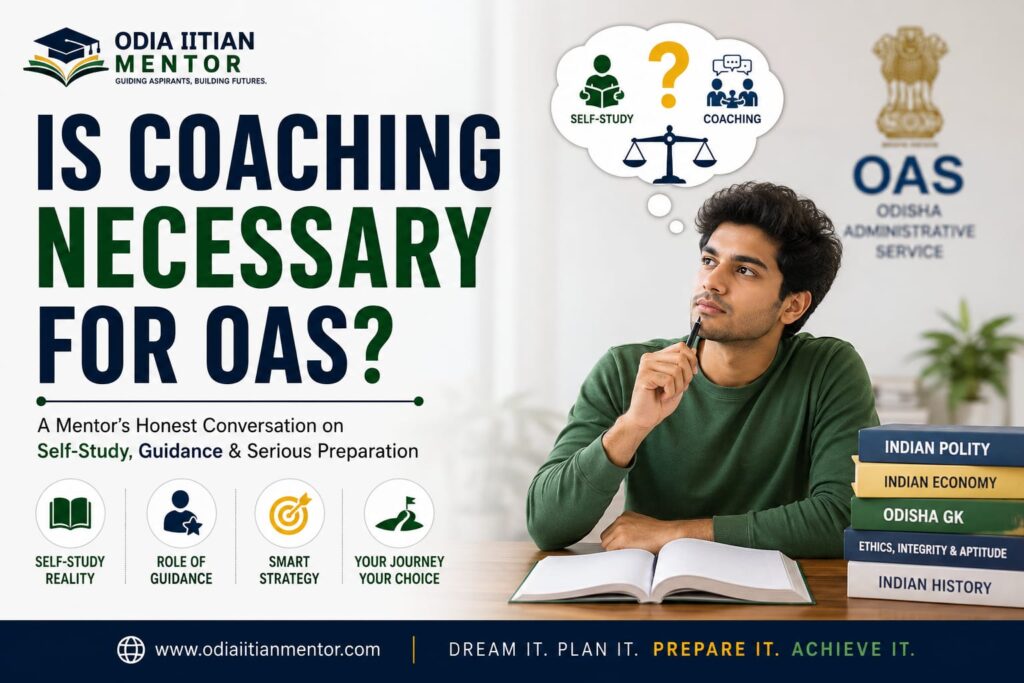
The Question Nobody Asks Out Loud
There is a question that lives quietly in the minds of thousands of OAS aspirants across Odisha — in rented rooms in Bhubaneswar, in village homes in Kalahandi, in library corners in Sambalpur, and in undergraduate hostels in Berhampur. It is rarely spoken aloud, partly out of shame, partly out of uncertainty, and partly because nobody around them seems to have a credible answer.
That question is: Without coaching, can I really crack OAS?
I have spent years interacting with aspirants from every kind of background — first-generation learners from Koraput and Malkangiri who have never set foot inside a coaching institute; bright students from Cuttack who have spent lakhs on courses but are still stuck after three attempts; self-study aspirants from ordinary Odia-medium schools who quietly cleared the preliminary examination without anyone noticing; and students from well-off families in Bhubaneswar who joined every available batch yet could not cross the mains threshold.
What I have observed across all of them is a pattern. And that pattern has very little to do with coaching, and everything to do with character.
This article is for the serious aspirant — the one who wants a clear, honest answer without the marketing noise. I will tell you what coaching can genuinely do for you, what it cannot, where self-study beats everything, and how to make a practical decision based on your real situation rather than fear or social pressure.
The Ground Reality of OPSC OAS Preparation
Let us first understand what the OPSC OAS examination actually demands. The Odisha Civil Services examination — conducted by the Odisha Public Service Commission — is a multi-stage competitive exam that tests breadth of knowledge, analytical depth, answer writing ability, and personality. The three stages — Preliminary, Mains, and Interview — each demand different preparation strategies.
What does it take to clear each stage? The preliminary examination is essentially a test of syllabus coverage, conceptual clarity, and speed. The mains examination rewards those who can construct coherent, structured arguments in writing. The interview demands self-awareness, composure, and a grounded sense of public service values.
Now, does any of this inherently require classroom coaching? Not structurally. What it requires is systematic study of the right material, regular answer writing practice, honest self-assessment, and the emotional resilience to keep going through repeated setbacks. These are habits. And habits are built in private, not in classrooms.
The Coaching Culture Reality in Odisha
The coaching industry in Odisha — particularly in Bhubaneswar — has grown enormously over the last decade. There are now dozens of institutes, online platforms, YouTube channels, Telegram groups, and PDF repositories all claiming to provide the definitive path to OAS success. Many of these are genuinely useful. Many are not.
Here is the uncomfortable truth: if coaching guaranteed success, then every student who enrolled in a coaching institute would clear the exam. But year after year, the selection ratio remains dismally low across all institutes. Thousands enroll. A handful clear. The institute then puts the toppers on banners and forgets about the rest.
The most successful OPSC aspirants I have known were not always the ones with the best coaching. They were often the ones with the strongest routines, the most honest self-assessment habits, and the deepest patience. These are qualities no institute can install in you. They have to come from within.
Common Mistakes Aspirants Make About Coaching
Mistake 1: Treating Enrollment as Preparation
This is perhaps the most widespread mistake I see. A student pays the fee, receives the study material, attends the first week of classes, and immediately feels — consciously or not — that preparation has begun. The psychological contract is signed. The box is checked.
But the truth is that enrollment is not preparation. Preparation begins the moment you sit alone with a standard text, read it carefully, make notes, revise those notes, and test yourself. This process happens inside the individual, not inside the classroom. A coaching institute can provide the container. It cannot provide the content of your effort.
I have seen aspirants who joined three different institutes over four years and never once practiced answer writing independently. They attended classes, collected PDFs, took notes on their phones — but never built the habit of sitting alone and writing answers under time pressure. Unsurprisingly, they struggled in mains.
Mistake 2: Waiting for Coaching Before Starting
This mistake is particularly common among aspirants from financially constrained backgrounds. They postpone beginning their OPSC preparation because they believe they cannot prepare properly without coaching. So they wait — for the right time, the right institute, the right city.
Meanwhile, months pass. Sometimes years. The examination cycle moves on without them.
The brutal reality is that the OPSC syllabus is not a secret. The standard books are freely available or affordably priced. Previous year question papers are in the public domain. NCERT textbooks — which form the backbone of any serious foundation — are available for free online. There is nothing in the coaching institute’s possession that you cannot access on your own with discipline.
Perfect conditions never arrive. The aspirant who begins today with imperfect resources will always be better positioned than the one who waits for the ideal setup.
Mistake 3: Confusing Information with Preparation
Coaching institutes, YouTube channels, and Telegram groups generate enormous volumes of content. Notes, PDFs, previous year analyses, current affairs compilations, mock tests — the supply is nearly infinite. And many aspirants spend a disturbing amount of their time collecting this material rather than studying it.
I call this the collector’s trap. The aspirant downloads every PDF, subscribes to every channel, joins every group — and feels perpetually busy. But busy is not the same as prepared. The student who reads one good book three times will always outperform the one who skims ten books once.
Coaching can inadvertently deepen this trap by generating more content than any aspirant can meaningfully absorb. The strongest preparation strategy is depth over breadth, and revision over discovery.
Mistake 4: Ignoring Answer Writing Until It Is Too Late
This is the mistake that kills otherwise capable aspirants at the mains stage. Many OPSC aspirants spend the bulk of their preparation time reading and making notes, treating answer writing as something they will begin once their reading is complete. But the reading is never complete. There is always one more topic, one more source, one more current affairs compilation.
Answer writing for OPSC mains is a skill, and like any skill, it must be practiced consistently over months to become natural. The structure, the language, the balance between analytical points and factual content, the use of diagrams and maps where appropriate — these are not things you can learn in the last two months before mains.
Whether you are in coaching or preparing independently, begin answer writing from the first month. It will feel uncomfortable at first. That discomfort is the signal that learning is happening.
Mistake 5: Overlooking Odisha-Specific Content
This is a mistake both coaching students and self-study aspirants make, but it is particularly common among those who follow UPSC-centric resources without adaptation. OPSC OAS has a significant focus on Odisha — its history, geography, culture, tribal issues, government schemes, governance structure, rivers, forests, economy, and current affairs.
Aspirants who prepare primarily through UPSC materials often find themselves well-versed in national issues but surprisingly thin on Odia context in the mains examination. This costs them marks on questions where a well-prepared aspirant who knows Odisha-specific content will score significantly higher.
Read Odisha Review. Study the Economic Survey of Odisha. Follow the state budget. Know your districts, your tribes, your folk traditions. Know the Mahanadi issue not just as a water dispute but as an Odia identity question. This depth of local knowledge is what separates a good OPSC aspirant from a generic civil services student.
Is Coaching Necessary for OAS in 2026? What Actually Works in OPSC Preparation
Over the years, I have closely observed aspirants who cleared OAS and those who did not. The patterns are clear enough to state with confidence.
Consistency Over Intensity
The aspirant who studies six hours every day for eighteen months will almost always outperform the one who studies twelve hours a day for three months before the exam. OPSC is a long-distance race. The exam rewards those who have built knowledge structures over time, not those who sprint desperately in the final stretch.
This is why I always tell aspirants: build a daily routine that you can maintain even on your worst days. Four focused hours every day is more valuable than twelve exhausted hours followed by three days of collapse. Coaching institutes, by concentrating content into intensive batches, sometimes inadvertently encourage the wrong rhythm.
Revision as the Core Practice
One of the most reliable predictors of success I have observed is the aspirant’s relationship with revision. Strong aspirants revisit their notes regularly. They return to topics they studied weeks ago. They use active recall — closing their notes and trying to reproduce what they remember — rather than passive re-reading.
Most aspirants, in contrast, treat revision as what you do after you have finished covering the syllabus. But the syllabus is vast, and the coverage never feels complete. So revision is endlessly deferred, and the early topics fade from memory just as the later ones are being absorbed.
Build revision into your weekly schedule from the beginning. Do not wait to finish a topic to revise it. Revisit the previous week every weekend. This small habit compounds over months into a formidable depth of retention.
Answer Writing as a Daily Practice
For OPSC mains, answer writing is not preparation for the examination — it is the examination itself, practiced in advance. The aspirant who writes five answers a day for a year does not merely improve their writing. They develop an instinct for structure, a sensitivity to word limits, a fluency in framing arguments, and a confidence in their own analytical voice.
Write in Odia if you are taking the Odia medium paper. Write every day, even when you feel you do not know enough. Especially when you feel that way. The discipline of committing your thinking to paper is one of the most honest assessments you can give yourself, and one of the most powerful ways to deepen understanding.
Selective and Strategic Use of Resources
The gold standard resources for OPSC preparation are well-known and widely available. Standard NCERT texts from Class 6 to 12 for foundational knowledge. Laxmikant for Indian Polity. Bipan Chandra for Modern History. Ramesh Singh for Indian Economy. Spectrum for a history overview. And crucially — Odisha-specific texts for history, geography, culture, and governance.
A focused aspirant with these books, previous year question papers, a current affairs source, and a consistent writing practice does not need anything else. The temptation to add more resources is almost always counterproductive. Depth in fewer sources beats superficial familiarity with many.
A Practical Framework for Deciding About Coaching
Rather than giving you a blanket answer — take coaching or do not take coaching — I want to give you a framework for making this decision based on your own situation.
Ask Yourself These Honest Questions
Do I have a clear understanding of the OPSC syllabus? If you cannot map the syllabus confidently, coaching may help provide structure. But you can also achieve this by downloading the official OPSC notification and spending two days mapping it yourself.
Am I practicing answer writing regularly? If not, this is the single most important gap to address. A focused answer writing program — whether through coaching or independently — is more valuable than any amount of additional reading.
Am I consistent in my daily study? If you struggle to sit down and study without external accountability, a structured coaching environment may provide the discipline trigger you need. But recognize that this is a temporary crutch — the goal is to internalize the discipline, not depend on the institute permanently.
Can I afford coaching without financial stress? This is a practical question many aspirants avoid asking clearly. Financial stress is a preparation killer. If enrolling in an expensive coaching institute means your family faces hardship, or means you yourself feel constant anxiety about the money spent, the psychological cost may outweigh the academic benefit.
Am I in a location with limited access to quality coaching? If you are in a smaller town or rural area and good quality coaching is not available locally, the practical choice is self-study with selective online guidance. Traveling to Bhubaneswar specifically for coaching — unless you are already at an advanced stage of preparation and have a specific gap — is often not necessary.
When Coaching Is Genuinely Useful
Coaching is most valuable for complete beginners who need structured introduction to the exam. If you are at the start of your journey and feel genuinely overwhelmed by the breadth of the syllabus, a good foundational batch can help you get oriented. But be selective — choose institutes known for quality mentorship, not just quantity of content.
Coaching is also useful at the answer writing stage if you are not getting honest feedback on your writing elsewhere. A good test series with quality evaluation and personalized feedback is worth the investment. But you can also get this through online programs and peer feedback groups, which are often more flexible and affordable.
When Coaching Is Unnecessary or Even Counterproductive
If you are already disciplined and have a clear study plan, adding coaching classes to your schedule can actually disrupt your routine. You will lose hours to commuting, attending classes, and processing someone else’s structure rather than your own.
If the coaching institute has poor mentorship quality — which is unfortunately common in Odisha — you may find yourself paying significant money for nothing more than PDF materials and rushed classroom coverage of the syllabus. This is not worth the investment when the same content is available elsewhere.
And if you are beyond the foundational stage, deep into your mains preparation, you are almost certainly better served by focused self-study, targeted answer writing, and mentorship conversations than by classroom attendance.
A Mentor’s Honest Perspective
The most successful OAS aspirants I have known shared one quality above everything else: they had a profound respect for their own time and a clear-eyed honesty about their own weaknesses. Coaching didn’t give them that. Life gave them that.
Let me be direct about something I rarely see discussed openly in the OPSC preparation space.
The coaching industry — like any industry — has commercial interests. These interests are not necessarily aligned with your interests as an aspirant. A coaching institute benefits from your enrollment, from your fear of missing out, from your comparison anxiety when you see someone else’s preparation. It benefits from your staying enrolled for multiple years.
This does not mean coaching institutes are villains. Many run by genuinely dedicated educators who care deeply about their students. But it does mean you should make the coaching decision based on your honest needs, not on the institute’s marketing or on social pressure from peers who are enrolling.
I have seen aspirants from deeply disadvantaged backgrounds — Odia-medium students from tribal districts, the first person in their family to sit for any civil service examination, students who had never owned a personal smartphone until their final year of graduation — clear OAS through rigorous self-study. Their success was not accidental. It was the product of an unusual combination of self-discipline, emotional maturity, and willingness to work without external validation.
I have equally seen students from privileged backgrounds, with access to the best coaching in Bhubaneswar, who could not clear the preliminary examination after three attempts. Not because they were unintelligent, but because they had never developed the internal discipline that serious preparation demands.
The examination is a great equalizer. It does not know whether you studied in a coaching classroom or a public library. It only knows what you have understood, how clearly you can express it, and whether you have practiced answering questions under pressure.
A Word to Aspirants from Rural Odisha
This section is specifically for you — the aspirant from a small town or village who carries the weight of an entire family’s hope on your shoulders, who does not have a mentor nearby to guide you, who has never had someone sit with you and explain what OPSC actually is and what it takes to succeed.
Please do not let the coaching culture make you feel that your circumstances are a disadvantage. They are not — not in the way you think. Yes, you may have fewer resources. But you likely have something that many city-based aspirants lack: the genuine hunger and motivation that comes from having a real stake in your success. That hunger, channeled into disciplined daily study, is more powerful than any coaching material.
Many of the finest administrative officers in Odisha today prepared from circumstances similar to yours. The IAS and OAS examination has always been, at its core, a test of character as much as knowledge. And character is built in exactly the kinds of conditions you are facing right now.
Action Steps for Aspirants
If You Are Just Starting
Begin by downloading the official OPSC OAS notification from the OPSC website. Read the complete syllabus carefully — not once, but three times. Map every topic in the syllabus to a specific book or source. This exercise alone will give you more clarity than most introductory coaching classes.
Start reading NCERT texts from Class 6 to 12 across History, Geography, Polity, Economics, and Science. Do not skip these even if you have a strong academic background. The conceptual foundations built here will serve you through every subsequent stage of preparation.
Begin a current affairs habit from day one. The Hindu, Odisha Review, and the PIB website for central schemes are your core sources. Do not try to cover everything — be selective and consistent.
If You Are in the Middle of Preparation
Honestly assess what is working and what is not. Many aspirants in the intermediate stage are caught in the collector’s trap — accumulating resources without deepening their command over any of them. Do a resource audit. Remove what you are not actually using. Double down on what is genuinely building your understanding.
Begin or intensify your answer writing practice. Write answers to previous year OPSC mains questions. Evaluate them against model answers. Identify your weaknesses in structure, language, and content. Work specifically on those weaknesses.
At this stage, if you have not already, begin dedicating at least an hour a day to Odisha-specific content — Odisha’s history from pre-historic times to post-independence, Odisha’s geography, the state’s tribal communities and their issues, and Odisha’s governance and economic challenges.
If You Have Attempted and Not Cleared
This is a moment that requires extreme honesty and self-awareness. Do not let repeated non-selection become a source of shame or identity crisis. It is feedback, not judgment. But it is feedback you must take seriously.
Analyze your performance objectively. Where exactly did you lose marks? Was it the prelims cutoff? Was it mains answer quality? Was it the interview? Each of these failures has a specific remedy, and identifying the correct failure point is the first step to addressing it.
Consider whether your preparation strategy has genuinely evolved between attempts, or whether you have been repeating the same approach and expecting a different result. If the latter, something must change — and it is not necessarily more coaching. It may be more focused answer writing, a deeper engagement with the Odisha-specific syllabus, or a more honest confrontation with the gaps in your conceptual foundations.
For Everyone: The Non-Negotiables
- Study every day without exception. Even thirty minutes on your worst day.
- Revise more than you discover. Cover fewer topics, but cover them deeply.
- Write answers every week. Mains success is a writing skill, not just a reading skill.
- Know Odisha deeply. This is what OPSC tests that no other exam does.
- Build emotional resilience. This preparation takes years. You will have bad days, bad weeks, bad months. The ones who succeed are those who get back up.
Final Thoughts
Let me close with what I genuinely believe after years of watching aspirants succeed and struggle.
OPSC OAS is not a test that rewards privilege. It is not a test that rewards expensive preparation. It is a test that rewards the aspirant who has genuinely engaged with knowledge — who has read carefully, thought clearly, written honestly, and prepared patiently over a sustained period of time.
Coaching can be one part of that journey. It is not the journey itself. The journey is built in the hours you spend alone with your books, your notes, and your practice papers. It is built in the discipline of showing up every day even when motivation is absent. It is built in the willingness to face your own weaknesses honestly and address them specifically.
If coaching helps you build that foundation, use it. If it is not accessible to you financially or geographically, know with complete clarity that self-study is not a compromise — it is a viable, honourable, and historically proven path to OAS success.
Odisha needs administrative officers who come from its villages, who understand its forests and its farmers, who speak its language with their whole heart. The examination is the door. But the key is always your own consistent, honest, disciplined effort.
Start where you are. Use what you have. Improve slowly. Stay disciplined. The door will open.
— Prakash Chandra Mallick
PhD Scholar, IIT Patna, Alumnus of TISS Mumbai & University of Hyderabad, Senior Development Professional | Educator
Odia IITian Mentor: Guidance for OAS | Competitive Exams | Career Growth | Student Transformation
For more info: https://odiaiitianmentor.com/guidance/
https://www.opsc.gov.in/ https://odiaiitianmentor.com/academy/