The Book That Never Existed — And the Strategy That Always Does
Every year, without fail, I receive the same question from aspirants across Odisha — from Koraput to Kendrapara, from Balangir to Bhubaneswar: “Sir, which books should I read for OAS?” And every time I hear it, I pause. Not because the question is wrong, but because behind that question lies an entire world of anxiety, confusion, and misplaced hope.
The honest answer is this: there is no single perfect booklist that guarantees success in the Odisha Civil Services Examination conducted by OPSC. And yet, aspirants spend months — sometimes years — chasing that imaginary list, rotating from one YouTube channel to the next, downloading PDF after PDF, filling hard drives with resources they will never open again.
I have spent years closely observing aspirants — those who cracked OAS from government school backgrounds in rural Odisha, and those who failed despite expensive coaching in Bhubaneswar. The difference was rarely about which books they owned. It was almost always about how they read, how often they revised, and how honestly they confronted their own gaps.
This article is not a booklist. It is something more useful: a strategy, a mindset, and a framework built from years of watching aspirants succeed and fail — often for the same predictable reasons. Read it carefully. Read it more than once.
The Ground Reality: Why So Many Aspirants Struggle
Let me describe a scene that plays out in hundreds of rooms across Odisha every year. A student from a small town — let’s call him Subhash — graduates with a decent degree, decides to attempt the OPSC OAS examination, and begins his preparation with genuine fire.
In the first month, Subhash buys six books, joins three Telegram channels, subscribes to two YouTube channels, and downloads seventeen PDFs. By the third month, he has read the first three chapters of four different books, watched forty-seven hours of video lectures, and made almost no revision notes. By the sixth month, he feels overwhelmed. He starts over with a new booklist.
This is not a story about one student. This is a pattern I have seen repeat itself so consistently that I can almost predict which aspirants will struggle — not by their intelligence or background, but by the early signs of scattered preparation.
The information environment today has become brutally cruel to unprepared aspirants. There are more resources available than ever before. And paradoxically, this abundance is one of the biggest threats to effective OPSC preparation. When everything seems important, nothing gets the deep attention it deserves.
Understanding the OPSC Examination: What It Actually Tests
Before we talk about any book or strategy, it is essential to understand what the Odisha Civil Services examination is genuinely testing. This understanding alone can save an aspirant six months of wasted effort.
The OPSC Preliminary Examination does not test whether you have read a particular book. It tests whether you have understood concepts, retained information through genuine revision, and developed the ability to think calmly under pressure. The OPSC Mains Examination goes further. It tests your analytical ability, your capacity to organise thoughts into structured answers, and your awareness of Odisha’s social, economic, and administrative realities.
The OPSC Interview — the Personality Test — is something else entirely. It tests who you are: your intellectual maturity, your rootedness in Odia society and culture, your communication, your ability to think on your feet. No book prepares you directly for that. But how you prepare — with genuine curiosity rather than mechanical memorisation — shapes the person who eventually sits in front of that board.
Common Mistakes Aspirants Make — Seen Up Close
Mistake 1: Confusing Collection With Preparation
The most widespread mistake in OAS preparation is treating resource collection as a form of progress. I have met aspirants who have every major book recommended for OPSC — Laxmikanth, Spectrum, Bipin Chandra, Ramesh Singh, NCERT sets from Class 6 to Class 12 — but who have not meaningfully revised even one of them. Their shelves look impressive. Their preparation is hollow.
The act of downloading a PDF or buying a book creates a temporary feeling of progress. The brain releases a small dose of satisfaction. But that satisfaction is false. A book unread and unrevised contributes nothing to your score. The aspirant who has read and revised one standard book five times will almost always outperform the one who has skimmed ten books once.
Mistake 2: Chasing Toppers’ Booklists Without Context
Every topper who speaks about their booklist is speaking from a position you do not occupy. They speak after the exam. They remember the books that helped them most in hindsight. They often forget the months of struggle with those same books. And they never fully account for the unique way their own mind processed information.
What works for an aspirant from a strong English-medium background in Bhubaneswar may genuinely not work for an Odia-medium aspirant from Phulbani who is simultaneously managing family responsibilities and financial pressure. Context matters enormously in OPSC preparation, and toppers’ booklists rarely carry context.
Mistake 3: Treating Current Affairs as Information Collection
Current affairs preparation has become one of the most misunderstood aspects of OPSC strategy. Many aspirants spend two to three hours daily consuming news, Telegram forwards, and YouTube current affairs videos — and then cannot write a single structured paragraph on any issue during mains.
Current affairs for OAS is not about volume of information. It is about depth of understanding on selected issues. An aspirant who deeply understands the implications of a policy on tribal welfare in Odisha, who can connect it to constitutional provisions, economic realities, and administrative challenges, is infinitely better prepared than one who has noted down a hundred headlines.
Mistake 4: Ignoring Answer Writing Until It Is Too Late
This is perhaps the most costly mistake in OPSC Mains preparation. Aspirants read extensively for months and then begin answer writing practice only a few weeks before the examination. By then, the gap between what they know and what they can express on paper is enormous — and there is not enough time to close it.
Answer writing is a skill. Like any skill, it develops through sustained, deliberate practice over months. The aspirant who writes five answers every week from the beginning of their preparation will write with clarity, structure, and confidence by the time of the actual examination. The one who defers it will write with panic.
Mistake 5: Neglecting CSAT Until It Becomes a Crisis
CSAT is qualifying in nature. This fact leads many aspirants to neglect it entirely. Then, two weeks before the preliminary examination, they open a CSAT paper and realise they cannot comfortably solve the comprehension passages or the reasoning problems.
Thirty to forty-five minutes of daily CSAT practice — maintained consistently throughout preparation — is all it takes. Neglect it, and you risk losing eligibility for the Mains regardless of how strong your general studies preparation is.
What Actually Works: Lessons from Real Preparation
Over the years, I have observed a set of consistent patterns among aspirants who successfully clear the OPSC examination — whether in their first attempt or after genuine, structured perseverance. These patterns are not glamorous. They are disciplined, repetitive, and often unglamorous. But they work.
The Principle of Limited Sources and Deep Revision
Every aspirant who has succeeded in the OAS examination will tell you, if you press them honestly, that they did not use more than four to five primary sources for their preparation. The rest was revision, note-making, and practice. This is not an accident. It is the result of understanding how competitive examinations actually work.
Memory works through repetition and association. When you read the same well-written source multiple times, your brain builds increasingly rich networks of understanding around that content. When you keep switching sources, you are starting new networks before the old ones are consolidated. The result is shallow knowledge spread across too many resources — exactly the opposite of what OPSC rewards.
The practical principle is simple: choose one standard source per subject, read it with genuine attention, make handwritten notes in your own words, and revise those notes repeatedly. Then, and only then, add supplementary reading where genuinely necessary.
The Indispensable Role of NCERTs
Many aspirants dismiss NCERTs as too basic, too school-level, beneath a graduate’s dignity. This is a serious miscalculation. NCERTs are the foundation of everything in OAS preparation. Their simplicity is their greatest strength.
For Geography, the NCERTs from Classes 6 to 10 — with selected portions from Classes 11 and 12 — build the conceptual clarity on climate, rivers, agriculture, resources, and Indian physical geography that makes advanced reading possible. For aspirants who need to understand disaster vulnerability in Odisha, OPSC’s geographical context, or environmental issues that regularly appear in both prelims and mains, NCERT Geography is not optional.
For History, the focus should be on building an understanding of Modern Indian History as a process rather than a collection of dates. Understanding why the Swadeshi Movement emerged, how it connected to economic policies of the British, and what it meant for communities in Odisha — this kind of contextual thinking is what distinguishes OPSC mains answers that are remembered by examiners from those that are forgotten.
For Economy, aspirants from non-economics backgrounds often panic unnecessarily. The early goal is conceptual clarity on inflation, GDP, fiscal deficit, banking, unemployment, and government schemes. NCERT Economics from Classes 11 and 12 handles this with exactly the right depth for early-stage OAS preparation.
Practical Framework: A Subject-by-Subject Strategy
Polity: The Thinking Aspirant’s Subject
Polity is among the highest-yielding subjects in both OPSC Prelims and Mains. M. Laxmikanth’s Indian Polity remains the standard reference, but the way most aspirants use it is wrong. They try to memorise it. This is both exhausting and ineffective.
The right approach is to first understand why the Constitution was designed the way it was. Why were Fundamental Rights made justiciable? Why was the Governor’s role made deliberately ambiguous? Why do Directive Principles not have legal enforceability? When you understand the reasoning behind constitutional provisions, the details become easier to retain because they carry meaning.
For OPSC specifically, pay special attention to provisions related to Panchayati Raj, Scheduled Areas, Tribal welfare, and State administration. Odisha has a significant tribal population and a constitutional framework — Fifth Schedule areas, PESA, Forest Rights Act — that is directly relevant to the administrative realities an OAS officer will face. Questions in OPSC Mains regularly reward aspirants who can connect these constitutional provisions to ground-level realities in Odisha.
History: Understanding Process Over Memorising Facts
History becomes manageable — and genuinely interesting — when approached as a story of processes rather than a burden of facts. For OAS preparation, the priority is Modern Indian History: the colonial period, the freedom movement, economic history under British rule, and the social reform movements.
Odisha’s own history deserves specific attention. The Paika Rebellion of 1817, the movements of tribal communities, the merger of Odisha’s princely states, the linguistic reorganisation of 1936 — these are not fringe topics for OPSC. They are central to understanding what kind of administrative officer Odisha needs and what examining boards expect aspirants from this state to know about their own land.
Current Affairs: Depth Over Breadth, Always
My consistent advice to OAS aspirants on current affairs is this: read one newspaper every day, read it with attention, and then stop. Do not spend additional hours on Telegram forwards, multiple YouTube channels, and competing current affairs PDFs. The return diminishes sharply after a certain point, and the cost in time and mental energy is severe.
While reading, the key discipline is making brief, structured notes — in your own words — on issues that connect to the OPSC syllabus. A news story about cyclone Fani’s long-term rehabilitation in coastal Odisha, for example, is not just a current affairs item. It connects to disaster management, climate vulnerability, state administrative capacity, livelihood economics, and community resilience. An aspirant who reads that story deeply and makes those connections is prepared to write a superior mains answer.
Also maintain a dedicated Odisha-specific current affairs practice. OPSC consistently rewards aspirants who are conversant with issues specific to the state: mining and its socioeconomic impact, tribal rights and forest governance, water resource management across river basins like the Mahanadi, agricultural distress in KBK districts, coastal fisheries policy. These are not decorative additions to your preparation. They are central to what the OPSC examination is designed to assess.
Answer Writing: The Skill That Decides Mains Rank
I want to say this as clearly as possible: in the OPSC Mains examination, knowledge is necessary but not sufficient. The candidate who wins is the one who can express organised, analytical, relevant content within a time constraint. That ability is built only through practice — regular, honest, and reviewed.
Begin answer writing practice early — not after you feel “ready,” because that feeling may never arrive on schedule. Start with five-marker answers. Practice structuring your thoughts in three parts: an introductory statement that directly addresses the question, substantive content organised logically, and a conclusion that adds perspective or context rather than merely repeating what was said.
Write by hand. Time yourself. And then critically read what you have written — not to feel good about it, but to identify where you drifted from the question, where you repeated yourself, where you introduced a point without adequate explanation. This honest self-review is what turns answer writing practice into genuine skill development.
OPSC Interview Preparation: Starting Earlier Than You Think
Most aspirants give almost no thought to the OPSC Personality Test until they have cleared Mains. This is understandable but represents a significant missed opportunity. The qualities that make a strong interview candidate — intellectual curiosity, rootedness in Odisha’s social reality, articulate communication, calm under pressure — are developed over years of reading, thinking, and engaged living. They cannot be manufactured in three weeks of mock interview sessions.
Throughout your preparation, develop the habit of forming genuine opinions on issues. Read a news story and ask yourself: what do I actually think about this policy? What are its potential failures? What would I recommend? This kind of engaged thinking, practised over months, creates the intellectual confidence and genuine engagement that examining boards find compelling.
A Direct Word for Aspirants from Difficult Backgrounds
I want to address, directly and without sentimentality, the thousands of aspirants preparing for OAS from financially difficult circumstances. From families where your preparation is an act of hope for an entire household. From villages where there is no library, no coaching institute, no mentor in walking distance. From Odia-medium educational backgrounds that left you unsure whether you belong in this examination at all.
You do belong. And you have one advantage that money cannot buy: the understanding of what Odisha actually is. Not the Odisha described in governance papers and policy documents, but the lived Odisha — the agricultural cycles, the water scarcity, the forest-dependence, the invisible administrative gaps in tribal areas, the weight of poverty on human aspiration. This understanding, brought into your answers and interview responses with honesty and precision, is something no urban coaching institute can teach.
The resources you need — standard books, NCERTs, one newspaper, access to past OPSC question papers — are available at very low cost or free. What remains genuinely scarce is not resources. It is the discipline to use limited resources deeply, the patience to trust a slow but compounding process, and the resilience to keep preparing on days when nothing feels possible. These qualities are not purchased. They are built.
Mentor’s Perspective: What I Wish Aspirants Understood Earlier
After years of working with OAS aspirants, there are a few things I wish I could communicate at the very beginning of every aspirant’s journey — before the confusion sets in, before the self-doubt arrives, before the comparison with others begins to poison the preparation.
First: preparation is not a race. The civil services examination rewards sustained quality, not speed. An aspirant who prepares seriously for eighteen months, revising deeply and practicing regularly, will almost always outperform one who rushes through materials in six months without genuine consolidation.
Second: every aspirant has a different starting point. Some come with strong subject backgrounds. Others come with strong life experience. Some have language advantages. Others have contextual knowledge advantages. Stop measuring yourself against an imaginary standard aspirant and start measuring yourself against your own previous understanding. Weekly improvement, compounded over months, is what produces results.
Third: mental health during OPSC preparation is not a peripheral concern. It is central to the quality of your preparation. Aspirants who ignore exhaustion, anxiety, and isolation for months at a time often make catastrophic decisions in their studies — abandoning strategies that were working, switching materials unnecessarily, comparing themselves destructively with others. Build rest into your schedule deliberately. Maintain relationships. Exercise. These are not indulgences. They are maintenance requirements for the kind of sustained mental effort this examination demands.
Action Steps for Aspirants Starting or Restarting Preparation
Step 1: Audit Before You Add
Before buying a single new book or downloading another PDF, audit what you already have. List every resource you own or have downloaded. Assess honestly how deeply you have engaged with each. For most aspirants, this audit reveals that they already have enough resources. What they lack is depth of engagement with what they have.
Step 2: Build a Subject-wise Source List — and Commit to It
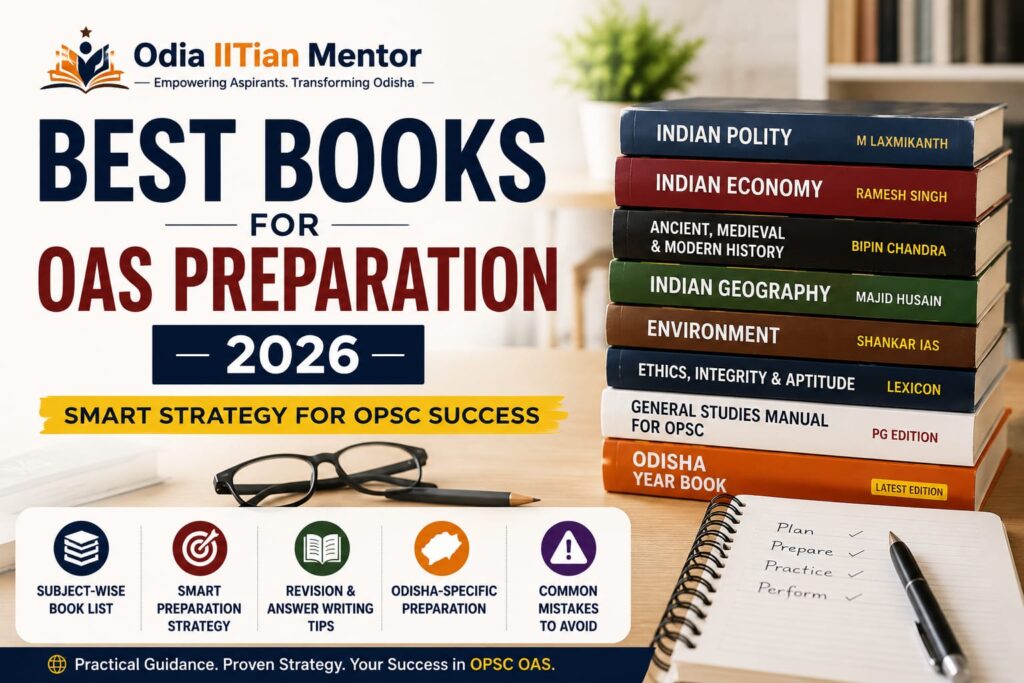
For each subject, choose one primary source and commit to reading and revising it thoroughly before adding anything else. For Polity: Laxmikanth. For History: NCERT Modern History and Spectrum for the freedom movement. For Geography: NCERT series. For Economy: NCERT Economics supplemented by selective reading of Economic Survey summaries. For Odisha-specific content: develop a curated set of reliable sources on state issues.
Step 3: Begin Answer Writing This Week, Not Next Month
Pick any topic from the OPSC syllabus that you have read recently. Write a 150-word answer on it by hand. Time yourself. Read it critically. Identify three things you would improve. Write the answer again the next day. This is how the skill is built — not by waiting until you feel ready, but by starting before you feel ready and improving through practice.
Step 4: Create a Revision Schedule and Protect It
Revision is not what you do after finishing a subject. It is what you do throughout preparation. Every week, schedule time to revisit notes from the previous two weeks. Every month, review major themes from the previous month. This compounding revision transforms short-term reading into long-term retention.
Step 5: Develop an Odisha Lens for Everything You Read
Every national policy, every constitutional provision, every economic concept — ask yourself what it means for Odisha. How does MGNREGA play out differently in KBK districts versus coastal Odisha? How does forest rights legislation affect tribal communities in Sundargarh versus Rayagada? This habit of applying an Odisha lens to everything you study is what produces the kind of contextualised, grounded answers that OPSC examiners find distinctive and persuasive.
Final Thoughts: Trust the Process, Not the Shortcut
The Odisha Civil Services examination is genuinely difficult. It is designed to be. Because the work of an OAS officer — administering a sub-division in drought-affected western Odisha, managing a cyclone relief operation along the coast, resolving a land dispute in a scheduled area — is genuinely difficult work that demands deep knowledge, sound judgment, and human sensitivity.
The preparation process, when done honestly, is itself a form of education — not just for the examination, but for the responsibilities that follow it. Aspirants who understand this tend to prepare differently. They read with curiosity, not just urgency. They think about issues, not just collect facts. They build a relationship with Odisha’s realities that deepens over months of focused engagement.
There will be days when the examination feels impossibly far away. There will be weeks when nothing seems to be going in. There will be months when comparison with others creates doubt about your own capacity. These are not signs that you should give up or change your strategy. They are signs that you are doing something genuinely hard — and that the person on the other side of this process will be substantially different from the person who began it.
Limit your resources. Deepen your revision. Practice your answers. Develop genuine curiosity about Odisha and its people. Stay consistent when consistency is difficult. This is the strategy. It is not exciting. It does not produce results in a week. But it works. It has always worked. And it will work for you too.
With Respect and Best Wishes
Prakash Chandra Mallick
PhD Scholar, IIT Patna | Alumnus of TISS Mumbai & University of Hyderabad, Senior Development Professional | Educator
ODIA IITIAN MENTOR: Guidance for OAS, OCS, Competitive Exams, Career Growth & Student Transformation
For more information: http://opsc.gov.in/ https://odiaiitianmentor.com/guidance/