The Slow Disappearance
Every year, I watch it happen. Thousands of students from across Odisha — from the lanes of Sambalpur, from small towns near Koraput, from Bhubaneswar hostels and villages in Mayurbhanj — begin their OPSC OAS preparation with something very real in their eyes: hope. They carry the weight of their family’s dreams, the weight of years of education, and a genuine hunger to change their circumstances.
Some of them are genuinely brilliant. Some are extraordinarily hardworking. Many have sacrificed social lives, relationships, comfort — things that young people in other careers never have to think about.
And yet, after six months, after one year, after sometimes three or four years — many of these aspirants simply disappear. Not dramatically. Preparation failures in Odisha Civil Services are rarely sudden collapses. They are slow erosions. The routine breaks down. The confidence drains. The mental clarity fades. And one day, the aspirant is no longer preparing — they are just surviving.
What went wrong? In my years of mentoring OAS aspirants, what I have come to understand deeply is this: most preparation failures are not caused by lack of intelligence. They are caused by specific, recurring, identifiable mistakes — mistakes that aspirants often cannot see because they are too close to their own struggle.
This article is not a motivational speech. It is a mentor’s honest inventory of the mistakes that silently destroy OPSC preparation from the inside. If you are serious about cracking the Odisha Civil Services — at the OAS or OCS level — you need to read this carefully. Not just once.
The Ground Reality of OPSC OAS Preparation
Before we talk about mistakes, let’s be honest about the battlefield. The OPSC OAS examination is one of the most demanding state civil services examinations in India. The OPSC syllabus is vast — covering General Studies, optional subjects, essay writing, and a personality test (interview) that evaluates the whole person, not just knowledge.
The competition has become increasingly serious. Many aspirants preparing for Odisha Civil Services are also former engineers, postgraduates, and experienced professionals who bring enormous preparation capacity. The days when mugging up a few standard textbooks was enough are firmly behind us.
Yet the structural reality many Odia aspirants face is genuinely difficult. Most do not have access to quality coaching institutes. Self-study is the norm, not the exception. Financial constraints are real. Many are preparing while managing family responsibilities, part-time jobs, or emotional pressures that urban coaching-institute students never experience. Rural aspirants face infrastructural disadvantages that rarely get acknowledged in the standard OPSC preparation narrative.
Understanding this ground reality is not about making excuses. It is about being honest about the specific challenges Odia aspirants must navigate — and why certain mistakes, which might seem avoidable on paper, are actually deeply predictable given these circumstances.
Common Mistakes OAS Aspirants Make
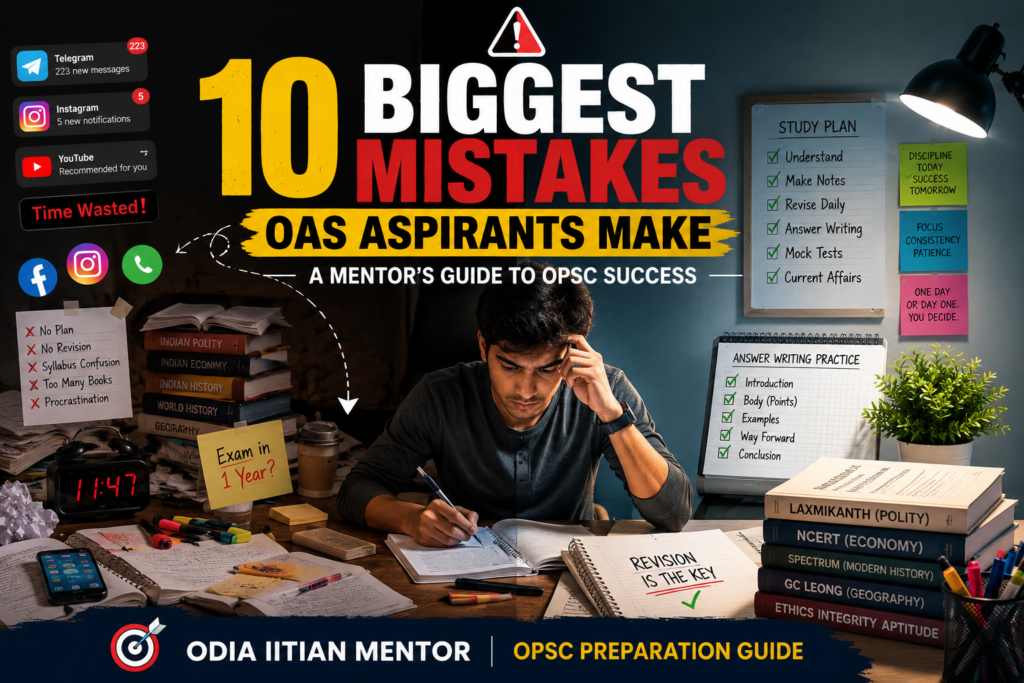
Mistake 1: Resource Overload — Confusing Collection with Preparation
This is perhaps the most universal mistake, and I have watched it claim aspirant after aspirant. It begins innocently: the student wants to be thorough. So they collect multiple booklists. They download hundreds of PDFs from Telegram channels. They save YouTube playlists. They gather coaching handouts from friends in Bhubaneswar or Delhi. Very quickly, the room fills with books — and the mind fills with confusion.
I have seen aspirants who own fifteen books on Indian Polity and cannot answer basic constitutional questions with confidence. The reason is simple: they have read fragments of many books, mastered none. The OPSC examination does not reward the student who has the largest library. It rewards the student who has the deepest command of limited, well-chosen resources.
The principle that actually works is almost embarrassingly simple: Limited Sources + Multiple Revisions. One standard book revised five times will serve you better than five books read once.
Why do aspirants fall into this trap despite knowing this principle? Because collecting resources feels like progress. It is emotionally satisfying. Actual deep revision is uncomfortable, slow, and mentally demanding. The mind seeks the easier activity and dresses it up as preparation.
Mistake 2: Studying Without Revising — The Leaking Bucket Problem
Related to the first mistake but distinct and equally destructive: aspirants who keep covering new topics without systematically revising old ones. I call this the ‘leaking bucket’ problem. You pour water in continuously — but the bucket has holes at the bottom. You remain perpetually busy, perpetually exhausted, and perpetually under-prepared.
Memory is not a hard drive where data is permanently stored once written. Without revision, even genuinely understood concepts fade within days. The human brain consolidates and retains information through repetition over spaced intervals. This is not motivational wisdom — it is basic cognitive science that should be at the foundation of every OPSC preparation strategy.
The aspirant who revises systematically — daily, weekly, and monthly — will consistently outperform the aspirant who merely reads more. Many mediocre performers in the OPSC Mains answer writing tests are not people who lack knowledge. They are people whose knowledge has leaked away because revision was never made non-negotiable.
Mistake 3: Constant Strategy Changing — The Restless Wanderer
I have had conversations with aspirants who changed their entire preparation strategy four times in six months. New timetable every week. New mentor every month. A YouTube video convinces them Monday that one approach is correct; a Telegram post on Friday convinces them the opposite. They are perpetually in motion but moving in circles.
Preparation for any serious examination requires something that strategy-changers never develop: depth through sustained effort. No preparation method produces visible results in ten days. Even genuinely good strategies need months of consistent application before their benefits become clear. When aspirants change course before results appear, they mistake the discomfort of early-stage hard work for evidence that the strategy is wrong.
The antidote is not to find the perfect strategy — there is no such thing. The antidote is to choose a sound strategy, commit to it for at least three months, and evaluate it based on actual outcomes rather than emotional discomfort.
Mistake 4: The Comparison Trap — Measuring Your Chapter One Against Someone Else’s Chapter Twenty
Social media has made this mistake far more dangerous than it was a decade ago. Aspirants from smaller towns in Odisha now constantly see the polished presentations of toppers, the confident English of coaching-educated aspirants from urban centres, the apparent ease with which others seem to handle the material. The comparison begins silently and is emotionally lethal.
What the comparison never shows: the topper’s family situation, financial backing, previous attempts, the years of failure that preceded the success, the coaching support system that rural Odia aspirants often cannot access. You are seeing someone’s result while comparing it to your process. That is not a fair or useful comparison.
I have mentored aspirants from genuinely difficult circumstances — first-generation graduates, students who taught themselves from borrowed books, aspirants who prepared in homes with no quiet study space. Many of them succeeded in Odisha Civil Services precisely because they stopped comparing their journey to others and focused on their own incremental improvement. Your only meaningful competition is the version of yourself from last month.
Mistake 5: Memorising Without Understanding — Building on Sand
The traditional rote-learning approach that worked for school examinations is actively dangerous in OPSC preparation. I have seen aspirants who can recite Articles of the Constitution from memory but cannot explain what the Basic Structure Doctrine means in practice. They have memorised the scaffolding but have no building inside.
The OPSC Mains examination — particularly the General Studies papers — increasingly rewards analytical thinking. Questions on Odisha’s tribal rights issues, river water disputes, agricultural challenges, or economic development require more than recalled facts. They require the aspirant to understand the issue, analyse multiple dimensions, and construct a structured, insightful response.
The simple diagnostic test: after studying any topic, close the book and explain it aloud in your own words. If you cannot, you have not understood it yet — you have only read it. Understanding creates confidence. Memorisation without understanding creates anxiety, especially in the examination hall when a question arrives phrased differently from the version you memorised.
Mistake 6: Digital Distraction — The Invisible Time Thief
This is the mistake that most aspirants will privately acknowledge but rarely address seriously. The aspirant sits down to study at 9 AM with genuine intention. By 9:12 AM, the phone has opened Instagram. By 9:30 AM, a YouTube video has started — ‘just a quick current affairs update.’ By 10 AM, thirty minutes of actual study have occurred in ninety minutes of sitting.
This is not a character flaw. Smartphones are designed by the world’s smartest engineers to capture and hold attention. The aspirant is not failing because they are weak — they are fighting a machine optimised for exactly this outcome. The only realistic response is structural: remove the phone from your study environment. Not willpower. Physical removal.
Aspirants who develop genuine deep focus capacity — the ability to sit with a difficult text for ninety uninterrupted minutes — have an enormous advantage in OPSC preparation. This capacity does not come naturally in the smartphone age. It must be deliberately built, one distraction-free study block at a time.
Mistake 7: The Heroic Timetable — Fourteen Hours on Paper, Two Hours in Reality
I have seen aspirants create preparation timetables so ambitious they would exhaust a trained athlete: 5 AM wake-up, fourteen hours of study, no breaks, no recreation, no emotional space. For the first two days, motivation is high enough to sustain it. By day five, the exhaustion is real. By day ten, the timetable has been abandoned entirely, replaced by guilt.
The aspirant then concludes they lack discipline, when in reality they made the common error of confusing ambition with sustainability. Preparation is a marathon, not a sprint. Six to eight hours of genuinely focused, distraction-free daily study sustained over eighteen months will consistently outperform fourteen-hour days that collapse into zero-hour days within a fortnight.
Mistake 8: Neglecting Mental and Emotional Health
Nobody talks about this openly enough in the OPSC preparation ecosystem, so I will say it plainly: OPSC preparation is one of the most emotionally demanding journeys a young Odia can undertake. The uncertainty is prolonged. The feedback cycles are slow. The social pressure is immense — questions from relatives, the financial strain of not being employed, the anxiety of watching peers move forward in careers.
Self-study aspirants carry this weight largely alone. Repeat aspirants carry it with the added burden of previous disappointment. Aspirants from economically weaker families carry it with the constant awareness of what is at stake financially. These pressures, left unacknowledged, do not disappear — they quietly erode the mental stability that high-quality preparation requires.
Sleep is not laziness — it is memory consolidation. Rest is not weakness — it is recovery that enables continued effort. Physical exercise, even a thirty-minute walk, is not time wasted from preparation — it is the maintenance of the instrument through which all preparation happens: your mind and body. Treat emotional health as a preparation variable, not an afterthought.
Mistake 9: Ignoring OPSC-Specific Answer Writing Until It Is Too Late
Many aspirants spend the majority of their preparation time on reading and almost none on answer writing practice. They plan to ‘start writing practice later’ — after the syllabus is done, after the revision is complete, after they feel ready. They never feel ready. The examination arrives, and they discover in the hall that knowing information and being able to write a structured, time-bound answer are entirely different skills.
OPSC Mains answer writing is a craft. It requires knowing how to open an answer with a relevant context, how to structure arguments across multiple dimensions, how to incorporate Odisha-specific examples where relevant, how to conclude with a forward-looking perspective — all within a strict word limit and time constraint. This cannot be improvised on examination day. It must be practised for months.
Begin writing practice from day one. Write imperfectly at first. Improve progressively. Seek feedback whenever possible. The aspirant who has written three hundred practice answers before the examination will always outperform the aspirant who has read three hundred books but never practised writing.
Mistake 10: Quitting Mentally Before Success Arrives
The most painful mistake of all, because it is the one closest to the finish line. Many aspirants who could have succeeded abandon their preparation — not because they encountered insurmountable obstacles, but because progress was slow, confidence was low, and hope had gradually been replaced by despair.
I have seen aspirants reach extraordinary levels of preparation and then quietly walk away because they lost faith. And I have seen aspirants who seemed less academically gifted persist through doubt and difficulty and eventually succeed — sometimes in their third or fourth attempt. The difference was not intelligence. It was the refusal to quit mentally.
Slow progress is not the absence of progress. It is the nature of deep, lasting preparation. Every serious achievement — in any field — involves long periods where growth is invisible from the inside but is actually accumulating.
What Actually Works in OPSC Preparation
Having spent years observing what separates OAS and OCS qualifiers from aspirants who remain stuck, certain patterns emerge with consistent clarity:
Radical Simplification of Resources
Successful aspirants typically use surprisingly few books — but use them completely. Standard NCERT texts, Laxmikanth for Polity, Ramesh Singh for Economy, a well-chosen set of Odisha-specific materials for state-related content. They are not impressed by obscure sources or rare PDFs. They master the standard material while others are still accumulating.
Non-Negotiable Daily Revision
Every successful aspirant I have observed treats revision as sacred. Not optional. Not something to do when other tasks are complete. Revision is the primary task — covering new material is secondary. A minimum of one to two hours of daily revision of previously studied content is non-negotiable.
Consistent Answer Writing Practice
From the first month of serious preparation, successful aspirants write. Daily. They write poorly at first, improve slowly, and arrive at the OPSC Mains examination with a writing muscle that is trained and reliable.
Odisha-Centric Current Affairs Engagement
Not generic current affairs consumption — but thoughtful, Odisha-anchored analysis. Understanding how national policies interface with Odisha’s specific challenges: the tribal rights issues in Niyamgiri, the coastal vulnerability, the agricultural distress in KBK districts, the industrial development in Angul-Dhenkanal, the educational challenges in aspirational districts. This contextual depth is what separates average answers from excellent ones.
A Practical Framework for Serious OPSC Preparation
Phase 1: Foundation (Months 1–3)
Select your resources carefully and finalise them. Do not add new books after this phase. Cover the OPSC syllabus systematically, understanding every topic deeply rather than rushing to complete it. Build your daily revision habit from Week 1. Begin writing one short practice answer every day from Month 2.
Phase 2: Deepening (Months 4–8)
Second revision of all subjects. Increase answer writing to two to three answers daily. Begin tracking current affairs with a dedicated Odisha-focused note system. Attempt previous years’ OPSC question papers under timed conditions. Identify and address weak areas specifically.
Phase 3: Integration (Months 9–12)
Multiple rapid revisions. Full-length mock tests. Intensive answer writing with focus on quality, structure, and time management. OPSC interview preparation begins — building the intellectual personality, not just factual recall. Consolidation of current affairs. Mental preparation for the examination.
The Mentor’s Perspective: What I Wish More Aspirants Understood
After all these years of interaction with OAS and OCS aspirants, here is what I wish I could communicate more effectively:
The OPSC journey is ultimately a character-building exercise disguised as an examination. The discipline you develop, the patience you cultivate, the intellectual curiosity you nurture — these qualities do not disappear if you do not clear the examination in your first attempt. They become permanent assets.
Most aspirants who eventually succeed in Odisha Civil Services will tell you their second or third attempt was better not primarily because they knew more material, but because they had developed a more mature, disciplined, and emotionally stable relationship with preparation. The examination tests readiness. Readiness takes time to develop.
I also want to say this directly: the English language advantage that some aspirants carry is real but not absolute. The OPSC examination rewards clear thinking expressed clearly — not necessarily sophisticated English. Many outstanding OAS officers from Odisha have written in Odia medium and communicated ideas with remarkable clarity. Focus on clarity of thought first. Language will follow.
And finally: the optional subject choice matters more than most aspirants realise. Choose your OPSC optional based on genuine interest and background strength, not on rumours about which subject is ‘scoring’ this year. An optional you understand deeply will serve you far better than one you chose strategically but struggle to engage with genuinely.
Action Steps for Aspirants
If you have read this article seriously, here are the immediate actions that matter:
- Audit your current resources. If you have more books than you can realistically revise three times before the examination, remove the excess. Simplify now.
- Add a daily revision block to your schedule — minimum sixty minutes — starting tomorrow. Make it non-negotiable.
- Begin writing one practice answer today. Not when you feel ready. Today. Imperfect writing that you can improve is infinitely more valuable than writing you never start.
- Delete or silence social media notifications during your study hours. Structure your environment for focus, not willpower.
- Build a weekly review habit: every Sunday, review what you studied, what you retained, and what needs more attention.
- Start an Odisha-specific current affairs notebook. Not a general current affairs dump — a curated, analytical record of issues relevant to OPSC.
- Identify your weakest subject. Dedicate specific daily time to it rather than avoiding it.
- If you are a repeat aspirant, do an honest post-mortem of your previous attempt. Identify the specific reasons for underperformance and address them directly, not generally.
Final Thoughts
Every aspirant who has ever succeeded in OPSC made mistakes. Many made the same mistakes described in this article. The difference between those who eventually succeed and those who don’t is not that the successful ones never erred. It is that they observed their errors, made corrections, and continued forward.
The Odisha Civil Services is a noble pursuit. The OAS and OCS officers who serve Odisha’s people — who reach the forest villages of Nabarangpur, who manage disaster response in cyclone-affected coastal areas, who implement welfare schemes in the tribal belts of Kandhamal — they matter enormously. The journey to join them deserves your most serious, most disciplined, most honest effort.
Simplify your preparation. Protect your focus. Revise relentlessly. Write consistently. Stay emotionally grounded. And above all, refuse to quit on yourself.
One disciplined year of genuine, mistake-aware preparation can completely change the direction of your life.
Consistency is more powerful than temporary motivation. And you are more capable than your doubt tells you.
With Best Wishes,
Prakash Chandra Mallick, PhD Scholar, IIT Patna | Alumnus, TISS Mumbai & University of Hyderabad, Senior Development Professional | Educator
Odia IITian Mentor — Guidance for OAS | Competitive Exams | Career Growth | Student Transformation
For More Info: https://odiaiitianmentor.com/guidance/
https://www.opsc.gov.in