Introduction
Of every field covered in this series so far, social sciences carries the heaviest stigma relative to its actual opportunity. Sociology, Psychology, Economics, Political Science, Social Work, and Anthropology are routinely described, even by well-meaning relatives, as “safe but directionless” — degrees you complete rather than careers you build.
This article applies the same R.E.A.L framework used for Engineering, Medicine, and Law to social sciences, and makes a direct claim worth stating plainly: the gap between this field’s actual opportunity and its public reputation is wider here than in any other field this series has covered.
This gap is also where this article departs slightly from the others in this series. Rather than relying entirely on composite examples, it draws more directly on lived professional experience, because this is the one field in the series the author has actually built a career inside.
The Problem: A Stigma Built on an Outdated, Narrow Picture
The stigma around social sciences usually rests on one narrow image — underpaid NGO fieldwork — treated as the entire field’s ceiling. This image was never fully accurate, and it has become considerably less accurate as India’s policy, research, development, human resources, and user-research sectors have all expanded their demand for trained social scientists.
This author’s own academic background — a Master’s from TISS Mumbai and an MPhil from the University of Hyderabad — sits squarely inside this field, and the career that followed, including a State Lead role at WASSAN Odisha, reflects exactly the kind of trajectory this stigma tends to obscure from students considering the field today.
Why This Field Deserves a Direct, Personal Correction
Most fields in this series are corrected through general research and composite examples. This one benefits from something more direct: a working career built on this exact educational path, demonstrating that social sciences leads somewhere real, structured, and capable of sustaining a serious professional life — not a consolation choice for students who could not get into something else.
The R.E.A.L Framework, Applied to Social Sciences
- R — Range: the genuine breadth of careers across social science disciplines.
- E — Entry Path: how each discipline and career track is actually accessed.
- A — A Day in the Life: what the work actually involves, myths included.
- L — Long-Term Trajectory: where each path genuinely leads.
R: The Range Inside Social Sciences
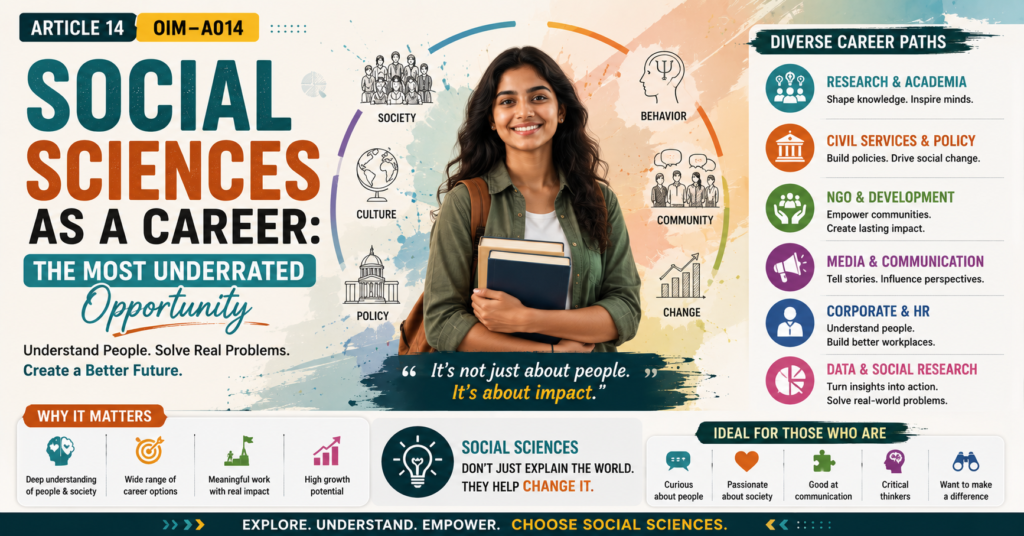
Sociology and Anthropology lead toward research, social policy analysis, and development-sector program work. Psychology splits into several genuinely distinct tracks: clinical and counseling psychology, organizational and HR-focused psychology, and a fast-growing user-experience and market-research track that draws directly on psychological training to study how people actually behave.
Economics leads toward policy analysis, data and research roles, banking and financial-sector research, and is one of the strongest social-science routes into civil services. Political Science leads toward civil services, journalism, public policy, and think-tank research. Social Work, typically through a Master’s in Social Work, leads toward direct community practice, NGO program leadership, and increasingly corporate social responsibility roles within companies. Development Studies, the discipline most directly tied to this author’s own background, leads toward program management and leadership roles across NGOs, government development programs, and multilateral organizations.
E: How Each Path Is Actually Accessed
A Bachelor’s degree in a specific social science discipline is the standard entry point, offered widely across Indian universities with considerable variation in research depth and placement strength. For research, policy, and senior development-sector roles specifically, a Master’s degree carries real Signal value — institutions like TISS, the Delhi School of Economics, Jawaharlal Nehru University, and the University of Hyderabad are widely recognized within the field, similar to how National Law Universities function within law.
Clinical psychology specifically requires formal registration through the Rehabilitation Council of India after the relevant postgraduate qualification — a regulatory requirement worth knowing early, since it shapes which specific psychology postgraduate program to pursue. Civil services, as with law, remains open to social science graduates from any of these disciplines without additional credentialing.
A: A Day in the Life, Myths Included
The dominant myth — that a social science career means underpaid NGO fieldwork indefinitely — collapses a genuinely wide range of working realities into one narrow, often outdated image. A market or UX researcher with a Psychology background spends most days interviewing users and analyzing behavioral data for a technology company. An HR or organizational-development professional spends days on talent strategy and structured people-management work. A policy analyst spends days on research and structured writing, often within well-funded think tanks or government bodies.
A second myth, less discussed but equally inaccurate, treats social science research as methodologically easy compared to STEM fields. In practice, rigorous social science work demands serious training in research methods, statistics, and structured fieldwork discipline — the rigor looks different from a laboratory science, but it is genuine rigor, not its absence.
L: Where Each Path Genuinely Leads
A research and academic track builds toward a PhD and eventual professorship or senior research positions. A policy and think-tank track builds toward senior policy advisory and government consultancy roles. A development-sector track — this author’s own trajectory — builds from program-level roles toward state or country leadership positions, sector specialization, or senior roles within multilateral organizations.
A corporate track, drawing on Psychology or Economics training specifically, builds toward HR and organizational-development leadership, or toward senior UX and market-research leadership roles. A clinical track builds toward senior psychologist positions or independent practice, following the formal registration process noted above.
Discipline Snapshot: A Starting Comparison
| Discipline | Entry Path | Example Careers | Typical Further Study |
| Psychology | BA/BSc, then specialized Master’s | Clinical psychologist, HR specialist, UX researcher | MA + RCI registration for clinical track |
| Sociology / Anthropology | BA, then MA at a research-focused institute | Researcher, policy analyst, program manager | MA/MPhil, PhD for academic track |
| Economics | BA, then MA at a strong economics department | Policy analyst, banking researcher, civil servant | MA essential; PhD for research/academic track |
| Social Work | BA, then MSW | NGO program lead, CSR manager, counselor | MSW required for most senior roles |
Common Myths Worth Retiring
- “Social sciences have no real career path.” They lead toward research, policy, corporate HR and UX, clinical practice, and senior development-sector leadership — a genuinely wide range.
- “Every social science job is underpaid NGO fieldwork.” Corporate, policy, and senior development-sector roles span a wide compensation range, just as in any other field.
- “Social science research lacks rigor.” Serious work in this field demands real training in research methods, statistics, and fieldwork discipline.
- “Civil services is the only good outcome for a social science graduate.” It is one strong outcome among several, not the only one worth pursuing.
A Worked Example
Consider a composite case drawn from recurring patterns across mentoring conversations, not one identifiable individual.
A student strongly drawn to Sociology faces sustained family discouragement, with repeated suggestions to switch to Commerce for “better prospects.” Researching the Range and Entry-Path lenses in this framework — including specific institutes known for strong placement into research and development roles — gives the family a concrete trajectory to evaluate rather than a vague worry to react to. Pursuing an MA at a respected institute, the student moves into a structured development-sector career, eventually leading state-level programs — a trajectory the family had assumed did not exist within social sciences until it was actually researched and laid out.
A second composite case involves a Psychology student who assumed clinical practice was the only real outcome of the degree, and felt mismatched with the idea of full-time one-on-one therapy work. Running the S.T.R.O.N.G strengths framework surfaces strong Natural Energy around structured research and pattern-finding rather than individual clinical sessions, pointing toward UX or market research — a path the student had not previously known existed within Psychology at all.
Both cases share a common thread: the corrective information already existed, but neither family had been exposed to it until the specific research step was deliberately taken. This is precisely the gap this article is written to close — not by arguing the stigma is wrong in the abstract, but by naming the specific tracks the stigma tends to hide.
Common Mistakes Students and Families Make About Social Sciences
- Dismissing the field based on one narrow, often outdated image of underpaid NGO fieldwork.
- Choosing a specific discipline based on general reputation among peers rather than genuine interest and strength.
- Skipping a credentialing Master’s where the field genuinely requires one, such as clinical psychology or social work.
- Assuming civil services is the only strong outcome, overlooking research, policy, corporate, and development-sector tracks.
- Treating social science research as methodologically easier than it actually is, leading to under-preparation for genuinely rigorous postgraduate programs.
Action Steps: Apply the R.E.A.L Framework to Social Sciences
- List the specific social science career tracks in the Range section you have not yet researched in depth.
- If pursuing Psychology, decide early whether you are aiming for the clinical, organizational, or research track, since each has a different postgraduate route.
- Research two or three specific Master’s institutes relevant to your discipline and compare their placement and research strength.
- Talk to one person working in a development, policy, or corporate social-science role about their actual daily work.
- Run the S.T.R.O.N.G strengths framework against your specific discipline to confirm genuine fit before committing to a postgraduate specialization.
Reflection Questions
- Have I dismissed or under-researched a social science path because of its general reputation rather than its actual range?
- Which specific track within my discipline of interest — research, policy, corporate, clinical, or development — genuinely fits my strengths?
- Have I checked whether my target career requires a specific Master’s or professional registration I have not yet planned for?
Key Takeaways
- Social sciences carry a stigma built on one narrow, outdated image that does not reflect the field’s actual range.
- Psychology, Sociology, Economics, Political Science, and Social Work each lead toward genuinely distinct career tracks.
- A Master’s degree carries real Signal value for research, policy, and senior development-sector roles, similar to law and several other fields in this series.
- Corporate HR, UX research, and market research are legitimate, growing destinations for social science graduates, not exceptions to the field.
- Civil services is one strong outcome among several, not the field’s only respectable destination.
Frequently Asked Questions
Is social science actually a good career choice today, or just a personal passion with no practical outcome?
It is a genuinely practical choice when paired with the right specific track and, where relevant, the right Master’s program. The growth of policy, research, HR, and UX-research roles over the past decade has measurably widened practical outcomes well beyond the traditional NGO-only picture.
Is a Master’s degree necessary, or can I build a career with just a Bachelor’s?
It depends heavily on the specific track. Research, policy, clinical, and senior development-sector roles generally require a Master’s; some corporate-adjacent roles, particularly in HR and certain research-support functions, are more accessible with a strong Bachelor’s alone, especially when paired with demonstrated practical experience.
Can social science graduates get corporate jobs, or is the field mostly NGO and government work?
Yes, genuinely — HR, organizational development, UX research, and market research are all corporate-sector roles that actively recruit social science graduates, particularly from Psychology and, increasingly, Sociology and Anthropology backgrounds.
How does this connect to civil services specifically?
Strongly, similar to the Arts-and-Humanities overlap discussed in our Science-Commerce-Arts article — Political Science, Economics, and Sociology in particular align closely with the civil services examination syllabus and are common, successful background disciplines for aspirants.
Is fieldwork a required part of every social science career?
No. Fieldwork is central to community-based development and certain research roles, but policy analysis, corporate HR, UX research, and clinical practice each involve very different proportions of fieldwork, desk-based research, and direct client or user interaction.
How do I choose between Sociology, Psychology, Economics, and Political Science if I’m interested in several of them?
Use the same Strengths Discovery approach from our companion article: which of these disciplines’ actual day-to-day methods — statistical analysis, clinical interaction, policy writing, structured fieldwork — produces the strongest Genuine Flow and Natural Energy for you specifically. The disciplines overlap considerably in subject matter but differ significantly in method, and method is usually the better predictor of long-term satisfaction.
Conclusion
Social sciences are, by a meaningful margin, the field most underestimated relative to its actual opportunity in this entire series. The stigma rests on an image of the field that was never fully accurate and has become considerably less accurate as policy, research, HR, and UX-research sectors have expanded their demand for exactly this training.
Apply the R.E.A.L framework to the specific discipline and track that genuinely fits you, and you will likely find — as this author’s own career reflects directly — that the field leads somewhere considerably more structured and substantial than its reputation suggests.
If this article changes one thing in a family conversation, let it be this: ask which specific track inside the field is actually being dismissed, before dismissing the entire field on its behalf.
What to Do Next
The Career Exploration Handbook and Future Careers Handbook at Odia IITian Mentor go further into mapping social science disciplines against your own strengths profile. This series continues with Management Careers and Public Service Careers, both of which connect closely to several tracks covered here.
About the Author
Prakash Chandra Mallick is a Senior Educator, Senior Development Professional, and PhD Scholar at IIT Patna, with prior academic training at TISS Mumbai and the University of Hyderabad. He founded Odia IITian Mentor to bring structured, evidence-based career guidance and civil services preparation to students across Odisha, with particular attention to first-generation learners and rural and Odia-medium students who are too often left out of mainstream career advice.