Introduction
For most Indian families, “medical career” and “MBBS” are treated as the same sentence. This is understandable — MBBS leads to a respected, well-understood profession — but it also creates a painful trap for the much larger number of NEET aspirants who do not secure an MBBS seat than the smaller number who do, given how competitive the examination has become.
This article applies the same R.E.A.L framework introduced in our companion piece on Engineering as a Career to the medical and healthcare field, with a specific focus on the genuine, often underexplored range of paths beyond MBBS — because the choice, for most aspirants, was never really between MBBS and nothing.
This matters as much for parents and counselors reading this as for aspirants themselves. A great deal of the pressure that keeps capable students repeating NEET attempts indefinitely comes from family members who have simply never had the alternatives explained to them in any real depth.
The Problem: One Visible Path Crowds Out a Dozen Real Ones
NEET’s visibility and MBBS’s social prestige create a narrow mental model of “medical career” that excludes nursing, allied health sciences, pharmacy, public health, biomedical engineering, and several other genuinely strong healthcare paths — most of which involve real patient impact, real career growth, and considerably less brutal entry competition than MBBS specifically.
The cost of this narrow model is significant: capable students spend two, three, or more years repeating NEET attempts without ever seriously researching the alternatives, often because no one around them treated those alternatives as real medical careers worth taking seriously.
Why This Matters Specifically in the NEET Era
NEET seat availability has not kept pace with aspirant numbers, which means a large share of capable, motivated students will not secure an MBBS seat regardless of effort — a structural reality, not a reflection of their ability. Treating every one of those students as having “failed at medicine” rather than having dozens of genuine healthcare paths still available is both inaccurate and, frankly, unkind.
The R.E.A.L Framework, Applied to Medicine
- R — Range: the genuine breadth of healthcare careers beyond MBBS.
- E — Entry Path: how each path is actually accessed.
- A — A Day in the Life: what the daily work in each path actually involves.
- L — Long-Term Trajectory: where each path genuinely leads.
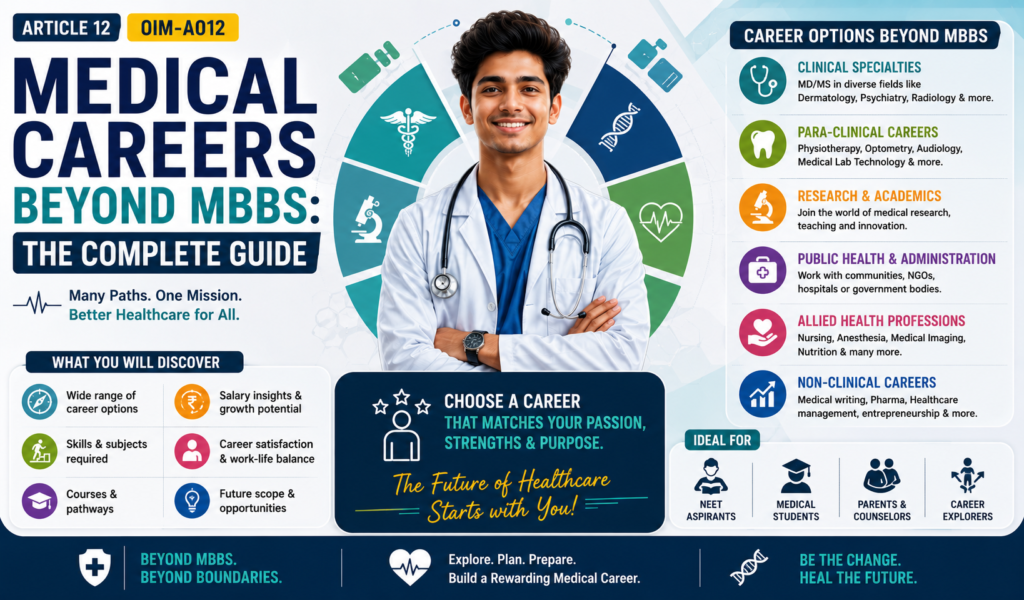
R: The Range Beyond MBBS
MBBS itself leads toward clinical practice as a doctor, typically followed by further specialization through MD or MS programs for most lucrative and senior roles — a substantial multi-year commitment beyond the base degree. BDS (dentistry) and AYUSH paths — BAMS, BHMS, BUMS — are also accessed through NEET and lead to distinct clinical practices with their own scope and recognition, worth researching specifically rather than treating as lesser fallback options.
Beyond these NEET-linked clinical paths sits a wide allied health category: B.Sc Nursing, Physiotherapy, Medical Lab Technology, Radiology and Imaging Technology, Optometry, and Occupational Therapy, each leading to a genuine clinical or technical healthcare role with real patient contact and clear specialization paths. Pharmacy (B.Pharm) sits adjacent to this, covering both clinical and industry-research roles. Public Health and Healthcare Management, often pursued through a postgraduate route after a relevant undergraduate degree, lead toward policy, program, and administrative roles — work that looks considerably more like planning and systems design than direct clinical practice.
Two further paths deserve specific mention, since they are even less visible than the categories above. Biomedical Engineering — usually entered through the engineering route discussed in our companion article rather than through NEET — sits at the intersection of healthcare and technical design, building the medical devices and diagnostic equipment that clinical staff rely on. Medical and health research, pursued through science or pharmacy postgraduate study, leads toward laboratory and clinical-trial work that shapes future treatments rather than delivering them directly.
E: How Each Path Is Actually Accessed
MBBS, BDS, and the AYUSH degrees are all accessed through NEET, with seat competition varying considerably across this group — AYUSH and several BDS seats are frequently more accessible than MBBS specifically, while leading to genuinely distinct and respected clinical paths in their own right.
Nursing, allied health sciences, and pharmacy programs typically use separate entrance processes or merit-based admission depending on the state and institution, generally with meaningfully less extreme competition than MBBS. Public health and healthcare management programs are usually entered at the postgraduate level, often open to graduates from medical, science, or even social science backgrounds, depending on the specific program.
A: A Day in the Life, Myths Included
The common myth that only MBBS doctors do “real” medical work obscures how much direct patient care, technical skill, and clinical responsibility exists in nursing and allied health roles — a radiology technician, a physiotherapist, and a senior nurse all carry genuine clinical responsibility, frequently with more sustained direct patient contact per day than many specialist doctors.
The opposite myth — that anything other than MBBS is “easier” — is equally inaccurate. Allied health roles involve their own demanding technical training and licensing requirements, and public health and healthcare management work, while less clinically hands-on, frequently involves complex, high-stakes planning work, particularly in government and large NGO settings.
L: Where Each Path Genuinely Leads
MBBS leads toward specialization through MD or MS, then private practice, hospital consultancy, or government medical service, typically over a long total timeline once specialization is included. AYUSH and BDS lead toward their own distinct clinical practice and specialization routes, with separate professional recognition and growth paths worth researching on their own terms.
Allied health and nursing paths lead toward senior clinical, supervisory, or teaching roles within their specialization, often with strong demand in both India and several international healthcare systems. Public health and healthcare management paths lead toward program leadership, policy roles, and senior positions within government health departments, NGOs, and international health organizations — a trajectory this author has seen directly through years of public-health-adjacent development work in Odisha.
Path Snapshot: A Starting Comparison
| Path | Entry Route | Typical Timeline | Example Roles |
| MBBS | NEET | 5.5 years + MD/MS for specialization | Doctor, specialist, consultant |
| BDS / AYUSH | NEET | 4-5.5 years + optional specialization | Dentist, Ayurvedic/Homeopathic physician |
| Nursing / Allied Health | Separate entrance or merit-based | 3-4 years + optional specialization | Nurse, physiotherapist, lab technologist |
| Public Health / Healthcare Mgmt. | Postgraduate entry after base degree | 2 years postgraduate | Program officer, health administrator |
Common Myths Worth Retiring
- “Without MBBS, you can’t have a real medical career.” Nursing, allied health, public health, and pharmacy all involve genuine clinical or systems-level healthcare work with real impact.
- “NEET failure means no path in healthcare.” It means no MBBS path through that specific attempt cycle — dozens of other healthcare paths remain genuinely open.
- “Allied health is a fallback for those who couldn’t get MBBS.” Many allied health professionals choose their path deliberately for genuine fit, not as a consolation option.
- “Public health isn’t really medicine.” It is a distinct, essential branch of healthcare work, focused on systems and populations rather than individual clinical treatment.
A Worked Example
Consider a composite case drawn from recurring patterns across mentoring conversations, not one identifiable individual.
A NEET aspirant from a small Odisha town attempts the examination three times across four years, falling just short of an MBBS seat each time, with mounting financial and emotional cost to the family. Applying the Honest Backup Planning step from our Class 12 decision article — which the family had skipped each of the first three attempts — surfaces B.Sc Nursing as a same-field backup that had never been seriously considered, dismissed early on as a lesser option without genuine research.
Pursuing nursing instead, the student finds a strong genuine fit confirmed through the S.T.R.O.N.G strengths framework — high Natural Energy specifically around direct patient interaction, a pattern that had been present all along but overshadowed by the singular focus on the MBBS attempt. Three years later, the student is a working, respected healthcare professional with growing specialization options, having reached a genuinely strong outcome roughly the same number of years after Class 12 that a fourth or fifth NEET attempt would have taken, with considerably less financial and emotional cost along the way.
The family’s initial resistance to nursing as a “lesser” path softened considerably once the specialization and growth options were laid out concretely — critical care, midwifery, and nurse-educator tracks among them — rather than the vague, dismissive impression they had started with.
Common Mistakes Families Make About Medical Careers
- Treating every healthcare path other than MBBS as a lesser fallback rather than a genuine, deliberately chosen career.
- Repeating NEET attempts indefinitely without building an honest backup plan early in the process.
- Assuming allied health and nursing roles involve less skill or training than they actually require.
- Overlooking public health and healthcare management as legitimate medical-adjacent careers entirely.
- Choosing AYUSH or BDS reluctantly as a “consolation prize” rather than researching their genuine, distinct value as clinical paths.
Action Steps: Apply the R.E.A.L Framework to Medical Careers
- List every healthcare path in the Range section above that you have not yet seriously researched.
- If you are a current or repeat NEET aspirant, build an honest backup plan now, specifically among the alternatives in this article, not as a last resort.
- Talk to one person currently working in nursing, allied health, or public health about their actual daily work and career trajectory.
- Run the S.T.R.O.N.G strengths framework against your specific interest in healthcare — is it the clinical contact, the technical problem-solving, or the systems-level impact that genuinely energizes you?
- If you are a parent or family member, research at least one alternative path in depth before discouraging a child from considering it.
Reflection Questions
- Have I treated MBBS as the only “real” medical career, without genuinely researching the alternatives?
- What part of healthcare work actually draws me — direct clinical contact, technical precision, or large-scale systems impact?
- If I am currently repeating NEET attempts, do I have an honest, researched backup plan, or only a hope that the next attempt will succeed?
Key Takeaways
- MBBS is one strong path among many genuine healthcare careers, not the single definition of a medical career.
- NEET seat competition is a structural reality; not securing a seat reflects the numbers, not necessarily your capability.
- Nursing, allied health, pharmacy, and public health all involve real skill, real training, and real impact.
- An honest backup plan, built early, prevents years of repeated attempts without a researched alternative.
- Genuine fit — clinical, technical, or systems-level — matters more than the perceived prestige of a specific path.
Frequently Asked Questions
Is BDS a good alternative to MBBS?
Yes, as its own genuine path rather than a consolation prize — dentistry is a distinct, respected clinical profession with its own specialization and practice opportunities, worth choosing deliberately rather than reluctantly.
Is nursing a viable career for male students as well?
Yes, and male nurses are an increasingly common and valued part of the profession, with the same clinical responsibilities, specialization options, and career growth available regardless of gender.
How many NEET attempts should I make before seriously considering an alternative?
There is no universal number, but the Honest Backup Planning principle applies regardless: build a genuine alternative plan after your first attempt, not after your third or fourth, so that any further attempt is a deliberate choice rather than the only path you have prepared for.
Does public health or healthcare management pay well compared to clinical roles?
Compensation varies considerably by specific role, sector, and seniority, similar to the variation we discussed in our Government vs Private comparison — senior roles in government health systems, NGOs, and international health organizations can be genuinely competitive, though the trajectory and timeline differ from clinical practice.
Is AYUSH considered equivalent to MBBS?
AYUSH systems are distinct, separately recognized clinical paths with their own scope of practice, not a lesser version of MBBS. Whether one is a better fit depends on genuine interest in that specific system of medicine, not on treating it as an inferior substitute.
What about biomedical engineering or medical research as alternatives — are these taken seriously as healthcare careers?
Yes, increasingly so. Biomedical engineering and medical research roles are essential to how healthcare actually advances — designing the equipment clinicians depend on and developing the treatments that eventually reach patients. They are less visible than clinical roles specifically because their impact is upstream and less direct, not because the work itself is less significant.
Conclusion
“Medical career” deserves the same widening this series has applied to engineering and to the Science-Commerce-Arts decision before it: a single visible path crowding out a genuinely wide range of real, valuable options. MBBS remains a strong choice for the right student, but it was never the only door into healthcare, and treating it that way costs capable students years they did not need to spend.
Research the full range honestly, apply the R.E.A.L framework to whichever path genuinely fits your strengths, and build a backup plan early enough for it to be a deliberate choice rather than a last resort.
What to Do Next
The Future Careers Handbook and Career Decision Handbook at Odia IITian Mentor go further into mapping healthcare paths against your own strengths profile. If you are a current NEET aspirant weighing a backup plan, the Career Decision System course walks through this exact decision in structured depth.
About the Author
Prakash Chandra Mallick is a Senior Educator, Senior Development Professional, and PhD Scholar at IIT Patna, with prior academic training at TISS Mumbai and the University of Hyderabad. He founded Odia IITian Mentor to bring structured, evidence-based career guidance and civil services preparation to students across Odisha, with particular attention to first-generation learners and rural and Odia-medium students who are too often left out of mainstream career advice.