
Introduction
Most aspirants describe their preparation as a single, undifferentiated activity — “studying for OAS” — as though strong subject knowledge automatically and equally prepares them for whatever the exam asks, regardless of stage. Then comes a confusing, often painful surprise: an aspirant who cleared Prelims comfortably finds Mains-style answer writing far harder than expected, or an aspirant who writes thoughtful, well-argued answers in practice struggles with the speed and elimination demands of objective questions.
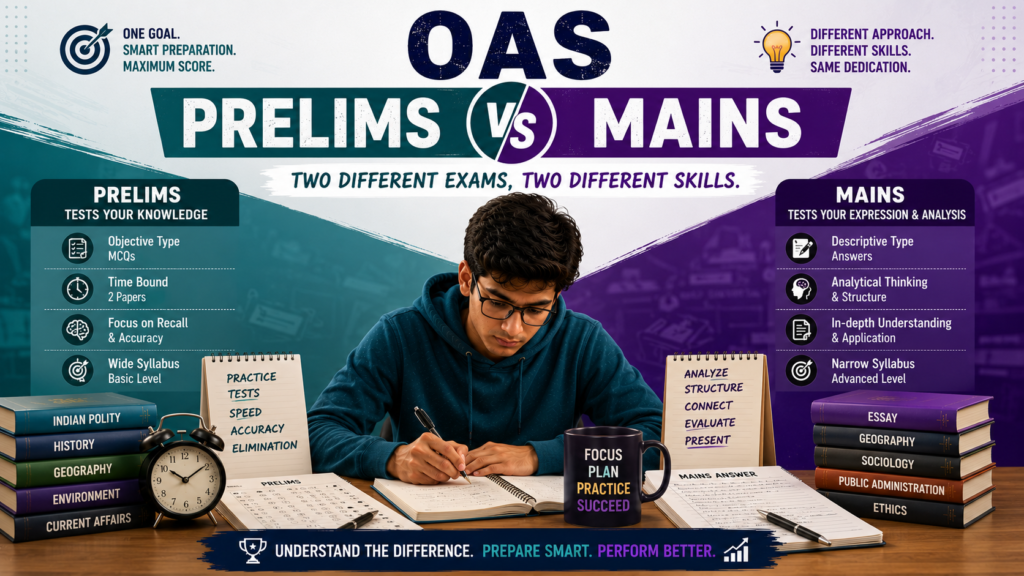
Both situations point to the same underlying truth this article names directly: Prelims and Mains are not the same exam wearing two different formats. They test genuinely different skills, and preparing well for one does not automatically prepare you for the other.
This distinction has a direct, practical consequence for how you should sequence your entire preparation timeline, not just an interesting observation about exam design — and that practical consequence is the central argument this article is built around.
The Problem: Treating Knowledge as the Only Variable
Knowledge of the syllabus matters for both stages, but it is far from the only variable separating strong from weak performance at each one. Prelims rewards quick, confident elimination among several plausible-looking options, often under real time pressure across a large number of questions. Mains rewards the ability to construct a complete, well-organized answer from memory, with no options to lean on and a fundamentally different kind of sustained effort required.
An aspirant can possess excellent underlying knowledge and still underperform badly at either stage if the specific skill that stage actually demands has never been deliberately trained.
The S.H.I.F.T Framework
- S — Spot the Skill Difference
- H — Hold Parallel Tracks, Not Sequential Ones
- I — Invest Differently in Each Stage
- F — Flip Your Revision Style Between Stages
- T — Track Each Stage’s Specific Metrics
S: Spot the Skill Difference
Name the distinction explicitly rather than treating it as a vague background fact. Prelims is fundamentally a recognition and elimination skill — you do not need to recall an answer unaided, only to identify which presented option is most likely correct, often by ruling out clearly wrong ones first. Mains is a construction skill — there are no options to recognize from, only a blank page and the expectation of a complete, well-structured response built entirely from your own recall and reasoning.
H: Hold Parallel Tracks, Not Sequential Ones
The most consequential strategic mistake in this entire comparison is waiting until after clearing Prelims to begin serious Mains preparation. The gap between Prelims results and the Mains examination is typically too short to build genuine answer-writing skill from scratch within it. Running both tracks in parallel from early in your preparation — objective practice alongside regular, even if occasional, answer-writing practice — means that gap can be used for focused revision rather than skill-building under pressure.
This single sequencing decision is, in this author’s experience mentoring aspirants through multiple preparation cycles, one of the clearest predictors of how confident and well-prepared an aspirant feels once Mains actually arrives. The aspirants who feel calm during that period are almost always the ones who had already been quietly building the relevant skill for months, not the ones who happened to feel less anxious by temperament.
I: Invest Differently in Each Stage
Prelims preparation benefits from broad coverage, frequent objective-style practice, and deliberate elimination-strategy drills — recognizing common wrong-option patterns, managing time across many questions, and calibrated guessing where negative marking applies. Mains preparation benefits from depth on a narrower set of high-value topics, structured answer practice, and the kind of full-answer reconstruction covered in our companion article on active recall.
This does not mean splitting your study time evenly down the middle at every point in preparation. Earlier in your timeline, Prelims-style practice can reasonably take up a larger share, while a modest, protected Mains-style practice habit runs alongside it; closer to the actual Prelims date, that balance can shift further toward objective practice temporarily, before shifting decisively toward Mains-style depth once Prelims is behind you.
F: Flip Your Revision Style Between Stages
As you move from Prelims-focused to Mains-focused revision, deliberately change your revision method, not just your subject matter. Prelims revision suits quick recognition-based review — flashcards, rapid-fire self-testing across many topics. Mains revision suits full-answer reconstruction — writing a complete response from memory and checking it against a model answer, a fundamentally different and more time-intensive revision activity per topic.
Many aspirants continue using flashcard-style review well into their Mains-focused weeks simply because it is the habit they have already built, even though it no longer matches what the upcoming exam will actually demand. Noticing and correcting this drift deliberately is itself part of the skill this article is asking you to build.
T: Track Each Stage’s Specific Metrics
Prelims progress is best tracked through practice-test accuracy and speed across timed sets. Mains progress is best tracked through answer quality — structure, argument, use of relevant examples — ideally reviewed by a mentor, peer, or structured self-assessment rubric, since a Mains answer’s quality is far harder to self-judge accurately than a simple right-or-wrong objective score.
How This Distinction Reshapes Your Earlier Decoding Work
Once you accept that Prelims and Mains demand different skills, it becomes clear that the syllabus decoding from our companion article and the PYQ analysis from our companion piece on previous year questions should both be tagged by stage, not treated as one undifferentiated body of material. A sub-topic might carry high frequency in Prelims-style objective questions while rarely appearing in a Mains-style descriptive format, or the reverse — and your earlier analytical work becomes considerably more useful once this stage-specific layer is added to it.
Revisit your decoded syllabus map and PYQ frequency analysis specifically to add this stage tag if you have not already. A sub-topic worth memorizing for quick objective recognition might deserve a meaningfully different depth and study style if it also appears, in a different guise, as a Mains-style descriptive question.
Prelims vs. Mains: A Direct Comparison
| Dimension | Prelims | Mains |
| Core Skill | Recognition and elimination among options | Construction of a complete answer from memory |
| Coverage Style | Broad, across the full syllabus | Deep, on a narrower set of high-value topics |
| Time Pressure Type | Many quick decisions across numerous questions | Sustained writing endurance across fewer, longer responses |
| Revision Method | Quick recognition-based review, flashcards | Full-answer reconstruction from memory |
Why This Matters Specifically for OAS Aspirants
Because OPSC’s OAS examination, like most state and national civil services exams, follows a staged Prelims-Mains-Interview structure, this skill distinction shapes nearly every other decision covered across this series — how you tag your PYQ analysis by stage, how you build notes differently for objective versus descriptive preparation, and how you sequence your full preparation timeline. Always confirm the current official notification for the exact, current structure and marking scheme specific to your exam cycle, since these administrative details can be revised between cycles even though the underlying skill distinction described here remains structurally stable.
A Worked Example
Consider a composite case drawn from recurring patterns across mentoring conversations, not one identifiable individual.
An aspirant focuses almost entirely on objective-style practice throughout the months leading up to Prelims, clearing it comfortably through strong elimination skill and broad factual recall. With Mains only weeks away and no meaningful prior answer-writing practice, the aspirant attempts to build this entirely new skill from a standing start under significant time pressure, producing underdeveloped, poorly structured responses despite genuinely strong underlying subject knowledge.
A second aspirant, preparing for a later exam cycle, runs parallel tracks from the very beginning — regular objective practice alongside a modest but consistent weekly answer-writing session, even months before attempting Prelims at all. After clearing Prelims, this aspirant enters the same narrow preparation gap with already-functional answer-writing competence, using the available time for focused revision and refinement rather than skill construction from scratch. The resulting Mains performance reflects months of accumulated practice rather than a few rushed final weeks.
The two aspirants had spent roughly the same total number of hours preparing across the full cycle. The difference was entirely in how those hours were sequenced — concentrated in one stage at a time versus distributed in parallel across both from early on — which turned out to matter considerably more than the raw total invested.
Common Myths Worth Retiring
- “If I know the syllabus well, both stages happen automatically together.” Knowledge is necessary for both but insufficient on its own; each stage demands its own dedicated, distinct skill practice.
- “I should focus entirely on Prelims first and start Mains prep only after clearing it.” The narrow gap between the two stages is rarely enough time to build genuine answer-writing skill from a standing start.
- “Mains is essentially Prelims with longer answers.” The two demand structurally different cognitive skills — elimination versus construction — not simply different answer lengths.
- “The gap between Prelims and Mains is sufficient time to build answer-writing skill from scratch.” That gap is better used for revision and refinement of a skill already under deliberate, parallel development.
Common Mistakes Aspirants Make Across the Two Stages
- Treating Mains preparation as something that begins only after Prelims results are announced.
- Applying the same revision method — quick recognition-based review — to both stages, when Mains genuinely requires full-answer reconstruction instead.
- Assuming strong Prelims performance predicts strong Mains performance, or the reverse.
- Never practicing answer writing under real time pressure until the Mains exam itself.
- Tracking only one undifferentiated measure of “progress,” rather than the distinct metrics each stage actually requires.
Action Steps: Apply the S.H.I.F.T Framework This Week
- Name, in writing, the specific skill each upcoming stage of your preparation actually demands.
- If you have not yet started, begin a modest weekly answer-writing practice now, even months before attempting Prelims.
- Tag your PYQ analysis and notes by stage, distinguishing objective-style practice material from Mains-style answer practice.
- Have one Mains-style answer reviewed this week by a mentor, peer, or structured rubric, rather than judging it entirely on your own.
- Review your current revision methods and confirm they actually differ between your Prelims-focused and Mains-focused study sessions.
Reflection Questions
- Have I been treating Prelims and Mains preparation as one undifferentiated activity, or as the two genuinely distinct skills they actually are?
- Am I building Mains-style answer-writing skill in parallel with Prelims preparation, or planning to start only after clearing it?
- Does my current revision method actually differ between stages, or am I applying the same approach to both?
Key Takeaways
- Prelims and Mains test genuinely different skills — recognition and elimination versus construction and articulation — not the same knowledge in two different formats.
- Running parallel preparation tracks from early on protects the narrow Prelims-to-Mains gap for revision rather than skill-building from scratch.
- Each stage rewards a different study and revision style, and applying one undifferentiated method to both wastes the specific advantage either could offer.
- Progress should be tracked using metrics specific to each stage, not one general, undifferentiated sense of preparedness.
- Strong performance at one stage does not reliably predict strong performance at the other.
Frequently Asked Questions
How much time should I allocate to Mains-style practice before even attempting Prelims?
Even a modest, consistent weekly practice — one or two structured answers — sustained over many months before Prelims, builds meaningfully more genuine skill than an intensive but very late start ever can. Consistency over this longer horizon matters more than the specific weekly volume.
Is it risky to spend time on Mains prep if I might not even clear Prelims?
The risk runs more strongly in the opposite direction — skipping Mains practice until after clearing Prelims risks far more, given how narrow that gap typically is. A modest, ongoing Mains-style practice habit costs relatively little weekly time and protects against a much larger downside.
Is the OAS interview a third, separate skill again, distinct from both Prelims and Mains?
Yes, genuinely — the interview evaluates personality, judgment, and verbal articulation rather than written knowledge recall, a distinction our companion article on the OAS interview addresses directly.
Does the optional subject choice matter only for Mains, or for Prelims as well?
This depends on the specific current exam structure, which can vary between cycles — confirm against the current official notification, though optional subjects in many state and national civil services structures are weighted more heavily, or exclusively, toward the Mains stage.
How do I specifically practice elimination strategy for Prelims?
Work through timed objective practice sets specifically analyzing your own wrong-option reasoning afterward — which specific wrong options you found plausible and why — rather than only checking your final score, since this reveals the actual elimination-skill gaps a raw score alone does not show.
Conclusion
Prelims and Mains are not one exam in two formats; they are two genuinely different skill demands sharing a syllabus. Spotting this distinction explicitly, running parallel preparation tracks rather than sequential ones, investing differently in each stage’s specific practice style, and tracking each stage’s own appropriate metrics together prevent the common, costly mistake of treating strong knowledge as automatically sufficient for both.
Build both skills deliberately, from early in your preparation, and the narrow gap between the two stages becomes a period of confident revision rather than a frantic, late scramble to build an entirely new skill from nothing.
What to Do Next
Our companion articles on OAS answer writing and the OAS essay paper go further into building the specific Mains-stage skill this article argues you should start developing early. The OAS From Zero Program at Odia IITian Mentor structures preparation around exactly this parallel-track approach from the very beginning.
About the Author
Prakash Chandra Mallick is a Senior Educator, Senior Development Professional, and PhD Scholar at IIT Patna, with prior academic training at TISS Mumbai and the University of Hyderabad. He founded Odia IITian Mentor to bring structured, evidence-based career guidance and civil services preparation to students across Odisha, with particular attention to first-generation learners and rural and Odia-medium students who are too often left out of mainstream career advice.