Introduction
Twenty articles into this series, it is worth stepping back to address the practice that sits quietly behind all of them: career counseling itself. Most readers have encountered some version of it — often a single aptitude test administered in school, followed by a printed report and little else — and have, understandably, formed an opinion about the entire field based on that one limited experience.
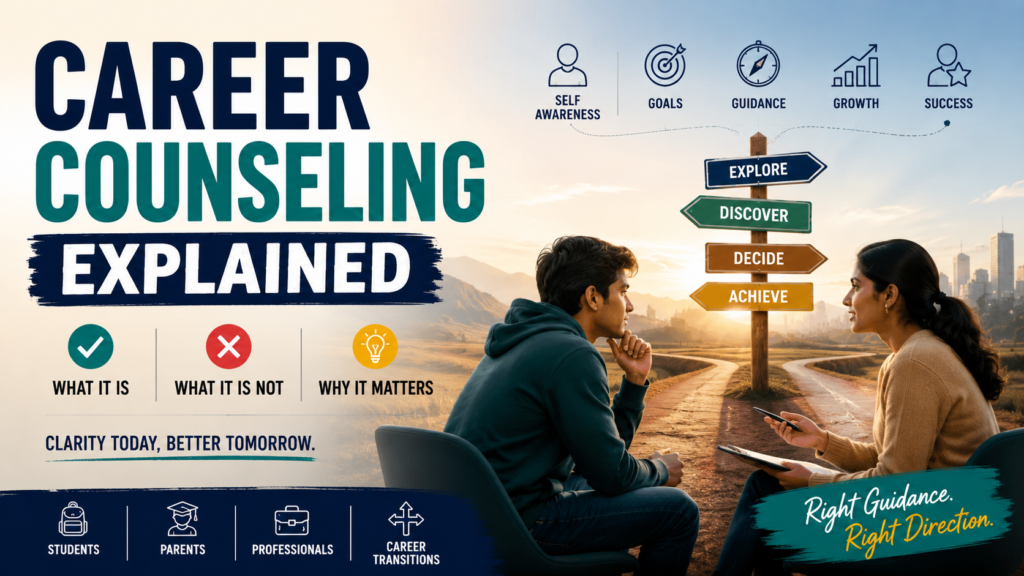
This article explains what genuinely structured career counseling actually involves, what it is not, and why the distinction matters enough to close this series with it. If the frameworks across the previous twenty articles felt useful individually, this article explains the practice that ties them together into something closer to real counseling than any single article could offer alone.
This is also the natural place in the series to be direct about something most articles in this genre avoid saying plainly: the goal of structured career counseling is not to replace the thinking this series has tried to teach you to do yourself. It is to support that same thinking with outside perspective, structure, and accountability you cannot fully provide for yourself, however carefully you work through it alone.
The Problem: A Field Defined by Its Worst Common Experience
Ask most people what career counseling involves, and the answer is usually some version of “a test that tells you what job to do.” This single, shallow experience — common in many Indian schools, delivered in twenty minutes with a printed verdict and no follow-up — has quietly defined an entire field’s reputation, despite being a poor representative of what structured, ongoing career counseling actually looks like when done well.
A second, opposite misconception has grown alongside the first: that career counseling, done properly, is something closer to open-ended therapy — vague, unstructured conversation with no concrete methodology at all. Neither extreme matches what this article describes.
Why This Matters Enough to Close This Series With It
Every framework introduced across this series — the Curiosity Audit, the Strengths Discovery Log, the Career Planning Framework, the Build vs. Join comparison, and every other tool along the way — is, in effect, one piece of what structured career counseling actually does across multiple sessions. Understanding the practice itself helps you recognize good counseling when you encounter it, and helps explain why a single test was never going to be enough.
The C.O.A.C.H Framework: What Real Career Counseling Does
- C — Clarify genuine self-understanding, beyond a single test result.
- O — Open the full range of options, beyond the visible, familiar few.
- A — Align strengths and interests with realistic, researched paths.
- C — Commit to a structured decision, with reasoning the person understands and owns.
- H — Hold the process accountable over time, through follow-up rather than a single session.
Clarify: Genuine Self-Understanding
Real career counseling builds genuine self-understanding from multiple sources — interests, strengths, values, and constraints — rather than from a single test result treated as a verdict. This is the same multi-signal logic behind our Strengths Discovery framework: a pattern across several signals is far more reliable than any one data point alone, including a single aptitude test score.
Open: The Full Range of Options
Good counseling widens the visible option set rather than confirming whichever path a student or family had already assumed. Across this series, the Range lens applied to Engineering, Medicine, Law, Social Sciences, Management, Data Science, and Public Service exists precisely because most people’s mental map of any field is narrower than its genuine reality — and a counselor’s job includes correcting that map, not simply validating it.
Align: Matching Strengths to Realistic Paths
Clarified self-understanding and a widened option set still need to be matched against each other honestly — which specific paths actually fit this specific person’s strengths, constraints, and goals. This synthesis step is where a counselor’s structured judgment adds real value beyond what a student could discover entirely alone, simply by having seen this matching process across many different individuals.
Commit: A Structured, Owned Decision
The goal of good counseling is never to hand down a verdict for the client to accept passively. It is to support a structured decision-making process — like the C.H.O.I.C.E or A.N.C.H.O.R frameworks introduced earlier in this series — so the eventual choice is genuinely understood and owned by the person making it, not simply received from an authority figure.
Hold: Accountability Over Time
A single session, however well run, cannot replace the kind of ongoing review built into our Career Planning Framework and Career Roadmap articles. Real counseling includes follow-up — checking in as circumstances evolve, adjusting the plan as new information arrives — rather than ending the relationship the moment a single report is handed over.
What Career Counseling Is Not
It is not a single aptitude test that outputs a final verdict in one sitting. It is not a substitute for the person’s own decision-making — a good counselor supports a decision rather than making it on someone else’s behalf. It is not the same as psychotherapy, though the two can overlap meaningfully when a client’s career stress connects to broader mental health concerns a counselor should recognize and, when appropriate, refer onward rather than attempt to address alone. It is not a guarantee of one single correct answer, since most genuine career decisions involve several viable options rather than one objectively right choice. And it is not a replacement for family conversation — as our companion article on parental influence makes clear, good counseling complements that conversation rather than bypassing it.
Each of these distinctions matters because each one corresponds to a way the field’s reputation gets quietly damaged — by a test mistaken for the whole process, by a verdict mistaken for support, by a single score mistaken for genuine self-understanding, and by a session mistaken for a substitute for the people who actually know the client best.
What It Is vs. What It Is Not
| What It Is | What It Is Not |
| A multi-session, structured process | A single test with a one-time printed report |
| Support for the client’s own decision | A verdict handed down for passive acceptance |
| Built on multiple, varied evidence sources | Built on one personality or aptitude score alone |
| Complementary to family conversation | A replacement for talking with family |
| Ongoing, with follow-up and review | A one-time event with no further contact |
A Worked Example
Consider a composite case drawn from recurring patterns across mentoring conversations, not one identifiable individual.
A student’s only prior experience of career guidance was a twenty-minute school aptitude test that recommended Engineering based on a single score, with no further conversation or follow-up. Years later, working through a structured engagement built on the C.O.A.C.H framework — a genuine Strengths Discovery process, a widened Range of options across several fields, a structured decision framework, and a scheduled follow-up review — the student arrives at a considerably better-fitted direction, not because the second process was magic, but because it actually did the five things real counseling is supposed to do, where the first one had only attempted the first, and incompletely at that.
The student later described the difference simply: the school test had told them an answer; the structured process had helped them build one, and could explain exactly why each piece of it fit, which the printed report from years earlier had never been able to do.
Common Mistakes People Make When Evaluating Career Counseling
- Judging the entire field based on one shallow, test-only school experience.
- Expecting a single session to produce a final, complete answer.
- Treating a counselor’s suggestion as a binding verdict rather than as structured input to a decision still genuinely yours.
- Assuming a free online quiz is equivalent to a structured, multi-session counseling process.
- Not asking a prospective counselor or program about their actual process before committing time or money to it.
Action Steps: How to Evaluate Career Counseling Before Committing
- Ask whether the process involves multiple sessions and genuine follow-up, or only a single test and report.
- Ask how the counselor widens your option set, not just whether they confirm a path you already had in mind.
- Ask whether you will leave with a written, structured plan you understand and can explain yourself.
- Ask what kind of follow-up or review is included after the initial engagement.
- If a single test is the entire offering, treat it as one data point to feed into a fuller process, not as the process itself.
Reflection Questions
- Has my own impression of career counseling been shaped by one limited experience rather than what the field can actually offer?
- If I sought counseling today, would I be looking for a verdict, or for structured support toward a decision I still make myself?
- Which of the five C.O.A.C.H steps have I already done for myself, working through this series, and which still feel incomplete?
Key Takeaways
- Real career counseling clarifies self-understanding, opens options, aligns strengths with realistic paths, supports a committed decision, and holds the process accountable over time.
- A single test with a printed report represents an incomplete version of this process, not its full definition.
- Good counseling supports your own decision rather than replacing it with someone else’s verdict.
- Counseling complements family conversation rather than bypassing it, consistent with our companion article on parental involvement.
- Evaluating a counselor or program by their actual process — not just their promised outcome — protects you from mistaking a shallow offering for a complete one.
Frequently Asked Questions
Is career counseling actually necessary, or can I work through this entirely on my own using free resources?
Many of the frameworks across this series can genuinely be self-applied with discipline, as this series itself demonstrates. Structured counseling adds the most value through outside perspective, accountability, and pattern recognition built from working with many different individuals — valuable, but not strictly required for every person.
How is real career counseling different from a single aptitude test?
An aptitude test produces one data point from one instrument. Structured counseling synthesizes multiple data points — interests, strengths, values, researched options, and ongoing review — of which a test result might be only one small input among several.
What should I realistically expect from a good first counseling session?
Expect genuine questions about your reasoning, interests, and constraints — not an immediate verdict. A good first session typically clarifies the actual decision in front of you and outlines a process, rather than delivering a final answer before genuinely understanding your situation.
Is career counseling worth the cost?
This depends on the specific program’s actual process, evaluated using the Action Steps above, rather than on the field in the abstract. A structured, multi-session, follow-up-inclusive process is worth meaningfully more than a single test, and pricing should be evaluated against which of those you are actually being offered.
At what age or stage should someone first seek career counseling?
Useful starting points exist at each major decision covered across this series — the Class 10 stream choice, the Class 12 course decision, and the post-graduation roadmap among them — though counseling can add value at any stage where a genuine decision, rather than a settled path, is in front of you.
What credentials or background should I look for in a career counselor?
Look for a demonstrated, structured process more than a specific credential alone — ask directly how they clarify self-understanding, how they widen the option set, and what kind of follow-up they provide. A counselor who can describe their actual methodology clearly is generally a stronger signal than a credential by itself, though relevant training and experience working with people in situations similar to yours both matter as well.
Conclusion
This series began with a single Class 10 student trying to choose a stream, and has worked through field after field, decision after decision, ending here: an explanation of the structured practice that each individual article has, in its own way, been modeling throughout. Career counseling, done well, is not a single test or a printed verdict. It is the same five things this series has tried to do across twenty-one articles — clarify, open, align, commit, and hold accountable — delivered as a genuine, ongoing process rather than a collection of standalone pieces.
If any part of this series gave you a clearer next step, that is what real career counseling is meant to do, simply concentrated into a structured relationship with someone trained to do it across many decisions, not just the one you happened to be facing when you found this article.
No single article, including this one, replaces that ongoing relationship entirely. What this series can offer is a clear sense of what to actually look for once you decide to seek it — and, just as importantly, the confidence to recognize when a single test and a printed page are being offered to you as something they were never built to be.
What to Do Next
The Career Clarity Workshop, the Career Clarity Masterclass course, and the Career Guidance & Life Design Program at Odia IITian Mentor are built to deliver exactly the structured, multi-session, follow-up-inclusive process described in this article. If you have worked through this series and still want a guided second perspective on your specific situation, that structured support is the natural next step.
About the Author
Prakash Chandra Mallick is a Senior Educator, Senior Development Professional, and PhD Scholar at IIT Patna, with prior academic training at TISS Mumbai and the University of Hyderabad. He founded Odia IITian Mentor to bring structured, evidence-based career guidance and civil services preparation to students across Odisha, with particular attention to first-generation learners and rural and Odia-medium students who are too often left out of mainstream career advice.
https://odiaiitianmentor.com/academy