Introduction
This article has been quietly waiting in the background of nearly every other piece in this series. Our Law article noted how legal training feeds civil services. Our Social Sciences article noted how Political Science and Economics align closely with the examination syllabus. Our Engineering article noted how a technical background opens specific public-sector routes. Public service sits at the convergence point of nearly every field this series has covered — which is exactly why it deserves its own dedicated, structural treatment rather than a single passing mention.
It is also where this author’s own professional life sits most directly, through years of public-development work culminating in a State Lead role at WASSAN Odisha. This article applies the same R.E.A.L framework used throughout this series, with the added benefit of writing from inside the field rather than only researching it from outside.
For readers of this series who have arrived here from one of the field-specific articles, this piece is meant as the convergence point — the place where an Engineering, Law, Economics, or Data Science background connects to a structured public-impact career, rather than a separate, unrelated topic.
The Problem: “Public Service” Collapses Into One Exam in Most Conversations
Ask most Indian families what a public service career means, and the answer arrives almost instantly: the IAS, reached through the UPSC Civil Services Examination. This is one genuinely strong route among several, not the definition of the entire field — and treating it as the only one creates exactly the kind of narrow, high-pressure fixation this series has warned against in nearly every other article.
The cost of this narrow view is specific and serious: aspirants who treat IAS-or-nothing as the only acceptable outcome often spend years on repeated attempts without seriously researching state civil services, technical services, or development-sector paths that could deliver a genuinely meaningful, impactful career considerably sooner.
Why This Matters Specifically for Odisha Aspirants
For readers of this series based in Odisha, the State Civil Services examination conducted by OPSC deserves equal serious consideration alongside the UPSC route, not as a lesser fallback but as a genuinely strong, often faster path into meaningful public administration work within the state. Our OAS From Zero Program exists specifically because this path deserves the same structured preparation respect that UPSC preparation typically receives by default.
The R.E.A.L Framework, Applied to Public Service
- R — Range: the genuine breadth of public-impact career tracks.
- E — Entry Path: how each track is actually accessed.
- A — A Day in the Life: what public service work actually involves, myths included.
- L — Long-Term Trajectory: where each track genuinely leads.
R: The Range Inside Public Service
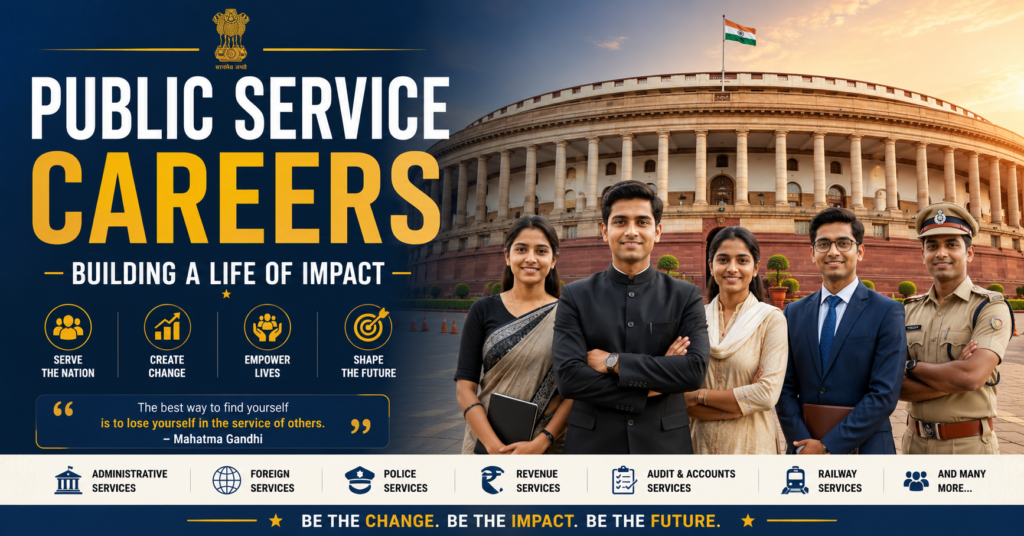
All India Services — the IAS, IPS, and IFoS among others — are accessed through the UPSC Civil Services Examination and offer postings across the country with the broadest administrative scope. State Civil Services, including Odisha’s OAS and allied state services through OPSC, offer a parallel, equally meaningful administrative career within the state, often with a faster preparation-to-selection timeline than the central route.
Technical and Engineering Services, accessed through the UPSC Engineering Services Examination, connect directly to our Engineering article — a public-service route built specifically for technical graduates. Judicial Services, connecting to our Law article, offer a public-service path through the judiciary. Beyond direct government employment, Public Sector Undertaking management and technical roles, policy and think-tank research positions, and development-sector and multilateral organization roles — this author’s own primary track — all serve genuine public impact without necessarily involving a traditional government recruitment exam at all.
E: How Each Track Is Actually Accessed
UPSC Civil Services and OPSC State Civil Services both follow a Prelims, Mains, and Interview structure, open to graduates of any stream, typically requiring one to several years of dedicated preparation — the exact territory our OAS From Zero Program is built to support. The UPSC Engineering Services Examination is restricted to engineering graduates and follows its own distinct technical syllabus.
PSU roles are typically accessed through GATE scores for technical positions or campus recruitment for management roles. Policy and think-tank positions are usually accessed through a Master’s in Public Policy, Economics, or a related social science, often combined with research experience. Development-sector and multilateral roles are typically accessed through a Master’s in Social Work or Development Studies, combined with field experience — the same route discussed in our Social Sciences article, and the one this author followed personally through TISS Mumbai and the University of Hyderabad.
A: A Day in the Life, Myths Included
The myth that all public service work is uniform, slow-paced desk work collapses considerably once you look at specific tracks. An early-career IAS or OAS officer in a district posting often faces unpredictable, high-pressure field responsibilities — law and order situations, disaster response, public grievance redressal — far removed from the calm, paper-pushing stereotype. Technical service officers oversee specialized engineering projects directly. Development-sector program officers spend significant time in the field, working directly with communities rather than behind a desk.
A second myth holds that public service guarantees a relaxed, predictable schedule. Many early-career postings, particularly at the district level across both All India and State Services, involve genuinely demanding and irregular hours, frequent transfers, and significant on-call responsibility — a reality worth knowing honestly before entering rather than discovering only after.
L: Where Each Track Genuinely Leads
All India Services progress toward senior state and eventually central secretariat-level postings, with possible deputation across central ministries over a career. State Civil Services progress through the state administrative hierarchy, with certain promotion routes into the IAS cadre itself for strong performers over time. Technical Services progress toward Chief Engineer-level technical leadership within government departments.
PSU careers progress toward Director and CMD-level leadership roles. Policy and think-tank careers progress toward senior fellow and policy advisory positions, sometimes moving between government and research roles across a career. Development-sector careers — this author’s own trajectory — progress from program-level roles toward state or country leadership positions, sector specialization, or senior multilateral organization roles.
Track Snapshot: A Starting Comparison
| Track | Entry Route | Typical Daily Work | Long-Term Path |
| All India Services | UPSC Civil Services Exam | Administration, field crisis response | Senior state/central secretariat roles |
| State Services (OAS) | OPSC State Civil Services Exam | State administration, public grievance work | Senior state bureaucracy, possible IAS promotion |
| Technical Services | UPSC Engineering Services Exam | Engineering project oversight | Chief Engineer-level leadership |
| Development Sector | MSW/MA Development Studies + fieldwork | Program management, community fieldwork | State/Country Lead, multilateral roles |
Common Myths Worth Retiring
- “Public service means the IAS, full stop.” The IAS is one strong route among several genuinely meaningful public-impact tracks.
- “State services like OAS are a lesser fallback compared to UPSC.” State Civil Services offer genuinely meaningful administrative careers, often with a faster preparation timeline.
- “All public service work is calm, slow-paced desk work.” Many early-career postings, across multiple tracks, involve demanding, unpredictable field responsibility.
- “Only the exam-based tracks count as real public service.” Policy, think-tank, and development-sector work serve genuine public impact without necessarily involving a traditional recruitment exam.
A Worked Example
Consider a composite case drawn from recurring patterns across mentoring conversations, not one identifiable individual.
An aspirant attempts the UPSC Civil Services Examination three times, fixated specifically on the IAS, while dismissing the OAS as a lesser option without genuine research. Applying the Honest Backup Planning principle from our Class 12 decision article — alongside a proper Range review from this one — surfaces OAS as a same-territory, faster-timeline option offering genuinely meaningful administrative work within Odisha specifically. Preparing for both examinations in parallel, using the shared foundation our OAS From Zero Program is built around, the aspirant secures an OAS posting two years sooner than a fourth or fifth UPSC attempt would likely have allowed, with a clear, well-researched path to a strong administrative career rather than years more spent waiting on one narrow outcome.
Common Mistakes Aspirants Make About Public Service Careers
- Fixating exclusively on the IAS while dismissing state services, technical services, or development-sector paths without genuine research.
- Treating non-exam public-impact careers, like policy research or development-sector work, as not “real” public service.
- Underestimating how demanding early-career postings can genuinely be, across nearly every track in this Range.
- Preparing for only one specific examination without a researched backup across a related track.
- Assuming a specific stream or degree is required, when most major public service examinations are open to graduates from any background.
Action Steps: Apply the R.E.A.L Framework to Public Service
- List the public service tracks in the Range section you have not yet researched against your own background and goals.
- If you are a UPSC aspirant, research the OPSC State Civil Services route as a genuine parallel option, not a fallback.
- If you have a technical or social-science background, check whether the Engineering Services or development-sector routes connect more directly to your existing training than the generalist IAS route.
- Talk to one person currently working in your target track about their actual daily reality, including its demanding aspects.
- Build a backup plan across a related track within the same broad Range, following the Honest Backup Planning principle from our Class 12 decision article.
Reflection Questions
- Have I researched state and technical services as genuinely, or only treated the IAS as the one acceptable outcome?
- Does my existing background — technical, legal, or social-science — point toward a specific public-service track I have not yet seriously considered?
- Am I prepared for the genuinely demanding, unpredictable early-career reality of my target track, or only its calmer long-term image?
Key Takeaways
- Public service spans All India Services, State Services, Technical Services, PSUs, policy research, and development-sector work — a genuinely wide Range, not one single exam.
- State Civil Services like Odisha’s OAS deserve equal serious consideration alongside UPSC, not treatment as a lesser fallback.
- Early-career public service work, across multiple tracks, is often more demanding and field-intensive than the calm-desk-job stereotype suggests.
- Policy, think-tank, and development-sector careers serve genuine public impact without necessarily requiring a traditional recruitment examination.
- A researched backup plan across a related track protects years that a single fixed exam fixation often costs.
Frequently Asked Questions
Is OAS a genuinely good alternative to IAS, or just a consolation prize?
A genuine, strong alternative — OAS offers meaningful state administrative work, a faster typical preparation timeline, and, for strong performers, a real promotion route into the IAS cadre over time. Treating it as a consolation prize undersells a career path with its own significant impact and respect.
How many attempts at UPSC or OPSC are reasonable before considering a different track?
There is no universal number, but the Honest Backup Planning principle applies here as it does throughout this series: build a genuine parallel plan after your first attempt, not your third or fourth, so continued attempts remain a deliberate choice rather than the only path you have prepared for.
Can engineering graduates pursue public service careers directly related to their technical background?
Yes, directly, through the UPSC Engineering Services Examination, which is built specifically for technical graduates and leads toward senior technical leadership roles within government departments — a path distinct from, and often less crowded than, the generalist civil services route.
Is development-sector or policy work financially viable as a long-term public-impact career?
It can be, though compensation varies considerably by organization and seniority, similar to the variation discussed in our Government vs Private comparison. Senior roles within established NGOs, multilateral organizations, and government-linked development programs can offer genuinely competitive long-term compensation alongside the public-impact work itself.
Do I need a specific degree to pursue most public service examinations?
Most major examinations, including UPSC and OPSC Civil Services, are open to graduates from any stream or discipline. Technical Services and Judicial Services are the clear exceptions, requiring an engineering or law background respectively.
What is the real difference between joining government service and joining the development sector for public impact?
Government service carries formal administrative authority and the structural stability of public employment, while development-sector work typically offers more flexibility in scope and organization but depends on project and funding cycles rather than permanent government appointment. Both genuinely serve public impact; the choice depends on whether you value formal administrative authority or programmatic flexibility more in your own working style.
Conclusion
Public service deserves to be understood as a genuinely wide field, not a single examination with one acceptable outcome. All India Services, State Services, Technical Services, PSUs, policy research, and development-sector work each offer a real, structurally different route toward the same underlying goal many aspirants describe simply as wanting to build a life of impact.
Apply the R.E.A.L framework to the specific track that genuinely fits your background and goals, and you may find — as this author’s own career reflects directly — that the path to genuine public impact was wider than the single exam most family conversations reduce it to.
Of every field this series has covered, this is the one where the destination — a life of genuine impact — matters more than the specific route taken to reach it.
What to Do Next
The OAS From Zero Program, OAS Foundation Workshop, and OAS From Zero Handbook at Odia IITian Mentor are built specifically to support the State Civil Services route discussed throughout this article. The Career Exploration Handbook is a strong starting point if you are still mapping which specific public service track fits your background.
About the Author
Prakash Chandra Mallick is a Senior Educator, Senior Development Professional, and PhD Scholar at IIT Patna, with prior academic training at TISS Mumbai and the University of Hyderabad. He founded Odia IITian Mentor to bring structured, evidence-based career guidance and civil services preparation to students across Odisha, with particular attention to first-generation learners and rural and Odia-medium students who are too often left out of mainstream career advice.