
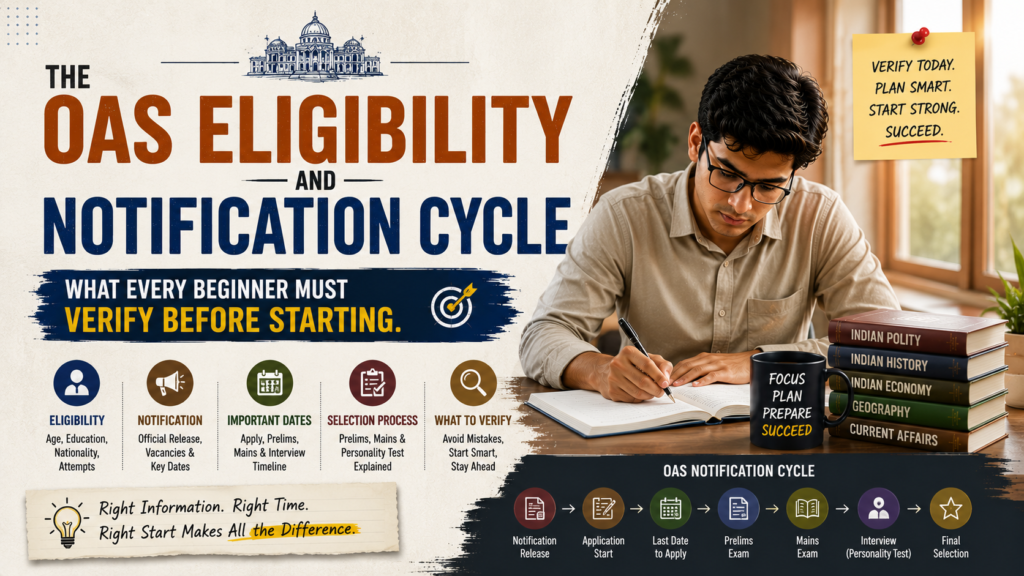
Introduction:
Before choosing a single book, before building a single study schedule, every beginner faces a question that sounds trivial but is answered incorrectly more often than you might expect: am I actually eligible, and when does the process actually begin? Months of preparation built on second-hand, outdated, or simply mistaken eligibility information is a genuinely common and entirely avoidable failure mode, and this article exists specifically to prevent it.
This article will not attempt to state specific current age limits, qualification requirements, or notification dates as fixed facts, because doing so would risk giving you exactly the kind of unreliable, potentially outdated information this article is built to warn against. Instead, it gives you the structural understanding and the verification habit you need to find and interpret the real, current, official rules correctly yourself.
This may feel like an unusual way to open an article — pointing you toward a source rather than simply telling you the answer — but that is precisely the discipline this specific topic actually requires. Eligibility is one of the few areas in this entire series where second-hand summary, however well-intentioned, is genuinely not good enough.
The Problem: Second-hand Information Treated as Authoritative
A coaching institute’s marketing page, a forwarded message from a friend, or last year’s notification all feel like reasonable sources of eligibility information, and all of them can be outdated, simplified to the point of inaccuracy, or simply wrong for your specific situation. Eligibility criteria — age limits, educational qualifications, category-based relaxations, permitted number of attempts — are set out precisely in each cycle’s official OPSC notification, and only that document is the authoritative source for your specific attempt.
The cost of relying on second-hand information runs in both directions. An aspirant who is actually eligible might wrongly believe otherwise, based on an inaccurate second-hand claim, and abandon a genuine opportunity unnecessarily. An aspirant who is not actually eligible, or no longer eligible due to a missed cutoff date, might continue preparing for months under a false assumption of eligibility, discovering the problem only when it is far too costly to address.
Neither outcome is rare, and both are entirely preventable through one simple habit applied consistently from the very start: treating the official notification, read carefully and directly, as the single source of truth for this specific question.
The C.H.E.C.K Framework
- C — Confirm the Official Source
- H — Honor the Exact Cutoff Date
- E — Examine Every Eligibility Category
- C — Check Your Specific Category’s Relaxations
- K — Keep Re-Checking Each Cycle
C: Confirm the Official Source
Treat the current cycle’s official OPSC notification as the only authoritative source for your eligibility, and treat every other source — coaching pages, forwarded messages, online forums, even well-meaning advice from someone who attempted a previous cycle — as a starting pointer to check, never as a final answer in itself. This single habit, applied consistently, prevents the majority of eligibility confusion before it ever has a chance to take root.
H: Honor the Exact Cutoff Date
Eligibility for criteria like age is typically assessed as of a specific date stated explicitly in the notification, which is often not the same as the date you submit your application or the date of the exam itself. This specific cutoff date is one of the most commonly misunderstood details in the entire eligibility process, and confusing it with a different date can lead to a genuinely incorrect eligibility assessment, in either direction.
E: Examine Every Eligibility Category
Eligibility is typically assessed across several distinct categories at once — age, educational qualification, nationality or domicile requirements, and permitted number of attempts among them. Many aspirants check only the one category that happens to concern them most, such as age, while overlooking that another category, like a specific educational qualification clause, might also apply directly to their situation in ways they had not considered.
C: Check Your Specific Category’s Relaxations
Reserved categories, persons with disabilities, ex-servicemen, and certain other defined groups frequently receive specific relaxations to the general eligibility criteria, varying by category and sometimes by the specific provision in question. If you belong to any category that might receive such a relaxation, look up the relevant clause specifically rather than assuming the general criteria, intended for unreserved candidates, automatically applies to you without modification.
K: Keep Re-Checking Each Cycle
Eligibility criteria, notification timing, and the broader application process can all be revised between cycles, sometimes in small ways and occasionally in more significant ones. Never assume that a previous cycle’s notification, even one you read carefully and correctly at the time, remains accurate for a later cycle without re-checking the current document directly.
Understanding the Notification Cycle
Beyond eligibility itself, beginners frequently misunderstand the broader rhythm of the process — how much time typically separates the notification’s release from the actual examination stages, and how long the full cycle, from initial notification through final selection, tends to run. This rhythm varies and should always be confirmed against current and recent official notifications directly, but understanding that a substantial gap typically exists between notification and the final outcome helps set realistic expectations for how long meaningful preparation genuinely requires.
A useful habit for any beginner: locate not just the current notification, but two or three recent previous ones as well, and read through their overall timeline structure side by side. This gives you a realistic sense of the cycle’s general rhythm without requiring you to treat any single past cycle’s specific dates as a guaranteed prediction for your own.
This same comparative reading also reveals something else worth noticing: whether recent cycles have followed a fairly consistent rhythm or whether timing has shifted noticeably from one cycle to the next. Either pattern is useful information, but only if you actually look for it rather than assuming, by default, that whatever happened most recently will simply repeat unchanged.
Eligibility Categories: What to Check and Where
| Eligibility Category | What to Check | Where to Verify |
| Age | Minimum and maximum limits, and the exact cutoff date | Current official OPSC notification |
| Educational Qualification | Exact wording of the required qualification clause | Current official OPSC notification |
| Nationality / Domicile | Any specific residency or domicile requirements | Current official OPSC notification |
| Category-Based Relaxations | Specific provisions for your own applicable category | Current official OPSC notification |
| Number of Attempts | Permitted attempts and any category-based variation | Current official OPSC notification |
Common Myths Worth Retiring
- “Eligibility rules are the same every year, so I don’t need to recheck.” Criteria and timelines can be revised between cycles, sometimes meaningfully.
- “A coaching institute’s eligibility page is just as reliable as the official notification.” Only the current official notification is fully authoritative for your specific cycle.
- “If my exact degree isn’t named on a list I saw online, I’m definitely ineligible.” Educational qualification clauses are often broader than informal lists suggest; check the precise official wording.
- “The application date is what matters for age eligibility, not a separate cutoff date.” A distinct, explicitly stated cutoff date typically governs age eligibility, not the application or exam date.
- “Eligibility relaxations only apply to a few obvious categories.” Multiple distinct categories may carry specific relaxations; check every one that might apply to your situation.
A Worked Example
Consider a composite case drawn from recurring patterns across mentoring conversations, not one identifiable individual.
An aspirant reads an older coaching institute blog post stating a general age limit, concludes they are already ineligible, and nearly abandons the idea of pursuing OAS entirely without checking any further. A direct check of the current official notification reveals a specific, applicable relaxation category the blog post had never mentioned at all, one the aspirant genuinely qualified for based on their own background — meaning eligibility had never actually been the real obstacle the second-hand source had suggested.
A second aspirant, in a related pattern, assumes a specific named degree is required based on an informal online list, and incorrectly believes their own qualification does not count. Checking the actual notification’s educational qualification clause directly reveals considerably broader wording than the informal list had implied, resolving a concern that had caused real, unnecessary anxiety for weeks before it was finally checked at the source.
Both cases share the same underlying lesson: the anxiety and uncertainty in each situation came not from the actual eligibility rules themselves, but from relying on an intermediate, second-hand interpretation of those rules instead of going directly to the one document that could have resolved the question in minutes.
Common Mistakes Beginners Make With Eligibility and Notifications
- Relying on coaching institute pages, forwarded messages, or informal lists instead of the current official notification.
- Confusing the application date or exam date with the actual, separately stated eligibility cutoff date.
- Checking only the eligibility category that feels most personally relevant, while overlooking others that may also apply.
- Assuming general eligibility criteria apply unmodified to a category that actually carries its own specific relaxation.
- Treating a previous cycle’s notification as a reliable, unchanged source for the current cycle without re-verifying it directly.
Action Steps: Apply the C.H.E.C.K Framework This Week
- Locate the current official OPSC notification directly, rather than relying on any second-hand summary of it.
- Identify the exact eligibility cutoff date stated in that notification, and confirm it against your own situation precisely.
- Work through every distinct eligibility category listed — age, education, nationality or domicile, attempts — rather than only the one that concerns you most.
- If you belong to any category eligible for a specific relaxation, locate and read that exact provision directly.
- Read through two or three recent previous notifications to build a realistic sense of the broader cycle’s typical rhythm.
Reflection Questions
- Have I personally verified my own eligibility against the current official notification, or am I relying on a secondhand source?
- Do I know the exact eligibility cutoff date that applies to me, and have I confirmed it directly?
- Have I checked every eligibility category that might apply to my specific situation, not just the one I assumed mattered most?
Key Takeaways
- The current official OPSC notification is the only fully authoritative source for your specific eligibility, not coaching pages or informal secondhand summaries.
- Eligibility cutoff dates are typically distinct from application or exam dates, and confusing them is a common, consequential mistake.
- Multiple eligibility categories apply simultaneously — age, education, nationality or domicile, attempts — and each deserves individual verification.
- Category-based relaxations can meaningfully change your actual eligibility position, and deserve specific, direct verification if they might apply to you.
- Eligibility criteria and notification timing can change between cycles, making re-verification each cycle a genuine necessity, not excessive caution.
Frequently Asked Questions
Where exactly should I check official eligibility criteria?
The official OPSC notification for your specific, current exam cycle is the authoritative source, typically published directly on OPSC’s own official channels. Always confirm you are reading the current cycle’s document, not an older one that may no longer apply.
How often does eligibility criteria actually change between cycles?
This varies and is not something to assume stable by default — some cycles see little change, others see meaningful revisions, which is precisely why re-checking the current notification directly each cycle matters regardless of what you might recall from a previous one.
What if I’m unsure which eligibility category I fall under?
Read the relevant sections of the current notification carefully and, if genuine uncertainty remains after doing so, contact OPSC directly through their official channels for clarification rather than relying on informal guesses or secondhand interpretations from others who may be equally unsure.
How far in advance is the notification typically released relative to the actual examination?
This varies by cycle, and reviewing two or three recent previous notifications side by side, as suggested in this article, gives a more realistic, evidence-based sense of typical timing than relying on a single remembered figure or someone else’s general impression.
What should I do if I think I might be borderline-eligible or ineligible?
Verify directly against the current official notification first, and if genuine ambiguity remains even after a careful direct reading, reach out to OPSC’s official channels for clarification rather than either assuming the worst and abandoning a genuine opportunity, or assuming the best and proceeding on an unverified hope.
Conclusion
The very first step of OAS preparation is not opening a textbook. It is confirming, directly and carefully against the current official notification, that you are genuinely eligible, understanding exactly which cutoff date governs that eligibility, and building a realistic sense of how the broader notification cycle actually moves. Skipping this step in favor of secondhand information is one of the most avoidable, and most consequential, mistakes a beginner can make.
Do this verification work once, carefully and directly at the source, and every other decision covered throughout this OAS From Zero series can proceed on a foundation of genuine certainty rather than secondhand assumption.
What to Do Next
Our companion article on the first ninety days for beginner aspirants picks up directly from this verification step, once your own eligibility is genuinely confirmed. The OAS From Zero Program at Odia IITian Mentor helps aspirants interpret the current official notification correctly as a structured first step.
About the Author
Prakash Chandra Mallick is a Senior Educator, Senior Development Professional, and an Executive PhD Scholar at IIT Patna, with prior academic training at TISS Mumbai and the University of Hyderabad. He founded Odia IITian Mentor to bring structured, evidence-based career guidance and civil services preparation to students across Odisha, with particular attention to first-generation learners and rural and Odia-medium students who are too often left out of mainstream career advice.