
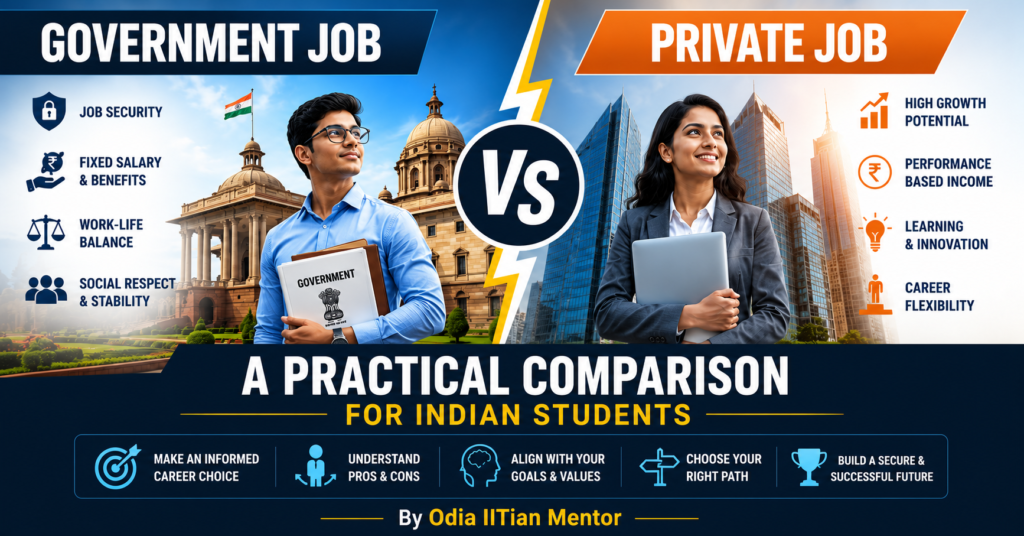
Introduction
Few career debates in India carry as much emotional weight as this one. A government job is often spoken of as the destination itself — proof of a settled life — while a private job is framed as either the route to real wealth or a source of constant insecurity, depending on who in the family is speaking.
Underneath all that emotion is a genuinely practical question that deserves a genuinely practical answer: which path actually fits your goals, your risk tolerance, and the kind of work you want to be doing ten years from now? This article sets the emotion aside and compares the two paths structurally.
This is not an argument for one side. Both paths produce successful, satisfied professionals, and both produce people who chose for the wrong reasons and spent years feeling stuck. The difference usually comes down to whether the choice was made structurally or by default.
This article is written specifically for Indian students and graduates standing at that fork, often for the first time facing a decision their parents’ generation experienced very differently — when government roles were comparatively more dominant and private-sector opportunity, particularly outside a few metro cities, was considerably more limited than it is today.
The Problem: This Debate Usually Runs on Slogans, Not Specifics
“Government job means security.” “Private job means more money.” Both slogans contain a grain of truth and a great deal of oversimplification. Security in government roles varies considerably by service and level. Compensation in private roles varies enormously by sector, company, and individual performance — far more than any single slogan can capture.
Most students absorb these slogans from family conversation long before they have any real information about either path, and then spend years preparing for one without ever structurally testing whether it actually fits them.
Why This Comparison Deserves More Care Than It Usually Gets
A government career path, particularly through competitive examinations like OAS or UPSC, often demands one to several years of dedicated preparation before the first salary arrives at all. A private career path demands a different kind of early investment — building specific, marketable skills and navigating a less predictable hiring process.
Choosing without genuine structural comparison risks years spent preparing for a path that does not actually fit your strengths or goals — either years of competitive exam preparation for a role that, once secured, does not satisfy you, or years job-hopping in the private sector without ever building the depth that would have made a government path’s stability genuinely valuable to you.
The Four-Lens Career Comparison
This framework compares government and private careers across four practical dimensions, each weighted differently depending on what actually matters to you.
- Lens 1 — Stability & Security
- Lens 2 — Growth & Compensation
- Lens 3 — Work-Life & Autonomy
- Lens 4 — Preparation Cost & Timeline
Lens 1: Stability & Security
Government roles generally offer strong job security once secured — removal is difficult and rare outside serious misconduct, and the role itself is largely insulated from market cycles, company performance, or a change in leadership.
Private-sector security has genuinely shifted over the past decade. Layoffs that once felt rare in certain sectors are now a recognized risk even at large, well-regarded companies. That said, private-sector security is not uniformly poor — it depends heavily on the specific company, sector, and how in-demand your particular skill set is at any given time. A skilled professional in a growing field often experiences more practical security than the slogan “private jobs are insecure” suggests.
Lens 2: Growth & Compensation
Government compensation typically follows a structured, predictable scale with periodic revisions, along with benefits like pension structures and allowances that add real value beyond the headline salary figure. Growth in seniority and responsibility tends to follow a known, time-based progression.
Private-sector compensation has a much wider range — it can exceed government compensation substantially in high-demand fields and senior roles, or fall well below it in saturated or low-demand roles. Growth can be considerably faster than the government track for strong performers, but it is far less guaranteed and depends heavily on company performance, market conditions, and individual visibility within an organization.
Lens 3: Work-Life & Autonomy
This lens varies the most by specific role on both sides, which makes blanket claims especially unreliable here. Some government postings, particularly in field or district administrative roles, involve demanding hours and significant public-facing responsibility. Others offer more predictable, structured working hours than most private roles.
Private-sector work-life balance similarly ranges from genuinely flexible, output-focused environments to high-pressure, always-on cultures, often within the same city and even the same industry. Researching the specific role and organization matters far more here than researching “government” or “private” as a category.
Lens 4: Preparation Cost & Timeline
Government roles secured through competitive examinations typically require one to several years of dedicated preparation, often without income during that period, plus the very real possibility of needing multiple attempts. This upfront cost — in time, money for preparation resources, and emotional toll — is substantial and deserves honest acknowledgment rather than being treated as a minor footnote.
Private-sector entry typically involves a shorter and more immediate preparation-to-income timeline, though it usually demands ongoing skill development throughout the career rather than a single intensive preparation phase upfront. The trade-off is between concentrated early effort with a delayed but structured payoff, and faster entry with a less predictable, more continuously demanding path.
Side-by-Side Summary
| Lens | Government | Private |
| Stability & Security | High once secured; largely market-insulated | Variable; depends on company, sector, and skill demand |
| Growth & Compensation | Structured, predictable, with benefits beyond salary | Wider range; can exceed or fall below government scale |
| Work-Life & Autonomy | Ranges by posting; some highly demanding, some structured | Ranges by company culture; varies even within one industry |
| Preparation Cost | High upfront; 1+ years, possibly multiple attempts | Lower upfront; ongoing skill-building required throughout |
The PSU Middle Ground
Public Sector Undertakings deserve treatment as a genuine third category rather than being folded into either “government” or “private” by default. Many PSUs offer the structured stability and benefit packages closer to government roles, combined with compensation, work environments, and growth structures that can resemble well-run private organizations in some cases.
Entry into PSUs varies by organization — some require competitive examinations similar in spirit to government services, others recruit more like private companies through campus placements and direct hiring. If your Four-Lens Comparison leaves you genuinely torn between government and private, researching specific PSUs relevant to your field is worth doing before assuming you must choose one extreme or the other.
Common Myths Worth Retiring
- “Private jobs always pay more.” True for some roles and sectors, false for many others — compensation comparisons need to be role-specific, not category-wide.
- “Government jobs mean low effort.” Many government roles, particularly in field administration and law enforcement, are demanding in ways an office-bound private role is not.
- “Government job security is absolute.” Security is very high but not absolute, and varies somewhat by service and conduct; treating it as a guarantee against all circumstances is inaccurate.
- “You can’t move from private to government later, or vice versa.” Many professionals do exactly this, in both directions, though each move comes with its own preparation and adjustment cost worth planning for honestly.
A Worked Example
Consider a composite case drawn from recurring patterns across mentoring conversations, not one identifiable individual.
A graduate with a strong, stable temperament and a genuine interest in public administration spends two years preparing for OAS while working a modest private job on the side to stay financially afloat. Running the Four-Lens Comparison honestly during this period — rather than only after securing or failing to secure the role — confirms a strong fit: the Stability and structured Growth lens matches the candidate’s actual risk tolerance, and the Preparation Cost, while real, is one the candidate had planned for financially and emotionally in advance, rather than discovering partway through.
A second, contrasting composite case involves a graduate with strong technical skills and a genuine appetite for fast-moving, less structured environments, who nonetheless begins OAS preparation primarily because of sustained family pressure. The Four-Lens Comparison, applied honestly, reveals a mismatch on Lens 3 specifically — the candidate’s actual temperament fits the autonomy and faster feedback loops of a private, skills-driven role far better than the structured pace of most government postings. Naming this mismatch early, rather than discovering it after two or three exam attempts, allows a redirection toward a private-sector path that the family eventually came to support once the reasoning was laid out clearly.
Common Mistakes Students Make in This Decision
- Choosing a path based on family slogans about security or money, without checking those slogans against the specific role being considered.
- Starting multi-year exam preparation without first running an honest Four-Lens Comparison against personal temperament and goals.
- Assuming private-sector instability applies equally across every company and sector, rather than researching the specific employer.
- Underestimating the real financial and emotional cost of multi-year government exam preparation, and being unprepared for it.
- Treating the decision as permanent and binary, rather than recognizing that movement between the two paths, while costly, is genuinely possible.
Action Steps: How to Apply This Comparison
- Write one honest sentence under each of the four lenses for both government and private paths, specific to your own temperament and goals.
- If leaning government, calculate the realistic financial and time cost of your preparation period, and confirm you can sustain it.
- If leaning private, research two to three specific companies or sectors rather than relying on general impressions of “private jobs.”
- Talk to one person currently in each path about their actual day-to-day reality, not just their decision to join.
- Revisit this comparison alongside the Career Decision Handbook before fully committing your next one to two years.
Reflection Questions
- Which of the four lenses matters most to me personally, and which government or private reality actually serves that lens best?
- Am I leaning toward this path because of genuine fit, or because of a slogan I absorbed without testing it?
- Could I honestly sustain the preparation cost of my preferred path, financially and emotionally, for as long as it might realistically take?
Key Takeaways
- Government and private careers each offer genuine strengths and real trade-offs — neither is universally superior.
- Stability, growth, work-life balance, and preparation cost all vary by specific role and organization, not just by category.
- Multi-year government exam preparation carries a real, often underestimated cost that deserves honest planning.
- Movement between government and private paths is possible in both directions, though never without its own adjustment cost.
- A structural comparison, run honestly against your own temperament, beats inherited family slogans every time.
Frequently Asked Questions
Is a government job still worth pursuing given how competitive exams have become?
Worth depends on genuine fit, not competition level alone. For a candidate whose temperament and goals align with Lenses 1 and 2 above, the competition is a real but manageable cost. For a candidate without that underlying fit, even a successful outcome often leads to dissatisfaction a few years in.
How long does government exam preparation realistically take?
This varies by exam and individual, but a realistic range for serious, well-structured preparation is one to three years, often including more than one attempt. Treat any plan that assumes success on the first attempt as a best-case scenario, not a baseline expectation.
Is it better to try a private job first and government roles later, or the reverse?
Both sequences work for different people. Starting private first can build financial stability and real-world skills that later support government preparation; starting government preparation first avoids the risk of private-sector habits and lifestyle making the preparation period harder to sustain. The right sequence depends on your financial situation and risk tolerance, not a universal rule.
How does a PSU job compare to a typical government or private role?
Public Sector Undertakings often sit between the two — many PSUs offer government-like stability and structured growth, combined with compensation and work environments closer to the private sector in some cases. They are worth evaluating as a distinct third category rather than assuming they behave exactly like either extreme.
What if I genuinely cannot decide between the two paths?
Indecision after an honest Four-Lens Comparison usually means the two paths are genuinely close for you, not that you have failed to think clearly. In that situation, a reversible first step — such as a private role with negotiated time for limited exam preparation alongside it — is often a more practical resolution than continuing to deliberate without acting.
Does where I live in Odisha change this comparison?
Location affects the private-sector side of this comparison more than the government side. Private-sector opportunity in specialized or high-growth fields is still concentrated in a smaller number of cities, which can mean relocation is part of the private path for many Odisha-based graduates. Government and PSU roles, by contrast, often involve postings across the state or country regardless of where you currently live, which changes the nature of the location question rather than removing it entirely.
Conclusion
Government and private careers are not a contest with one correct winner. They are two genuinely different shapes of working life, each with real strengths and real costs that depend heavily on the specific role, not just the category. The Four-Lens Comparison will not make this decision for you, but it will replace inherited slogans with an honest look at what you are actually choosing between.
That honesty is worth more, over a working lifetime, than any single piece of family advice repeated without examination.
What to Do Next
If you are leaning toward a government career path, the Government Career Navigator course and the OAS From Zero Program at Odia IITian Mentor map the specific preparation timeline and cost in detail. If you are still weighing both paths honestly, pair this comparison with the Career Decision Handbook to turn it into an actual decision rather than continued deliberation.
About the Author
Prakash Chandra Mallick, Sr. Educator, Sr. Development Professional and PhD Scholar at IIT Patna, with prior academic training at TISS Mumbai and the University of Hyderabad. He founded Odia IITian Mentor to bring structured, evidence-based career guidance and civil services preparation to students across Odisha, with particular attention to first-generation learners and rural and Odia-medium students who are too often left out of mainstream career advice.