Introduction:
If your current Mains structure includes an optional subject paper, you are facing one of the highest-leverage, least-reversible early decisions in your entire preparation. Many aspirants choose this subject based on rumor about which one “scores well,” peer pressure from friends preparing alongside them, or simple familiarity from their college years, without ever applying a genuinely structured decision process to a choice that will shape a meaningful share of their study time for the next year or more.
Exam structures are periodically reformed, and whether an optional subject paper is currently part of the OAS Mains structure, and exactly how it is weighted, should always be confirmed directly against the current official OPSC notification before you proceed. This article assumes that structure exists for your specific cycle and focuses on how to choose well within it.
Even readers whose current exam structure does not include a separate optional subject paper will likely find the underlying decision logic useful, since similar trade-offs — genuine interest versus secondhand reputation, overlap with required content versus standalone depth — apply to other significant preparation choices covered elsewhere in this series.
The Problem: Choosing on Rumor Instead of Structured Evidence
Two equally incomplete approaches dominate how aspirants actually choose an optional subject. Some choose almost entirely on rumor — a specific subject reputed to be “scoring well” this cycle — without checking whether that reputation reflects genuine, current evidence or simply repeated secondhand claims passed between aspirants. Others choose almost entirely on comfort and familiarity, picking whatever they studied in college, without checking how that choice interacts with scoring efficiency, syllabus overlap, or the genuine availability of guidance and material.
Neither approach alone produces a well-reasoned choice. A structured framework, drawing on several distinct factors at once, produces a considerably more defensible decision than either rumor or pure comfort alone.
This decision also tends to arrive earlier in preparation than most aspirants feel ready for it, often before they have built enough self-knowledge or research depth to choose confidently — which is precisely why a structured framework matters more here than it might for a decision made later, with more accumulated context already available.
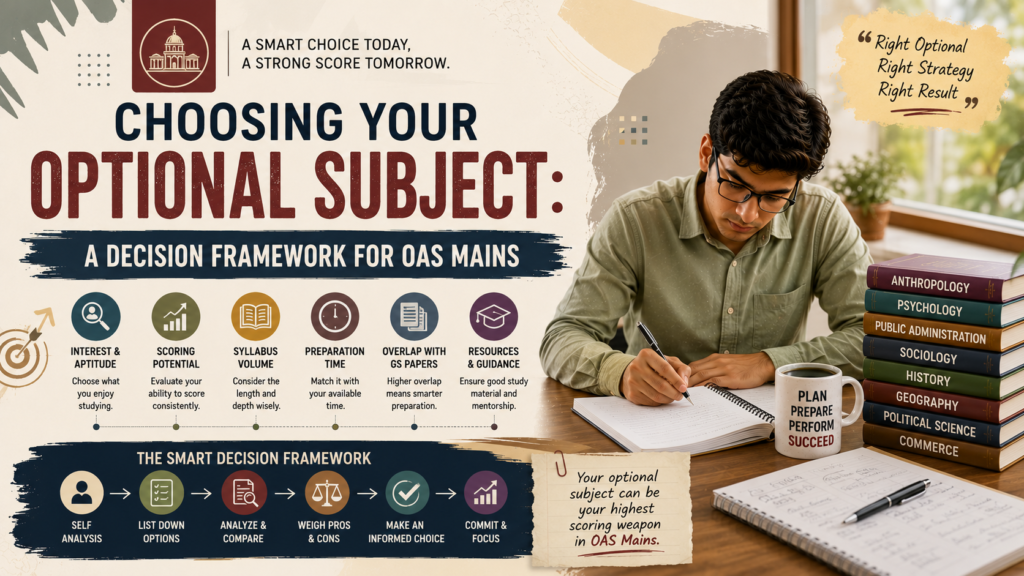
The S.E.L.E.C.T Framework
- S — Study the Syllabus Overlap
- E — Evaluate Genuine Interest and Background Fit
- L — Look at Material and Mentor Availability
- E — Estimate the Competition and Risk Profile
- C — Confirm Scoring Patterns Through Your Own Research
- T — Test Your Choice Before Fully Committing
S: Study the Syllabus Overlap
Some optional subjects overlap meaningfully with content you are already studying for General Studies papers, creating genuine preparation efficiency — material studied once supports two different papers. Others sit almost entirely separate from your General Studies preparation, requiring dedicated, additional study time with little crossover benefit. Map this overlap explicitly for each option you are considering, rather than assuming it either does or does not exist.
E: Evaluate Genuine Interest and Background Fit
This connects directly to the S.T.R.O.N.G strengths framework covered earlier in this series — genuine interest and background fit sustain motivation across the many months a serious optional subject preparation actually requires. A subject chosen purely for its reputed scoring potential, with no real underlying interest, often produces weaker sustained engagement than a subject with genuine personal connection, even if the second subject’s reputation is less widely discussed.
This factor matters more for an optional subject than for almost any other preparation decision in this series, simply because of the sheer depth and duration required — a year or more of sustained engagement with the same subject matter is a considerably larger commitment than a single study technique or revision habit, and genuine interest is what tends to carry an aspirant through the inevitable difficult stretches within it.
L: Look at Material and Mentor Availability
Some optional subjects have abundant, well-organized study material and easily available coaching or mentor guidance. Others are comparatively niche, with limited structured resources, requiring you to build more of your own preparation infrastructure from scratch. This is not necessarily a reason to avoid a niche option entirely, but it is a real cost worth weighing honestly against the subject’s other advantages.
E: Estimate the Competition and Risk Profile
A widely popular optional subject typically means more available guidance and more known preparation patterns, but also a larger pool of well-prepared competitors aiming for the same top scoring band. A niche optional subject typically means less available support, but potentially less competition for distinguishing performance. Neither profile is universally better; the right choice depends on your own risk tolerance and how much independent preparation infrastructure you are willing and able to build yourself.
C: Confirm Scoring Patterns Through Your Own Research
Rather than accepting secondhand claims about which optional subjects “score well,” apply the same PYQ-style intelligence approach from our companion article on previous year questions to whatever historical information is genuinely and reliably available about optional-subject outcomes. Treat any specific scoring-pattern claim, including ones repeated confidently by peers or coaching marketing, as something to verify through your own research rather than accept directly.
Where reliable, current data genuinely is not available, treat this factor as inconclusive rather than substituting an unverified rumor in its place — an honest “I don’t have reliable evidence either way” is a more useful conclusion than a confident-sounding claim that turns out to rest on nothing more solid than repeated hearsay.
T: Test Your Choice Before Fully Committing
Before fully committing significant preparation time, spend a focused trial period — a few weeks working through an introductory unit of your leading candidate subject — to confirm the genuine interest and fit you expect actually holds up once you are inside the material, not just considering it from the outside. This small, deliberate test is considerably cheaper than discovering a poor fit many months into full preparation.
Optional Subject Selection at a Glance
| S.E.L.E.C.T Factor | Key Question to Ask | How to Investigate It |
| Syllabus Overlap | Does this subject overlap with my GS preparation? | Compare the optional’s syllabus directly against your GS syllabus map |
| Interest and Fit | Do I have genuine, sustained interest in this subject? | Apply the S.T.R.O.N.G strengths framework honestly |
| Material Availability | Is quality material and guidance genuinely available? | Search for structured resources and mentor access directly |
| Competition and Risk | How does this subject’s popularity affect my realistic odds? | Weigh your own risk tolerance against available support |
A Worked Example
Consider a composite case drawn from recurring patterns across mentoring conversations, not one identifiable individual.
An aspirant chooses an optional subject almost entirely because several peers describe it as “the scoring subject this cycle,” without checking genuine personal interest, syllabus overlap, or independently verifying the scoring claim itself. After several months, motivation noticeably lags, the subject feels disconnected from the rest of preparation, and progress slows considerably despite real effort.
Applying the S.E.L.E.C.T framework before too much time has been invested, the aspirant identifies a different subject connecting directly to their own educational background, with meaningful overlap into an already-studied General Studies area. A focused trial period confirms genuine engagement holds up once inside the actual material, not just in the abstract. Switching while the cost of doing so remains manageable, the aspirant reports considerably stronger sustained motivation and a more efficient use of overall study time across both the optional and the overlapping General Studies content.
The aspirant’s own retrospective comment was telling: the original rumor about scoring potential may well have been accurate for some other candidate with a genuinely strong fit for that subject. The actual problem was never the rumor’s accuracy in general — it was applying someone else’s reported result to a personal situation that had never actually been checked for fit.
Common Myths Worth Retiring
- “There is one objectively best optional subject for everyone.” The right choice depends on your specific interest, background, and risk tolerance, not a universal ranking.
- “Popular optionals always score better than niche ones.” Popularity affects available support and competition level, not a guaranteed scoring advantage.
- “Switching your optional subject is always too costly to consider.” An early switch, before significant time has been invested, is often far less costly than persisting with a poor-fit choice for many additional months.
- “Your optional subject doesn’t matter as much as the General Studies papers.” Where an optional subject paper exists in the current structure, it typically contributes meaningfully to final marks and deserves comparable strategic attention.
- “Choosing based on what scored well for a friend guarantees the same result for you.” Individual fit, preparation depth, and execution matter as much as the subject itself.
Common Mistakes Aspirants Make When Choosing an Optional Subject
- Choosing based primarily on secondhand rumor about scoring potential, without independent verification.
- Ignoring genuine syllabus overlap with General Studies preparation, missing real efficiency.
- Selecting a subject with little available material or guidance without weighing that cost honestly.
- Committing fully without any trial period to confirm genuine interest holds up inside the actual material.
- Persisting with a poor-fit choice long after the signs of mismatch have become clear, out of reluctance to switch.
Action Steps: Apply the S.E.L.E.C.T Framework This Week
- List your top two or three candidate optional subjects and map each one’s syllabus overlap with your General Studies preparation.
- Run the S.T.R.O.N.G strengths framework against each candidate to check genuine interest and fit honestly.
- Research the actual availability of structured material and mentor guidance for each option.
- Independently verify any scoring-pattern claim you have heard, rather than accepting it directly from secondhand sources.
- Spend one focused week working through an introductory unit of your leading candidate before fully committing.
Reflection Questions
- Have I chosen my optional subject based on genuine, structured evaluation, or mainly on rumor and peer pressure?
- Does my chosen subject meaningfully overlap with my General Studies preparation, or sit entirely separate from it?
- If I am already several months into a specific optional subject, does my actual engagement and progress still support that original choice?
Key Takeaways
- Optional subject choice deserves a structured framework, not rumor or pure comfort alone.
- Syllabus overlap with General Studies preparation creates real efficiency worth deliberately checking for.
- Genuine interest and background fit sustain the motivation a long preparation cycle actually requires.
- Popularity and niche status each carry real trade-offs in available support and competition level, with no universally correct answer.
- A short trial period before full commitment is a low-cost way to confirm genuine fit before significant time is invested.
Frequently Asked Questions
How do I check syllabus overlap between an optional subject and General Studies myself?
Place both syllabi side by side and look for shared themes, topics, or skills — a social science optional might overlap considerably with governance or society-related General Studies content, for instance. Building this comparison yourself, rather than relying on someone else’s general claim, ensures it reflects the actual current syllabi accurately.
Is it ever too late to switch optional subjects?
There is no universal cutoff, but the cost of switching grows considerably the further into preparation you are. A switch made within the first few months, while the sunk cost remains modest, is usually far less risky than persisting for a full year with a poor-fit subject.
Should I choose based on coaching or material availability alone?
Availability matters but should be weighed alongside genuine interest and syllabus overlap, not treated as the single deciding factor — strong material support for a poorly-fitting subject rarely outweighs the sustained motivation cost of genuine mismatch.
Does optional subject choice still apply to the current OAS Mains structure?
Always confirm this directly against the current official OPSC notification before proceeding, since exam structures are periodically reformed and an optional subject paper’s presence, format, and weighting can change between cycles.
How many aspirants typically choose niche subjects versus popular ones?
This varies by cycle and subject and is not something to assume based on general impression — if available, genuine current enrollment or scoring data, verified directly rather than through rumor, gives a more reliable picture than a secondhand guess.
Conclusion
Choosing an optional subject deserves the same structured, evidence-based approach this series has applied to every other major preparation decision — not the rumor and peer pressure that too often drives this specific choice instead. Genuine interest, syllabus overlap, material availability, competition profile, and independently verified scoring evidence together produce a considerably more defensible decision than any single factor alone.
Test your leading choice before fully committing, and treat an early correction as a reasonable, low-cost adjustment rather than a failure — far better than discovering a poor fit many months into a commitment that grows more costly to reverse with every additional month invested.
This is, in the end, simply the same evidence-based discipline this entire OAS From Zero series asks you to apply everywhere else, brought to bear on one of the earliest and most consequential choices you will make.
What to Do Next
Revisit our companion article on the S.T.R.O.N.G strengths framework to apply it specifically to your optional subject candidates, and pair this decision with the PYQ intelligence approach from our companion article on previous year questions. The OAS From Zero Program at Odia IITian Mentor offers structured guidance for working through this exact decision.
About the Author
Prakash Chandra Mallick is a Senior Educator, Senior Development Professional, PhD Scholar at IIT Patna, with prior academic training at TISS Mumbai and the University of Hyderabad. He founded Odia IITian Mentor to bring structured, evidence-based career guidance and civil services preparation to students across Odisha, with particular attention to first-generation learners and rural and Odia-medium students who are too often left out of mainstream career advice.