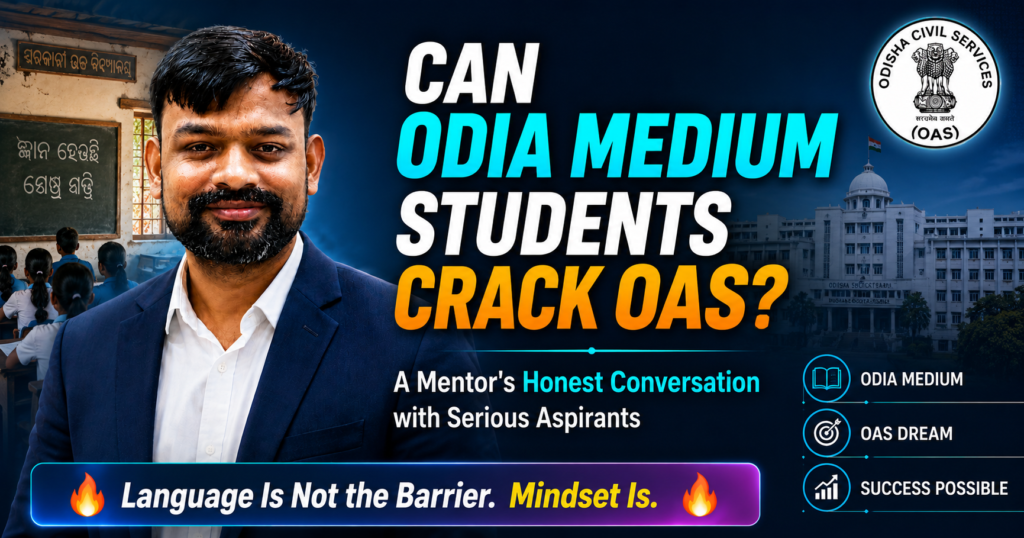
Can Odia Medium Students Crack OAS? This is perhaps the most common question I hear from aspirants across Odisha.
The Question Nobody Wants to Ask Out Loud
There is a question that sits quietly inside the minds of thousands of aspirants across Odisha — in the villages of Koraput and Kalahandi, in small towns of Balasore and Bargarh, in rented rooms near Bhubaneswar coaching hubs, and in government college hostels from Sambalpur to Berhampur.
The question is not written in any syllabus. It does not appear in any mock test paper. But it is perhaps the most consequential question a serious aspirant will ever face:
“Can students like me actually crack OAS?”
I have been interacting with OAS and OPSC aspirants for several years now. And I can tell you with certainty: this silent fear destroys more careers than poor preparation does. Students who lack intelligence rarely fail this examination. Students who lack belief in themselves fail it far more often.
So before we talk strategy, syllabus, or answer-writing, I want to address this foundational question directly — not with motivational slogans, not with coaching institute marketing language, but with the honest, uncomfortable, experience-driven truth that I wish someone had told aspirants five years earlier.
https://odiaiitianmentor.com/blog
The Ground Reality of OAS Aspirants : What the Data and the Classrooms Tell Us
Let me begin with something concrete. Every year, a meaningful number of OAS successful candidates come from Odia-medium educational backgrounds, from rural districts, from state government colleges, and from financially struggling families. They are not anomalies. They are not lucky exceptions. They are proof of a pattern.
The Odisha Public Service Commission (OPSC) examination, whether we are discussing OAS (Odisha Administrative Service) or OCS (Odisha Civil Services) more broadly, is designed to test a specific combination of qualities: knowledge depth, analytical reasoning, awareness of current affairs, administrative understanding, and communication. Notice what is absent from that list: English accent, urban sophistication, and expensive coaching.
Yet when I sit with aspirants — particularly those from smaller towns and Odia-medium schools — I consistently see one thing: they have underestimated themselves even before the preparation seriously begins. They have already accepted a narrative that this examination belongs to someone else. Someone more polished. Someone more connected. Someone more urban.
That narrative is false. And it is costing Odisha some of its most potentially capable administrators.
What Actually Happens Inside Preparation Cycles
I have observed a clear and repeating pattern across multiple batches of aspirants. Students from English-medium urban backgrounds often have a head start in terms of reading speed, comprehension fluency, and general awareness. But — and this is critical — that head start is largely mechanical and it erodes with sustained preparation.
What does not erode — what in fact grows stronger over time — is the emotional resilience, lived understanding of social realities, and patient discipline that many rural and Odia-medium aspirants bring naturally to this process. The student who has seen genuine hardship up close understands poverty, governance failure, and community life in a way that no textbook can teach. These same qualities show up powerfully in essay writing, ethics papers, and especially in the OPSC interview.
The OPSC selection process ultimately looks for someone who can be a good administrator — someone with judgment, empathy, awareness, and character. Those qualities do not come with an English-medium certificate.
Common Mistakes Odia Medium Aspirants Make (And Why They Make Them)
Having worked closely with aspirants across different backgrounds, I have noticed several recurring mistakes that disproportionately affect students from Odia-medium and rural backgrounds. These mistakes are not born of laziness or lack of intelligence. They are born of a distorted understanding of what this examination actually demands.
Mistake 1: Treating Language as the Core Problem
This is the most common and most damaging confusion. An Odia-medium aspirant begins preparing for OAS and immediately decides that the first task is to become fluent in English. So they spend months on spoken English courses, vocabulary apps, and grammar books — while the actual OPSC syllabus sits untouched.
Here is the truth: the OAS examination does not reward English fluency. It rewards clarity of thought expressed in reasonably correct written English. These are fundamentally different things. A student who writes clear, logically structured, factually accurate answers in simple English will consistently outscore a student who writes elaborate, vocabulary-heavy answers that lack analytical depth.
Language is a tool, not the destination. Improve it gradually, in parallel with content preparation — not instead of it.
Mistake 2: The Comparison Trap
Social media has made this problem significantly worse. Aspirants see toppers from prestigious backgrounds discussing their preparation on YouTube and Instagram. They see polished, articulate people discussing Odisha current affairs with apparent ease. And slowly, unconsciously, they begin to believe that preparation is supposed to look and sound like that.
It is not. Preparation happens in silence, in consistency, in daily revision. The aspirant sitting in a small room in Phulbani with basic study materials and genuine discipline is often better prepared than the aspirant in Bhubaneswar who is subscribed to fifteen YouTube channels but cannot write a coherent 300-word answer.
Stop measuring your preparation by comparing it to others’ presentations. Measure it by your own depth, consistency, and improvement.
Mistake 3: Waiting to Feel Ready
This is a quieter mistake, but extremely destructive. Many aspirants spend months — sometimes years — in what I call the “pre-preparation phase”. They are collecting books, organizing notes, deciding on a strategy, following different mentors, and generally preparing to prepare. The actual preparation never really begins.
The psychology behind this is the fear of failure. If you never truly begin, you never truly fail. But this is an illusion. Every month spent in the pre-preparation phase is a month of actual preparation lost. The OAS examination has age limits. It has attempt limits. Time is the one resource that never comes back.
Mistake 4: Neglecting Answer Writing Practice
The OPSC examination is fundamentally a writing examination. The Preliminary stage has MCQs, but the Mains examination demands sustained, structured written expression across multiple papers over multiple days. I cannot overstate how many aspirants — especially from Odia-medium backgrounds — do extensive content preparation but almost zero writing practice.
They can discuss a topic intelligently in conversation. But when they sit with a pen and answer sheet, the thoughts scatter, the structure collapses, and the time runs out. This is a skill gap that only writing practice can close. No amount of reading compensates for it.
What Actually Works: The Honest Framework
After years of observation, interaction, and analysis, I have developed a clear view of what actually determines success in OPSC OAS preparation, particularly for students coming from non-elite backgrounds. It is not complexity. It is not sophistication. It is a set of fundamentals applied with unusual consistency.
Foundation: Redefine What Success in This Exam Looks Like
The OAS preliminary examination tests general knowledge across a broad OPSC syllabus. The Mains tests analytical writing, depth of knowledge, and the ability to present arguments. The interview tests personality, awareness, and administrative temperament. None of these stages reward the person who merely sounds impressive. They reward the person who is genuinely prepared.
Genuinely prepared means: you have covered the syllabus systematically, you have revised it multiple times, you can write structured answers under time pressure, you follow Odisha and national current affairs consistently, and you have thought seriously about administrative and ethical questions.
That preparation is entirely achievable from any background.
Practical Framework: A Year-by-Year Strategy for Odia Medium Aspirants
Phase 1: Foundation Building (Months 1–6)
This phase is about building the infrastructure of your preparation, not about covering maximum content. Start with the OPSC syllabus document itself. Read it carefully. Understand what each paper demands. Map it to the standard reference materials.
For language improvement: begin reading one English article daily. Not for vocabulary memorization — for comprehension and flow. The Hindu, Down to Earth, and Odisha government reports are excellent sources. Write a brief 4–6 line summary after each article. This single habit, maintained for six months, produces measurable improvement in both reading comprehension and writing confidence.
For current affairs: begin following Odisha-specific news systematically. The governance decisions of the state government, schemes for tribal welfare, agriculture policy, infrastructure development, and social challenges like migration and malnutrition are themes that appear consistently in OAS Mains and interview. As an Odia-medium student, you often understand these realities more deeply than you realize. Begin connecting what you know from lived experience to what the syllabus demands.
Phase 2: Content Depth and Writing Practice (Months 7–15)
By the second half of your first year, content coverage should be well underway. More importantly, answer writing must become a daily practice. Begin with short 150-word answers. Focus on structure: introduction, body with two or three clear points, a brief conclusion. Do not worry about language quality initially. Focus on structure and relevance.
One of the most effective exercises I recommend: take any topic from Odisha’s governance landscape — MGNREGA implementation in Kalahandi, tribal rights under PESA in Sundargarh, the Jaga Mission in urban slums — and write a 300-word administrative analysis. This builds both writing skill and Odisha-specific content simultaneously.
Optional subject selection also happens in this phase. Odia-medium students should seriously consider Odia Literature as an optional subject in OPSC OAS Mains if it is available and if their undergraduate background supports it. The depth of cultural and literary understanding that Odia-medium students bring to this subject can be a genuine competitive advantage. Do not dismiss it simply because English-medium peers do not take it.
Phase 3: Revision, Mock Tests, and Interview Mindset (Months 16–24)
Revision is where most aspirants lose the examination even after excellent content preparation. Human memory is not linear. Information covered six months ago fades. A systematic revision schedule — weekly for recent topics, monthly for older topics — is essential.
Mock tests serve two functions: they simulate examination pressure, and they reveal gaps. Analyze your mock test performance not just for score, but for patterns. Are you consistently weak in Odisha geography? In Indian polity concepts? In answer structure? Each weakness is a specific, addressable problem — not a reflection of your overall capability.
For the OPSC interview preparation: begin thinking about your DAF (Detailed Application Form) background seriously. Your village, your district, your educational institutions, your family background — these are not embarrassments to be hidden. They are assets to be understood and articulated thoughtfully. An interview board does not want a performer. They want a genuine human being with self-awareness and administrative understanding.
A Mentor’s Perspective: The Hidden Strengths You Haven’t Counted
I want to be direct with you about something that coaching institutes rarely say, because it does not serve their marketing interests.
Odia-medium students, rural aspirants, and first-generation learners bring specific strengths to this examination that many urban, English-medium aspirants genuinely lack. These are not consolation prizes. They are real, measurable advantages in the right contexts.
The first is social groundedness. An aspirant who has grown up in a village in Mayurbhanj or Nabarangpur understands what water scarcity means at 5 AM. They understand what the absence of a paved road means for a pregnant woman traveling to a hospital. They understand what a government school teacher’s role means in a community where no other educated adult is present. This understanding, when expressed with clarity and structure in essay writing and in the interview, is extraordinarily powerful.
The OPSC interview board consists of senior administrators and academicians. They are not looking for someone who can recite policy frameworks with a polished accent. They are looking for someone who actually understands what administration means in the lives of real people. Rural aspirants, if they have done their preparation, often speak to this understanding more authentically than any coaching institute can teach.
The second strength is emotional resilience. Long competitive preparation — the kind that OAS/OCS demands across one, two, sometimes three or more years — is as much a psychological challenge as an intellectual one. Students who have grown up navigating genuine hardship have often developed a tolerance for delayed gratification, uncertainty, and persistent effort that is genuinely harder to cultivate artificially.
I have seen aspirants from privileged backgrounds crumble under examination pressure and self-doubt. I have seen aspirants from struggling rural families persist with a quietness and determination that eventually produces extraordinary results. The examination does not reward your starting point. It rewards your finishing discipline.
Action Steps for Aspirants Starting Their OAS/OPSC Preparation Today
Concrete, immediate steps matter more than elaborate plans. Here is what I would tell any Odia-medium or rural aspirant sitting down to take OAS preparation seriously for the first time:
Step one: Download the OPSC OAS syllabus today. Read it completely. Do not read it to memorize it — read it to understand the territory you are preparing to cover. Every section of the OPSC syllabus maps to standard, accessible study materials. You do not need to own a library. You need to understand the map.
Step two: Begin one English article daily. Not a chapter. Not a course. One article. Summarize it in six lines afterward. This is your language improvement program for the first three months. Simple, consistent, measurable.
Step three: Start a current affairs notebook specifically for Odisha. Every week, write five important developments in Odisha — governance, social issues, economy, environment, culture. By the end of three months, you will have a richly annotated, personally constructed current affairs resource that no coaching material can replicate, because it reflects your own understanding.
Step four: Write one practice answer every single day. Start with 150 words. Use a timer. Do not edit while writing. Review after. The goal is not perfection — the goal is the habit. OPSC answer writing is a learned skill, and like all skills, it responds only to practice.
Step five: Find two or three fellow aspirants for accountability — not for comparison. Share your daily progress. Discuss current affairs. Review each other’s answers. Isolation is one of the greatest threats to long preparation journeys. Community, even a small one, provides the accountability that sustains consistency.
Final Thoughts: The Answer to the Question You Were Afraid to Ask
Can Odia-medium students crack OAS?
Yes. Unambiguously, empirically, and repeatedly, yes.
But not by pretending the challenges do not exist, and not by waiting for the day they feel ready enough or polished enough or fluent enough. The preparation journey itself is what builds those qualities. You do not prepare until you are ready. You prepare until you are transformed.
The OPSC OAS examination is designed to identify administrators who can serve the people of Odisha with competence, integrity, and genuine understanding. There is nobody better positioned to understand the people of Odisha than someone who has grown up among them, in their language, in their reality, in their daily struggles and quiet dignities.
Your Odia-medium background is not a starting disadvantage. It is a different kind of starting asset. The question is whether you will recognize it, develop it, and bring it forward with preparation and discipline into the examination hall.
The journey ahead is long. It will test your patience, your confidence, your self-belief, and your consistency in ways you cannot fully anticipate today. But it is a journey that is open to you — not despite your background, but sometimes because of it.
Begin today. Begin imperfectly. Begin from wherever you are.
Odisha needs administrators who understand her. And Odisha’s children — especially those who grew up without advantage — have exactly that understanding within them.
With best wishes for your journey,
Prakash Chandra Mallick
PhD Scholar, IIT Patna | Alumnus of TISS Mumbai & University of Hyderabad
Senior Development Professional | Educator
Odia IITian Mentor — Guidance for OAS | Competitive Exams | Career Growth | Student Transformation
For more information: https://odiaiitianmentor.com/