
Introduction
Open almost any student’s notebook during exam season and you will find the same revision method: re-reading notes from the top, highlighter in hand, page after page. It feels productive. It is also, according to a large body of learning research, one of the least effective ways to actually retain material for an exam — and one of the most popular anyway, precisely because it feels so much like progress.
This article builds a revision system based on what genuinely works, picking up directly from the focus capacity our previous article addressed, since a revision system without the attention to sustain it accomplishes very little.
This distinction — between revision that feels productive and revision that genuinely works — is one of the most consequential gaps in this entire series, simply because nearly every other study technique covered elsewhere depends on the same underlying material actually being retained long enough to use.
The Problem: Familiarity Gets Mistaken for Mastery
Re-reading notes repeatedly produces a specific, well-documented illusion: the material starts to feel familiar, and that feeling of familiarity gets mistaken for genuine retention. The student closes the notebook feeling confident, then discovers in the exam hall that recognizing a fact while looking at it is a completely different skill from recalling it without any prompt in front of them.
This fluency illusion is not a personal failing — it is a predictable, well-studied pattern that affects nearly everyone using passive review methods, which is exactly why a deliberately structured alternative matters so much.
Recognizing this pattern in your own habits is the first real step toward fixing it, since most students who fall into it are not lazy or careless — they are simply following the same default method everyone around them appears to be using.
Why a Real System Beats More Hours of the Same Method
Adding more hours to an ineffective method produces more hours of the same illusion, not meaningfully better retention. The fix is not more time spent re-reading; it is a different underlying method, built on techniques that research consistently shows outperform passive review for genuine long-term retention.
This matters most precisely where the stakes are highest — multi-year preparation for examinations like OAS or ASO, where the sheer volume of syllabus material makes an inefficient revision method especially costly. A method that wastes even twenty percent of study time on low-yield re-reading compounds into months of lost ground across a full preparation cycle.
The S.P.A.C.E Framework
- S — Spaced Intervals
- P — Practice Testing
- A — Active Reconstruction
- C — Cycle Through Subjects
- E — Evaluate and Adjust
S: Spaced Intervals
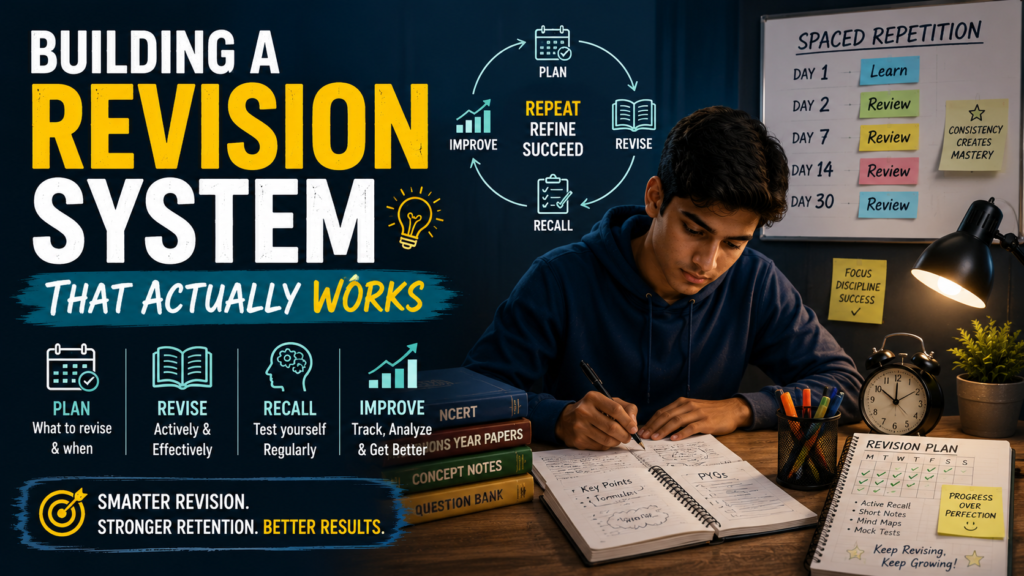
Material reviewed once and then left alone fades from memory at a predictable rate — the well-established “forgetting curve” pattern. Revisiting that same material at increasing intervals — a day later, then a week later, then a month later — interrupts this fade at exactly the point memory would otherwise weaken, strengthening retention far more efficiently than reviewing the same material repeatedly within a single cramming session.
This is the single most consistently supported finding in learning science covered across this series: spacing review sessions over time outperforms concentrating the same total review time into one sitting, even when the total hours invested are identical.
P: Practice Testing
Testing yourself on material — through practice questions, flashcards, or simply trying to recall key points without looking — produces measurably stronger retention than re-reading the same material an equivalent number of times. This technique, often called active recall, works precisely because it requires effortful retrieval, the same mental action an actual exam demands, rather than passive recognition.
The discomfort of practice testing — the moment of genuinely not knowing an answer — is not a sign it is not working. It is the mechanism by which it works; effortful, sometimes uncomfortable retrieval is what strengthens the memory trace, while comfortable re-reading leaves it largely unchanged.
Practice testing also produces an immediate, practical side benefit beyond retention itself: it tells you, in real time, exactly which topics need more work, rather than leaving you to guess based on how confident a recent re-read happened to feel.
A: Active Reconstruction
Beyond simple recall questions, actively reconstructing material from memory — writing out an explanation, redrawing a diagram, or teaching a concept aloud without notes — forces a deeper level of processing than re-reading ever requires. Errors that surface during this reconstruction point precisely to the specific gaps worth targeted further review, which passive re-reading never reveals.
C: Cycle Through Subjects
Reviewing one subject in a long, unbroken block — common in student revision schedules — feels organized but typically produces weaker long-term retention than cycling between two or three subjects within the same study session, a technique known as interleaving. Switching between related but distinct material forces the brain to actively discriminate between concepts rather than coasting through one familiar block.
This often feels less smooth in the moment than blocked study, which is part of why students underuse it — the discomfort of switching is, again, a sign the technique is working, not a sign it is inefficient.
A practical starting point is modest: rather than reorganizing an entire study plan around interleaving immediately, simply alternate between two related subjects within a single revision session and observe how recall differs afterward compared to a single-subject block.
E: Evaluate and Adjust
Track which topics you can genuinely reconstruct from memory under test-like conditions, separately from which topics simply feel familiar after a recent re-read. This evaluation step is what protects the rest of the system from quietly sliding back into the fluency illusion this article opened with.
Adjust your spacing intervals and practice-testing frequency based on this honest evaluation — topics that consistently test well can move to longer intervals, while topics that keep failing genuine recall tests need more frequent, more active review, not simply another re-read.
A Sample Spaced Revision Schedule
A simple way to apply Spaced Intervals to any topic, once it has first been learned.
| Review 1 | Review 2 | Review 3 | Review 4 |
| 1 day after learning | 3 days after Review 1 | 7 days after Review 2 | 14-21 days after Review 3 |
Each successful recall at a given interval earns a longer gap before the next review; a failed recall resets to a shorter interval, following the same Evaluate and Adjust principle described above.
This same simple logic scales to an entire syllabus once it becomes a habit, rather than a special technique reserved for a few difficult topics.
Common Myths Worth Retiring
- “Highlighting and re-reading notes is revision.” These produce a feeling of familiarity that is frequently mistaken for genuine retention.
- “More hours of revision automatically means better retention.” More hours spent on an ineffective method produce more of the same weak result, not proportionally stronger memory.
- “If the material feels familiar, I’ve learned it.” Familiarity reflects recognition, not the effortful recall an actual exam will demand.
- “Revising one subject in a long block is more efficient than mixing subjects.” Interleaving between subjects typically produces stronger long-term retention, despite feeling less smooth in the moment.
A Worked Example
Consider a composite case drawn from recurring patterns across mentoring conversations, not one identifiable individual.
A student preparing for a competitive examination spends several hours daily re-reading and highlighting notes, reporting high confidence heading into a scheduled mock test. The mock test result contradicts that confidence sharply, with several topics that had felt thoroughly reviewed producing blank recall under test conditions — a textbook instance of the fluency illusion this article opened with.
Switching to the S.P.A.C.E framework, the student replaces re-reading with practice testing and active reconstruction, spaces review sessions across increasing intervals rather than cramming each subject in one sitting, and begins cycling between two subjects per session instead of completing one entirely before starting the next. The next mock test, covering largely the same syllabus, shows a measurable improvement — not because more hours were added, but because the hours were finally being spent on methods that produce genuine retention rather than a comfortable feeling of having reviewed.
The student also reported a less obvious benefit: knowing in advance which topics had passed a genuine recall test and which had not removed much of the pre-exam anxiety that had previously come from an unclear, uneasy sense of “have I actually learned this or not.” The evaluation step had replaced that uncertainty with an honest, specific answer for every topic.
Common Mistakes Students Make When Revising
- Relying primarily on re-reading and highlighting, mistaking the resulting familiarity for genuine retention.
- Cramming all review of a topic into one sitting rather than spacing it across increasing intervals.
- Avoiding practice testing because it feels uncomfortable or reveals gaps, rather than recognizing that discomfort as the mechanism that strengthens memory.
- Blocking entire study sessions around one subject rather than cycling between related subjects.
- Never honestly evaluating which topics are genuinely retained versus merely familiar from a recent re-read.
Action Steps: Apply the S.P.A.C.E Framework This Week
- Replace your next re-reading session with a practice-testing session on the same material and compare how each feels.
- Build a simple spaced schedule for one topic using the Day 1 / Day 3 / Day 7 / Day 14 pattern above.
- Choose two related subjects and cycle between them within a single study session instead of blocking one subject entirely.
- After each review session, honestly separate topics you can reconstruct from memory from topics that only feel familiar.
- Adjust your next review interval for each topic based on that honest evaluation, not on how comfortable the last session felt.
Reflection Questions
- How much of my current revision relies on re-reading and highlighting versus genuine self-testing?
- Have I mistaken familiarity with material for actual retention at any point recently?
- Am I cramming each subject into one long block, or spacing and cycling my review across sessions?
Key Takeaways
- Re-reading and highlighting produce a feeling of familiarity that is frequently and predictably mistaken for genuine retention.
- Spacing review across increasing intervals outperforms cramming the same total review time into one sitting.
- Practice testing and active reconstruction outperform passive review by requiring effortful, exam-like retrieval.
- Interleaving between subjects, despite feeling less smooth, typically produces stronger long-term retention than blocked study.
- Honest evaluation — separating genuine recall from mere familiarity — protects a revision system from sliding back into the fluency illusion.
Frequently Asked Questions
How far in advance of an exam should structured revision begin?
Earlier than most students assume, since spaced intervals require real calendar time to work — beginning structured revision only in the final week or two leaves no room for the spacing this system depends on. For a multi-month syllabus, revision is generally most effective when it begins alongside initial learning, not after it ends entirely.
Is re-reading ever useful at all?
It has a limited, early role — a first pass to refresh context before practice testing — but it should not be the primary or final revision method for any topic you need to genuinely retain under exam conditions.
How do I build a spaced repetition schedule without using an app?
A simple paper or spreadsheet log, noting the date of each review and the next scheduled date based on whether recall succeeded or failed, works perfectly well — the schedule in this article requires no special software, only consistent tracking.
Does handwriting notes during revision help compared to typing them?
Many students find handwriting forces slower, more active processing than typing, which can support the kind of active reconstruction this framework emphasizes — though the more important factor is whether the activity requires genuine recall and reconstruction, regardless of which specific medium is used.
Should revision differ for numerical subjects compared to theory-heavy subjects?
The underlying principles — spacing, practice testing, active reconstruction — apply to both, though practice testing for numerical subjects typically means solving fresh problems rather than recalling facts, while theory subjects lean more on reconstructing explanations and arguments from memory.
How do I revise for a subject with an enormous amount of factual content, like general knowledge or current affairs?
Break the material into smaller, taggable chunks rather than treating it as one undifferentiated mass, and apply the same spaced practice-testing cycle to each chunk separately. High-volume factual subjects benefit especially from frequent, brief practice-testing sessions rather than occasional long re-reading sessions, since the sheer quantity of discrete facts makes the fluency illusion particularly easy to fall into.
Conclusion
A revision system that actually works rarely looks like the comfortable, familiar process most students default to. It looks like spaced intervals instead of cramming, effortful practice testing instead of passive re-reading, and honest evaluation instead of comfortable familiarity — each one slightly less smooth in the moment, and each one considerably more effective by the time the actual exam arrives.
Build the S.P.A.C.E framework into your existing study routine deliberately, and the gap between feeling prepared and actually being prepared narrows considerably.
The discomfort this system introduces is not a flaw to work around — it is the clearest available signal that genuine learning, rather than a comfortable illusion of it, is actually taking place.
What to Do Next
The Revision Handbook and the Revision Systems Workshop at Odia IITian Mentor go further into building this exact system for your specific syllabus. Our companion article on why most students fail at revision looks more closely at the specific failure patterns this framework is built to correct.
About the Author
Prakash Chandra Mallick is a Senior Educator, Senior Development Professional, and PhD Scholar at IIT Patna, with prior academic training at TISS Mumbai and the University of Hyderabad. He founded Odia IITian Mentor to bring structured, evidence-based career guidance and civil services preparation to students across Odisha, with particular attention to first-generation learners and rural and Odia-medium students who are too often left out of mainstream career advice.