Introduction
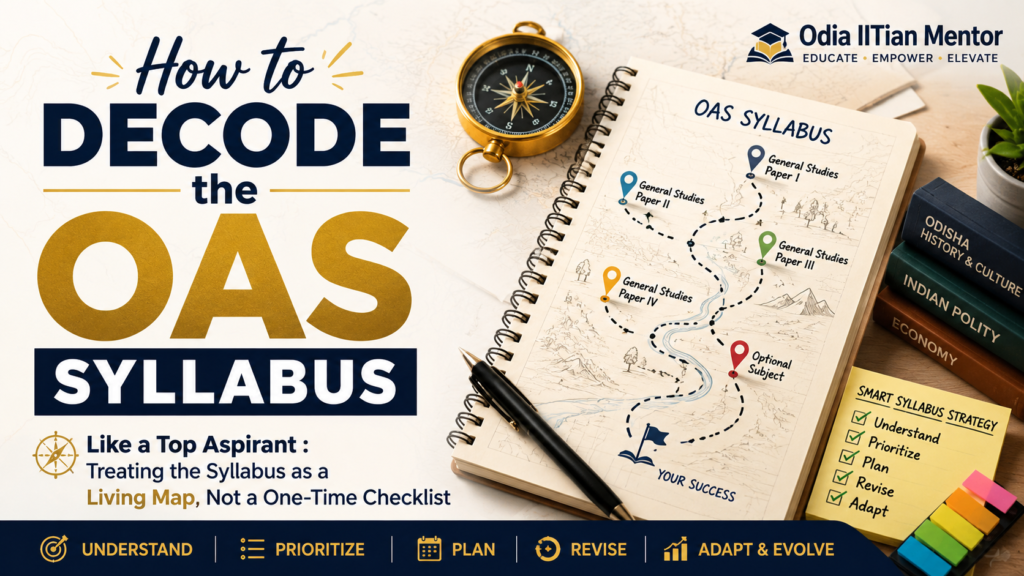
Most OAS aspirants read the official OPSC syllabus exactly once, usually in their first week of preparation, and then never look at it again with any real attention. It gets treated as a checklist to glance at, not a document to genuinely study. This is one of the most consequential early mistakes in the entire preparation journey, because the syllabus is not actually a list — it is a compressed, deliberately broad map that rewards exactly the kind of careful decoding most aspirants skip.
This article opens our OAS From Zero series with the single skill that determines the quality of almost everything that follows: notes, revision schedules, booklists, and even your sense of how much you genuinely have left to cover. Get this step right, and every later system in this series has a solid foundation to build on. Get it wrong, and even the best revision technique is organized around the wrong map.
This matters more for OPSC’s OAS examination specifically than it might for a more narrowly defined exam, simply because the combination of national-level subjects with substantial Odisha-specific content creates a genuinely larger decoding task than many aspirants initially anticipate when they first open the official notification.
The Problem: A Deliberately Broad Document, Read as a Simple List
Official competitive exam syllabi, OPSC’s included, are written in broad, compressed headings by design — a single line like “Modern History of India” or “Geography of India and Odisha” can quietly contain dozens of distinct, examinable sub-topics, each with its own specific angle the exam has historically tested. Read at face value, a heading like this gives almost no usable guidance about depth, emphasis, or which specific aspects within it actually matter most.
This vagueness produces two opposite, equally damaging responses. Some aspirants try to study everything conceivably related to a broad heading exhaustively, exhausting time and energy on low-yield depth long before exam day. Others, intimidated or simply unsure where the real boundary lies, skim the heading superficially and are later surprised by how specific and pointed the actual exam questions turn out to be.
Why This Is the Foundational Skill for Everything Else in This Series
Every other system this series will cover — building a note system specifically for OAS, designing a revision schedule that survives the long Prelims-to-Mains gap, choosing the right books — depends entirely on having an accurate, detailed map of what actually needs to be learned. A note system built around a vague, undecoded syllabus heading produces vague, undecoded notes. A revision schedule without a clear sub-topic breakdown has nothing concrete to actually schedule.
The D.E.C.O.D.E Framework
- D — Diagnose Vague Headings into Specific Sub-Topics
- E — Examine the Syllabus Through Past Year Questions
- C — Connect Static Topics to Current Affairs Hooks
- O — Order Topics by Weightage, Not by Printed Sequence
- D — Distinguish Static from Dynamic Components Within Each Heading
- E — Evolve the Map as You Progress
D: Diagnose Vague Headings into Specific Sub-Topics
Take each broad syllabus heading and deliberately break it apart into a working list of specific sub-topics before you begin studying it. A typical broad heading covering Indian history, for instance, almost always conceals distinct, separately examinable threads — political developments, social and religious reform movements, economic policy shifts, and the freedom struggle’s various phases — each of which deserves its own line in your working map rather than being absorbed into one undifferentiated block called simply “history.”
This diagnostic breakdown does not need to be perfect or exhaustive on the first attempt. A rough first pass, refined as you learn more, is considerably more useful than no breakdown at all, which is the default most aspirants unintentionally settle for simply by treating the printed heading as already specific enough.
E: Examine the Syllabus Through Past Year Questions
A syllabus heading tells you a topic is in scope; it does not tell you which specific angle within that topic the exam actually favors. Cross-referencing each sub-topic against previous years’ questions — covered in depth in our companion article on PYQ intelligence — reveals exactly this missing dimension, turning a vague heading into a far more precise sense of what genuinely gets asked, how often, and from which specific angle.
This step is what separates a syllabus map built on guesswork from one built on real evidence. Two aspirants working from the identical printed syllabus can end up with meaningfully different study priorities, simply because one cross-checked every heading against actual past questions and the other did not.
C: Connect Static Topics to Current Affairs Hooks
As you decode each static heading, actively watch for current events that connect to it — a new policy announcement linked to a governance topic, a recent geological survey linked to a geography heading, a contemporary social movement linked to a historical theme. Building this habit early, rather than treating current affairs as an entirely separate, disconnected subject, prepares you directly for the kind of integrated questions that connect a static topic to a live, current development.
O: Order Topics by Weightage, Not by Printed Sequence
The order topics appear in the official syllabus document is largely arbitrary from a study-planning perspective — it reflects an administrative listing convention, not a ranking of importance or expected marks. Once your PYQ analysis from the Examine step reveals which topics carry genuinely higher weightage, reorder your actual study plan around that evidence, rather than working through the syllabus document from top to bottom simply because that happens to be how it was printed.
D: Distinguish Static from Dynamic Components Within Each Heading
Many individual syllabus headings actually blend a static core with a dynamic, regularly shifting component — a governance topic might combine constitutional provisions that rarely change with current policy implementation that shifts yearly. Separate these explicitly within your decoded map, since static and dynamic content genuinely require different study and revision approaches, a distinction our companion article on the static-dynamic balance addresses in further depth.
E: Evolve the Map as You Progress
Treat your decoded syllabus map as a living document, not a one-time exercise completed in week one and never revisited. As you study further, encounter new PYQs, or notice a notification update, return to the map and refine it — adding a sub-topic you initially missed, adjusting a weightage estimate based on a fresh batch of questions, or removing a thread that, on closer inspection, never actually appears in the exam’s real pattern.
Why Odisha-Specific Content Makes Decoding Even More Important
A national-level competitive exam syllabus is challenging enough to decode on its own. OPSC’s OAS examination adds a further layer: a meaningful share of the syllabus carries an explicit Odisha-specific dimension, layered onto or alongside the broader national content most standard reference material is written to cover. A generic national-level book on geography, history, or governance will rarely treat Odisha-specific detail with anything close to the depth the exam itself expects.
This means the Diagnose step carries extra weight for OAS aspirants specifically. When you break apart a broad heading into sub-topics, deliberately ask whether each sub-topic has a distinct Odisha-specific version that needs separate, dedicated sourcing — a question national-level aspirants preparing for other exams simply do not need to ask in the same way. Our companion article on the Odisha Advantage goes further into treating this distinction as a genuine scoring opportunity rather than an additional burden.
Building Your First Working Syllabus Map
If you have never attempted this kind of decoding before, start small rather than attempting the entire syllabus in one sitting. Choose a single subject, list its broad printed headings, and work through the D.E.C.O.D.E steps for just that one subject first. A complete, carefully decoded map for one subject teaches you the actual process far more effectively than a rushed, shallow first pass across the entire syllabus at once.
Once the process feels familiar, extend it subject by subject, treating each one as its own focused decoding project rather than racing to finish the whole syllabus by an arbitrary early deadline. The quality of this initial map matters considerably more than the speed at which it gets built.
A Worked Example: Decoding a Broad Geography Heading
Consider a composite case drawn from recurring patterns across mentoring conversations, not one identifiable individual.
An aspirant initially treats a broad geography heading covering India and Odisha as one undifferentiated subject, attempting to study it generically from a single textbook cover to cover, with no clear sense of where the real boundary or emphasis sits. Progress feels slow and unfocused, and confidence stays low despite genuine hours invested.
Applying the D.E.C.O.D.E framework, the aspirant diagnoses the heading into specific sub-topics — physical geography and river systems, mineral and resource distribution, disaster-prone zones, and government schemes tied to regional development — then cross-references each against previous years’ questions. The analysis reveals a clear, previously invisible pattern: Odisha-specific physical and resource geography appears with disproportionately high frequency compared to broader national geography content, a weightage signal the original undifferentiated study approach had never surfaced. Reordering study time toward this evidence-based priority, and explicitly building Odisha-specific depth as a genuine scoring advantage, produces measurably stronger, more targeted preparation than the original generic pass through the same broad heading ever did.
The aspirant’s own retrospective summary captured the shift well: the syllabus heading had not actually changed at all between the two approaches. What changed was the resolution at which it was being read — from one wide, blurry category into five specific, separately addressable threads, each with its own clear evidence of how much attention it genuinely deserved.
Syllabus Heading: Vague Reading vs. Decoded Sub-Topics
An illustrative example of what this decoding process looks like in practice, applied to a typical broad heading.
| Broad Heading | Vague First Reading | Decoded Sub-Topics |
| Geography of India and Odisha | “Study geography generally” | Physical features, river systems, mineral distribution, disaster zones, regional schemes |
| Indian Polity and Governance | “Read the Constitution and current affairs” | Constitutional provisions, governance bodies, recent policy implementation, local self-government |
| Modern History of India | “Read a standard history textbook” | Political developments, reform movements, economic policy, freedom struggle phases |
Common Myths worth Retiring
- “The syllabus is just a list to glance at once.” It is a compressed map that rewards genuine, ongoing decoding throughout preparation.
- “Every topic in the syllabus deserves equal depth.” PYQ-based weightage analysis reveals that some headings carry far more examined weight than others.
- “A broad heading means you need to know everything conceivably related to that subject.” Decoding into specific sub-topics, cross-checked against PYQs, defines a far more realistic and accurate boundary.
- “The printed syllabus and the actual exam are essentially the same thing.” The syllabus defines scope; the exam’s actual pattern, visible only through PYQ analysis, defines genuine priority within that scope.
- “Current affairs has nothing to do with the static syllabus.” Many static headings carry a dynamic component that connects directly to current developments.
Common Mistakes Aspirants Make When Approaching the Syllabus
- Reading the syllabus once at the very start of preparation and never returning to it with real attention again.
- Studying broad headings generically from a single source, without diagnosing them into specific, examinable sub-topics.
- Following the syllabus document’s printed order as if it reflected genuine priority or weightage.
- Treating current affairs and static subjects as entirely separate, with no deliberate cross-referencing between them.
- Building an initial syllabus map and never revisiting or refining it as preparation progresses.
Action Steps: Apply the D.E.C.O.D.E Framework This Week
- Choose one broad syllabus heading you have not yet seriously decoded, and break it into a working list of specific sub-topics.
- Cross-reference that same heading against at least five years of previous questions to identify which specific angles actually get tested.
- Note one current affairs connection point for that heading, however small, and begin watching for similar connections going forward.
- Reorder your study plan for one subject based on the weightage evidence this exercise surfaces, rather than the syllabus document’s printed sequence.
- Schedule a recurring monthly reminder to revisit and refine your overall syllabus map as your preparation continues.
Reflection Questions
- Have I actually decoded my syllabus into specific sub-topics, or am I still working from the broad, undifferentiated printed headings?
- Have I cross-checked my current study priorities against real PYQ evidence, or am I relying on assumption alone?
- When did I last genuinely revisit and refine my syllabus map, rather than simply continuing to work from an early, unrefined first pass?
Key Takeaways
- The official syllabus is a deliberately broad, compressed document that rewards careful decoding, not a simple checklist.
- Diagnosing broad headings into specific sub-topics is the foundational step every other preparation system in this series depends on.
- Cross-referencing the syllabus against PYQs reveals genuine weightage and angle, information the printed document alone cannot provide.
- Many syllabus headings blend a static core with a dynamic, current-affairs-linked component that deserves separate treatment.
- A syllabus map should evolve throughout preparation, not remain frozen at whatever shape it took in week one.
Frequently Asked Questions
How often should I revisit my decoded syllabus map?
A monthly check is a reasonable baseline, with additional reviews whenever you complete a fresh round of PYQ analysis or encounter a relevant notification update, ensuring the map keeps pace with what you are actually learning rather than freezing at an early, incomplete stage.
Should I trust a coaching institute’s syllabus breakdown, or build my own?
A coaching breakdown can be a genuinely useful starting reference, but building your own decoded map, cross-checked against PYQs yourself, produces a far deeper, more personally internalized understanding than adopting someone else’s breakdown passively. Treat external breakdowns as a starting input, not a substitute for doing this work yourself.
How detailed should my sub-topic breakdown actually be?
Detailed enough that each sub-topic could reasonably anchor its own dedicated study or revision session, but not so granular that the breakdown itself becomes a time-consuming project rivaling the studying it is meant to support. A handful of clear sub-topics per broad heading is usually a reasonable working level of detail.
Does the OPSC syllabus change meaningfully from year to year?
Always check the current official notification directly for the most accurate and current syllabus wording specific to your exam cycle, since official documents are the only fully reliable source for this and can be revised between cycles.
Does this decoding process differ between the Prelims and Mains syllabus?
Yes, meaningfully — the two stages test different skills, a distinction our companion article on Prelims versus Mains addresses directly, and your decoded map should reflect each stage’s distinct emphasis and question style rather than treating both as one undifferentiated syllabus.
Conclusion
The syllabus you received at the start of your preparation was never meant to be read once and filed away. It is a compressed, deliberately broad map, and the depth of your eventual preparation depends directly on how carefully you decode it — breaking vague headings into specific sub-topics, checking them against real PYQ evidence, connecting static content to current developments, and revisiting the whole map as your understanding deepens.
Every other system this OAS From Zero series will cover — notes, revision, booklists, your entire preparation roadmap — works from this map as its foundation. Build it carefully now, and everything that follows has something solid to stand on.
Decoding is not a task you complete once and finish. It is a discipline you carry through your entire preparation, returning to it the way a careful traveler keeps checking and updating a map rather than trusting a single early glance to carry them the whole journey.
What to Do Next
Our companion article on the PYQ Intelligence System goes further into the cross-referencing step at the center of this framework. The OAS From Zero Program at Odia IITian Mentor provides a fully decoded, structured syllabus map you can use directly or compare against your own.
About the Author
Prakash Chandra Mallick is a Senior Educator, Senior Development Professional, and PhD Scholar at IIT Patna, with prior academic training at TISS Mumbai and the University of Hyderabad. He founded Odia IITian Mentor to bring structured, evidence-based career guidance and civil services preparation to students across Odisha, with particular attention to first-generation learners and rural and Odia-medium students who are too often left out of mainstream career advice.