Introduction
Every field covered so far in this series has had decades, sometimes centuries, to settle into a stable shape. Data Science and AI careers have not had that luxury — the field’s core job titles, tools, and expectations have shifted meaningfully within the past five years alone, and they will likely keep shifting. This makes it the hardest field in this series to write about honestly, and also the one where a clear-headed framework matters most.
This article applies the same R.E.A.L framework used throughout this series, with one honest caveat upfront: treat the specific tools and terms here as illustrative of a pattern, not as a permanent map. The underlying role distinctions are more durable than any single tool name, and that is what this article focuses on.
The Problem: One Buzzword Umbrella Covering Several Distinct Jobs
“I want to work in AI” or “I want to do Data Science” are now among the most common things students say in career conversations, and among the least specific. Data Analyst, Data Scientist, Machine Learning Engineer, Data Engineer, and AI Researcher are genuinely different roles, with different daily work, different entry requirements, and different skill emphases — yet they are routinely discussed as if they were one undifferentiated career.
This conflation causes real damage: students spend months learning the wrong emphasis of skills for the specific role they actually want, or chase the most hyped title without checking whether its daily reality matches their own genuine strengths.
Why This Field Rewards Substance More Than Almost Any Other
Recall the Three S’s framework from our Degree vs Skill article: Signal, Substance, and Sustain. Data Science and AI careers lean unusually hard on Substance — demonstrated project work, portfolios, and competition results carry real weight here, often comparable to or exceeding a formal degree’s Signal value, particularly for engineering-style roles. This makes the field more accessible to motivated self-learners than most others in this series, but it also means a credential alone, without genuine demonstrated capability, goes less far here than almost anywhere else.
The R.E.A.L Framework, Applied to Data and AI Careers
- R — Range: the genuine breadth of distinct roles inside this field.
- E — Entry Path: how each role is actually accessed.
- A — A Day in the Life: what each role actually involves, myths included.
- L — Long-Term Trajectory: where each role genuinely leads.
R: The Range Inside Data and AI Careers
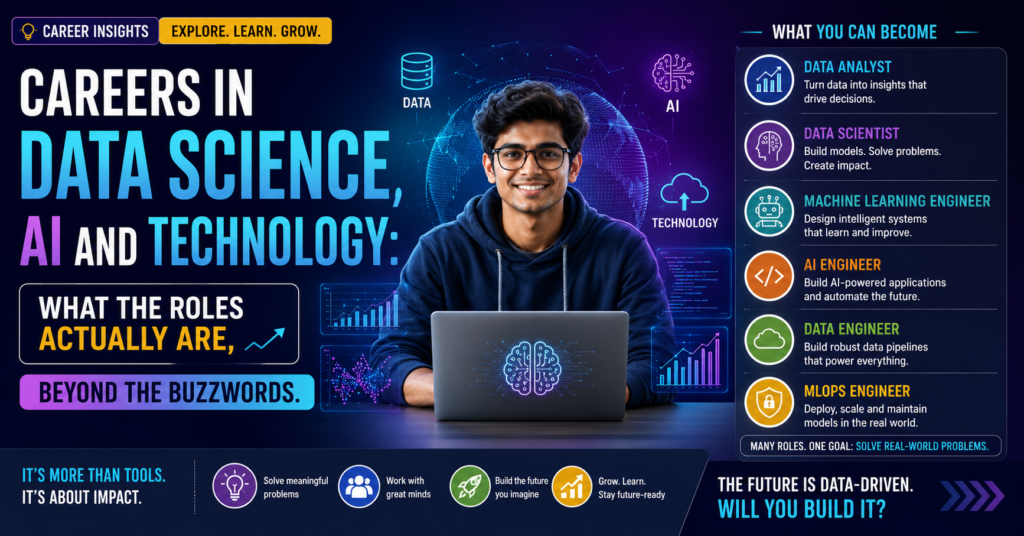
Data Analysts work closest to business decisions, building dashboards and descriptive reports that explain what has already happened. Data Scientists go further, building statistical and predictive models and running structured experiments to inform what should happen next, blending technical modeling with business communication.
Machine Learning Engineers focus on building and deploying models into reliable, production-grade software systems — closer in spirit to software engineering than to data analysis. Data Engineers build and maintain the pipelines and infrastructure that move and organize data in the first place, a less visible but consistently high-demand role that the entire rest of this list depends on. AI Researchers work on developing new algorithms and techniques, typically within research labs or academic settings, and usually require advanced study. A smaller but growing set of roles — AI product management, AI policy, and AI ethics — sit adjacent to these technical roles without being purely technical themselves.
E: How Each Role Is Actually Accessed
Computer Science and IT engineering backgrounds remain the most common entry route, but this field is genuinely more interdisciplinary than most — Statistics, Mathematics, Economics, and Physics graduates routinely enter Data Science and Analyst roles, particularly when paired with demonstrated project work. Bootcamps and online certifications carry real, if variable, Signal value here, stronger for engineering-style and analyst roles than for research positions.
AI Researcher roles typically require a Master’s or PhD, particularly for work at the cutting edge of the field, since this path is built more on the Signal of advanced research training than on portfolio projects alone. For nearly every other role in this Range, a strong public portfolio — competition results, open-source contributions, or documented independent projects — functions as unusually strong Substance evidence, often more persuasive to hiring managers in this field than in almost any other covered in this series.
A: A Day in the Life, Myths Included
The most common myth is that Data Scientists spend their days building sophisticated machine learning models. In practice, a large share of the role’s actual time goes toward data cleaning, wrangling messy real-world data, and communicating findings to non-technical stakeholders — the modeling work, while real, is often a smaller fraction of the week than the popular image suggests.
A second myth, intensified by recent public attention on large language models, assumes that AI Engineers are building systems like ChatGPT from scratch. In reality, the overwhelming majority of applied AI and ML engineering work involves adapting, fine-tuning, and integrating existing models into specific business products — building foundational models from scratch is the work of a small number of well-resourced research labs, not the daily work of most people with “AI” in their job title.
L: Where Each Role Genuinely Leads
Analysts progress toward senior analyst, analytics management, and eventually leadership of an analytics or business-intelligence function. Data Scientists progress toward senior and lead roles, and eventually toward Director-level data science leadership. ML Engineers progress toward senior and architect-level roles shaping a company’s broader AI infrastructure. Data Engineers progress toward senior roles and data-platform architecture, often becoming the most quietly indispensable senior technical staff in a data-driven organization.
Researchers progress through continued publication and seniority within research labs or academia. Several professionals across these roles also move toward AI-focused product management or entrepreneurship, building on technical credibility to lead or found AI-driven products and companies — a trajectory connecting directly to our companion articles on Management Careers and Engineering.
Role Snapshot: A Starting Comparison
| Role | Core Skill Focus | Typical Background | Entry Notes |
| Data Analyst | Reporting, dashboards, descriptive analysis | Any discipline + analytics tools training | Most accessible entry point |
| Data Scientist | Statistical modeling, experimentation | CS, Statistics, Math, Economics | Strong portfolio essential |
| ML Engineer | Model deployment, production systems | CS / Software Engineering | Software engineering skill required |
| Data Engineer | Pipelines, data infrastructure | CS / IT | High demand, lower visibility |
Common Myths Worth Retiring
- “Data Science, AI, and Machine Learning are basically the same thing.” They are related but distinct disciplines with different core skills and daily realities.
- “You need a Computer Science degree to enter this field.” Statistics, Mathematics, Economics, and other quantitative backgrounds, paired with demonstrated project work, are genuinely viable entry routes.
- “A bootcamp certificate alone makes you job-ready.” It can build real skill, but Substance — an actual portfolio of demonstrated work — is what hiring managers weigh most heavily in this field specifically.
- “AI will make entry-level data roles pointless to pursue.” The field is genuinely changing how some tasks are done, but treating this as a reason to avoid the field entirely overstates current uncertainty into a false certainty; staying adaptable and building genuine Substance matters more than predicting the field’s exact shape five years out.
A Worked Example
Consider two composite cases, drawn from recurring patterns across mentoring conversations rather than identifiable individuals.
The first is a student who pursues the “Data Scientist” title specifically, drawn by its visibility, without examining genuine fit. Running the S.T.R.O.N.G strengths framework after some frustration reveals stronger Natural Energy and Genuine Flow around building reliable, well-organized systems than around statistical storytelling and stakeholder presentations — a profile considerably better matched to Data Engineering. The pivot, once made deliberately, resolves a mismatch that had been wrongly attributed to “not being good at Data Science” rather than to choosing the wrong specific role within the field.
The second is an Economics graduate who assumed a Computer Science degree was a strict requirement for this field and nearly avoided it entirely. Building a portfolio through online coursework and structured practice on public datasets, paired with genuine domain knowledge from the Economics background, leads to a strong Data Analyst role and, over two further years of demonstrated Substance, a transition into a full Data Scientist position — confirming that the credential gate this student feared simply did not apply as strictly as assumed.
Common Mistakes People Make About Data and AI Careers
- Chasing the most hyped specific title without examining whether its actual daily work matches genuine strengths.
- Assuming a single bootcamp certificate, without a demonstrated portfolio, is sufficient for hiring in this Substance-driven field.
- Learning only trendy tools while neglecting foundational statistics, programming fundamentals, or domain knowledge.
- Avoiding the field entirely out of automation anxiety, without examining which specific roles and skills remain genuinely durable.
- Trying to learn every role in the Range shallowly rather than building genuine depth in one entry point first.
Action Steps: Apply the R.E.A.L Framework to Data and AI Careers
- Identify which specific role in the Range section — Analyst, Data Scientist, ML Engineer, Data Engineer, or Researcher — matches your actual interests, not just the field’s general reputation.
- Run the S.T.R.O.N.G strengths framework against that role’s actual daily-work profile, not its public image.
- Build one complete, documented project in your target role’s core skill area, rather than several shallow, incomplete ones.
- If pursuing Data Science or ML Engineering specifically, confirm your foundational statistics and programming skills are solid before layering on trendier tools.
- Revisit your target role choice every six months, given how quickly this field’s specific tools and expectations continue to shift.
Reflection Questions
- Am I drawn to a specific role’s actual daily work, or mainly to the field’s general buzz and visibility?
- Do I have a genuine, documented portfolio project, or only completed coursework without demonstrated independent application?
- Is my hesitation about this field based on a specific, researched concern, or a general anxiety about automation I have not examined closely?
Key Takeaways
- Data Science, AI, and related fields contain genuinely distinct roles — Analyst, Data Scientist, ML Engineer, Data Engineer, Researcher — not one undifferentiated career.
- This field rewards demonstrated Substance, through portfolios and projects, more heavily than most fields in this series.
- A Computer Science degree helps but is not strictly required for several roles, particularly with strong quantitative skills and demonstrated project work.
- Daily work in this field, across nearly every role, involves more data cleaning, communication, and integration work than the popular image suggests.
- The field’s specific tools and expectations will keep changing; durable foundational skills matter more than chasing the current trendiest tool.
Frequently Asked Questions
Is it still worth pursuing a career in data science or AI given how fast the field is changing?
Yes, for students who build genuine foundational skill and stay adaptable, rather than betting everything on one specific current tool or technique. The underlying skills — statistical thinking, programming fundamentals, and structured problem-solving — have remained durable even as specific tools have changed repeatedly.
Do I need a Computer Science degree to work in this field?
Not strictly, particularly for Data Analyst and Data Scientist roles, where Statistics, Mathematics, Economics, and other quantitative backgrounds are genuinely viable, especially paired with demonstrated project work. Machine Learning Engineer roles lean more heavily on software engineering skill specifically, making a Computer Science background more directly useful there.
Is a bootcamp or online certification enough to get hired?
A certification alone is rarely enough; a certification combined with a genuine, documented portfolio of independent project work is considerably more persuasive to hiring managers in this Substance-driven field.
What is the actual difference between a Data Analyst and a Data Scientist?
A Data Analyst primarily explains what has already happened, through reporting and dashboards. A Data Scientist goes further, building predictive models and running structured experiments to inform future decisions — a meaningfully deeper statistical and modeling skill set, usually built over more time.
Should I start learning AI and machine learning now as a school or early college student?
Building foundational mathematics, statistics, and programming skills now is genuinely valuable regardless of which specific role you eventually pursue. Specializing too early into one specific trendy tool, before these foundations are solid, often produces shallower long-term capability than a more patient, fundamentals-first approach.
Conclusion
Data Science and AI careers deserve the same fit-based scrutiny this series has applied to every other field, with one added layer of honesty: this field’s specific shape will keep shifting, and treating it as fixed and final at any one moment is itself a mistake worth avoiding.
Identify the specific role that genuinely fits your strengths, build real demonstrated Substance in it, and hold your specific tools and techniques more loosely than your underlying foundational skills — that combination travels well regardless of how the field’s surface continues to change.
Of every field in this series, this is the one where the framework matters more than the facts on the page, simply because the facts will keep moving. Apply R.E.A.L again in a year, and expect at least some of the specific answers to look different.
What to Do Next
The Career Exploration Handbook and Future Careers Handbook at Odia IITian Mentor go further into mapping data and AI roles against your own strengths profile. This series continues with Public Service Careers, where the growing demand for data and AI skill within government and public administration is explored directly.
About the Author
Prakash Chandra Mallick is a Senior Educator, Senior Development Professional, and PhD Scholar at IIT Patna, with prior academic training at TISS Mumbai and the University of Hyderabad. He founded Odia IITian Mentor to bring structured, evidence-based career guidance and civil services preparation to students across Odisha, with particular attention to first-generation learners and rural and Odia-medium students who are too often left out of mainstream career advice.