
Introduction
Management is the field almost every other field eventually points toward. Engineers consider an MBA. Doctors consider hospital administration. Civil servants consider public-sector management roles. This makes management unusual among the fields in this series — it is rarely a first choice out of Class 12, and far more often a second decision, made years into another career.
That second-decision pattern creates its own specific risk: management gets chosen as a generic “upgrade” — more salary, more authority, more options — without the same genuine fit-checking this series has applied to every other field. This article applies the R.E.A.L framework directly to that gap.
This matters as much for a final-year student weighing an MBA straight after graduation as it does for a working professional several years into a different field, since both face the same underlying risk of choosing the credential before choosing the function.
The Problem: “Management” Is Treated as One Upgrade, Not Several Functions
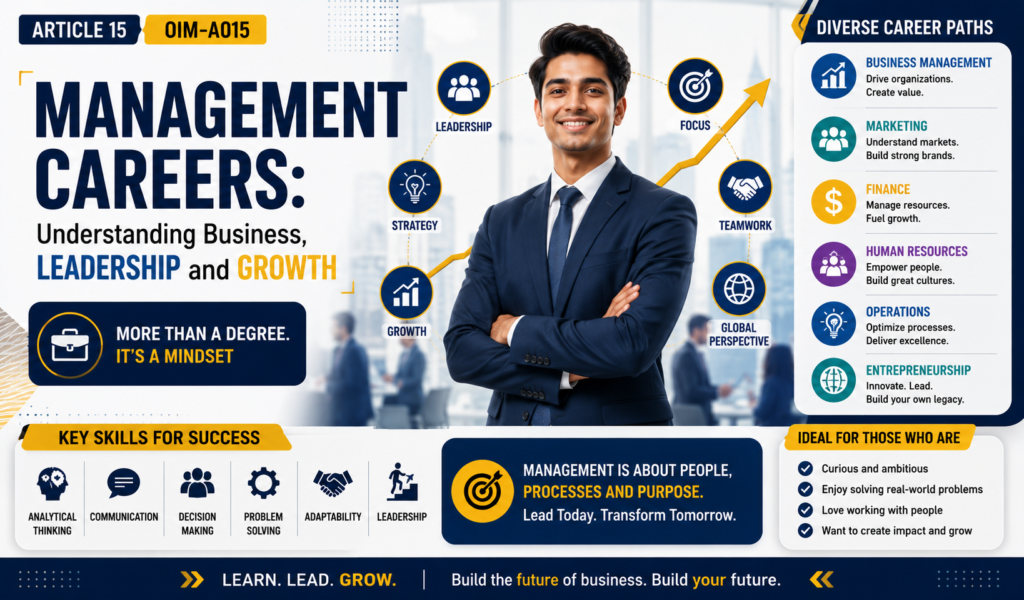
An MBA or management career is frequently discussed as a single credential that opens doors, without examining which specific door. Finance, marketing, operations, human resources, consulting, and entrepreneurship are genuinely different functions with different daily realities — choosing among them matters considerably more than the broad decision to pursue “management” in the first place.
This gap is expensive specifically because management study, particularly a full-time MBA, carries a real opportunity cost in time, tuition, and foregone income — a cost worth spending deliberately on the right function, not on the label “management” in the abstract.
Why This Matters Especially as a Second Career Decision
Because management is so often pursued after an initial degree in another field, the Three S’s framework from our Degree vs Skill article applies with particular force here: an MBA provides real Signal value, especially from a top-tier institute, but Substance — genuine functional fit and capability — still determines whether the resulting career actually satisfies the person pursuing it.
The R.E.A.L Framework, Applied to Management
- R — Range: the genuine functional breadth inside management careers.
- E — Entry Path: how each function and credential level is actually accessed.
- A — A Day in the Life: what management work actually involves, myths included.
- L — Long-Term Trajectory: where each function genuinely leads.
R: The Range Inside Management
Finance covers corporate finance, investment banking, and financial analysis — work centered on numbers, valuation, and structured decision-making. Marketing covers brand strategy, market research, and increasingly digital and data-driven customer acquisition work, blending creative and analytical skills. Operations and supply chain management covers process efficiency, logistics, and production planning, often the least visible but most consistently in-demand management function.
Human resources covers talent strategy, organizational design, and people management systems. Consulting covers structured problem-solving across client organizations, typically with significant travel and client-facing work. Entrepreneurship and general management apply across functions, toward eventually leading or founding an organization rather than specializing in one function. Product management, increasingly common in technology companies, sits at the intersection of management, design, and technical coordination.
This last category deserves particular attention for readers of this series who already have a technical background. Product management roles often value a prior Engineering or Data Science foundation specifically, making this one of the more natural management entry points for technical graduates who want management-style responsibility without abandoning their original technical training entirely.
E: How Each Path Is Actually Accessed
A BBA after Class 12 offers a direct entry into management study, though it carries less Signal value than a postgraduate MBA for most senior roles. The dominant credential remains an MBA pursued after a Bachelor’s degree, accessed through entrance examinations such as CAT, XAT, or GMAT, with the Indian Institutes of Management and a small set of other top-tier institutes carrying significantly stronger Signal value than the broader market of MBA programs, similar to the National Law University pattern discussed in our Law article.
Many strong MBA programs explicitly prefer or require two or more years of prior work experience before admission, which is why management is so often a second decision rather than a first one. Executive MBA programs serve working professionals seeking management credentials without leaving their current role entirely.
A: A Day in the Life, Myths Included
The common myth that management means primarily giving instructions and making high-level decisions obscures how much of actual management work, particularly in the first several years, involves detailed analysis, data work, and structured research — a finance analyst spends most days in spreadsheets and valuation models, not boardroom decisions; a consultant spends most days in research and client-data analysis, not direct strategic pronouncements.
The functions also differ substantially from each other in daily texture. Marketing work blends creative judgment with campaign data analysis. Operations work is often process- and metrics-heavy, closer in spirit to engineering than to the stereotype of “soft” management work. HR work increasingly involves structured organizational data analysis alongside people-facing responsibilities. Treating all of “management” as one daily experience flattens genuinely different working lives.
L: Where Each Function Genuinely Leads
Each function builds toward its own leadership track — a Chief Financial Officer track from finance, a Chief Marketing Officer track from marketing, a Chief Operating Officer track from operations — before any path realistically leads toward a general CEO-level role, which typically requires breadth across functions built over a long career, not a credential alone.
Consulting builds toward a partner track within a consulting firm, or toward a senior strategy role inside a company after some years of consulting experience. Entrepreneurship builds toward founding and growing an independent venture. Public-sector and PSU management trainee schemes, worth noting for readers of this series, offer a structured management career track within government-linked organizations, combining management training with public-sector stability.
Function Snapshot: A Starting Comparison
| Function | Typical Daily Work | Entry Route | Long-Term Path |
| Finance | Valuation models, analysis, reporting | MBA (Finance) or direct finance roles | CFO track, investment leadership |
| Marketing | Campaign strategy, market research, data analysis | MBA (Marketing) or direct entry roles | CMO track, brand leadership |
| Operations | Process design, logistics, efficiency analysis | MBA (Operations) or engineering-linked entry | COO track, supply chain leadership |
| Consulting | Client research, structured problem-solving, travel | Top-tier MBA or direct campus recruitment | Partner track, internal strategy roles |
Common Myths Worth Retiring
- “An MBA guarantees a big salary jump.” Outcomes vary enormously by institute tier and function; a generic MBA without functional clarity often underperforms a well-matched specialist path.
- “You need an MBA to become a manager.” Many strong management careers, particularly in operations and entrepreneurship, are built through direct experience without a formal MBA.
- “Management is only for natural extroverts and leaders.” Finance, operations, and analytical marketing roles reward careful, detail-oriented work as much as charisma.
- “Only IIM-tier MBAs matter.” Top-tier institutes carry strong Signal value, particularly for consulting and finance recruitment, but Substance built through real functional experience matters considerably for nearly every management career over time.
A Worked Example
Consider a composite case drawn from recurring patterns across mentoring conversations, not one identifiable individual.
An engineering graduate pursues an MBA primarily for prestige and an anticipated salary increase, without examining functional fit beforehand. Placed into a generalist rotational program, the graduate finds consulting-style client work draining rather than energizing, a mismatch that the S.T.R.O.N.G strengths framework, applied honestly only after two difficult years, traces to a stronger Natural Energy around structured, engineering-adjacent operations work than around client-facing strategy work. A deliberate move into a supply chain and operations specialization afterward — building on the original engineering background rather than discarding it — produces a far stronger fit than the initial generalist path the MBA’s prestige had pointed toward by default.
A second, contrasting composite case involves a Commerce graduate who researched functional fit honestly before applying to any MBA program at all, identifying a strong Genuine Flow around financial modeling and valuation work during an undergraduate internship. Choosing a finance-specialization MBA deliberately, rather than a generalist program, the graduate enters investment banking directly aligned with an already-confirmed strength — reaching a satisfying, well-fitted role considerably faster than a generalist path would have allowed, simply by doing the functional research before committing to the credential rather than after.
Common Mistakes People Make About Management Careers
- Pursuing an MBA for general prestige or salary expectation without examining functional fit first.
- Assuming all management functions involve the same daily mix of leadership, analysis, and people work.
- Treating institute tier as the only factor that matters, ignoring the functional specialization chosen within the program.
- Pursuing an MBA immediately after a Bachelor’s degree without checking whether the target program or function values prior work experience.
- Overlooking PSU management trainee schemes and public-sector management tracks as legitimate, structured alternatives to the private-sector MBA route.
Action Steps: Apply the R.E.A.L Framework to Management
- List the management functions in the Range section you have not yet researched against your own working style.
- Run the S.T.R.O.N.G strengths framework specifically against the daily-work profile of your top two functional choices.
- If considering an MBA, research your target institutes’ typical incoming work-experience profile before applying.
- Talk to one person currently working in each of your top two target functions about their actual daily work.
- If you already have a prior degree, consider whether a specialization building on it — like engineering-linked operations — fits better than a fully generalist management path.
Reflection Questions
- Am I pursuing management as a genuine functional fit, or as a generic upgrade I have not examined closely?
- Which specific management function’s daily work, based on real research, actually appeals to me?
- Does my prior background offer a specialization advantage I would lose by choosing a fully generalist management path?
Key Takeaways
- Management is rarely a first career choice, which makes deliberate functional fit-checking especially important as a second decision.
- Finance, marketing, operations, HR, and consulting are genuinely distinct functions, not interchangeable versions of one generic management role.
- Institute tier carries real Signal value, particularly for consulting and finance, but functional fit and Substance matter for long-term satisfaction.
- Many strong management careers do not require a full-time MBA at all, particularly in operations and entrepreneurship.
- Public-sector and PSU management tracks are legitimate, structured alternatives worth researching alongside the private-sector MBA route.
Frequently Asked Questions
Is an MBA actually worth the time and cost?
It depends heavily on institute tier, target function, and genuine fit. A well-matched MBA from a strong institute, pursued with functional clarity, is often genuinely worth the investment; a generic MBA pursued mainly for prestige, without functional research, carries a much weaker return on the same investment.
Do I need work experience before pursuing an MBA?
Many top-tier programs explicitly prefer or require it, typically two or more years, since it strengthens both the application and the classroom learning itself. Direct-entry programs after a Bachelor’s degree exist but generally carry less Signal value for senior roles than the standard experienced-entry MBA route.
Does it matter which specific MBA institute I attend, beyond the IIMs?
Yes, though the gap is more of a gradient than a single GMI-or-nothing cutoff. A small set of top-tier institutes carries the strongest Signal value, particularly for consulting and finance recruitment; beyond that tier, the specific program’s functional strength and placement record in your target function matters more than general institute reputation.
Can students from non-Commerce backgrounds succeed in management careers?
Yes, genuinely — Engineering, Science, and Arts and Humanities graduates all pursue management careers successfully, often bringing a valuable specialization, such as engineering-linked operations or social-science-linked HR and organizational roles, that a purely generalist Commerce background does not automatically provide.
Is consulting the best management track to aim for?
Not universally — it is the most visible and often the most discussed track, but it suits a specific working style: frequent travel, client-facing work, and broad problem-solving across industries. A genuinely well-fitted specialist in finance, operations, or marketing often builds a more satisfying long-term career than a poorly-fitted consultant chasing the track’s visibility alone.
How does product management compare to a traditional MBA-style management career?
Product management is generally entered through a technical or design background combined with demonstrated cross-functional coordination skill, rather than through an MBA specifically, though some product managers do pursue an MBA later for broader business grounding. It rewards a blend of technical fluency and people coordination that differs meaningfully from the more purely business-analytical profile of finance or consulting roles.
Conclusion
Management deserves the same fit-based scrutiny this series has applied to engineering, medicine, law, and social sciences — not the generic “good upgrade” treatment it usually receives, especially as a second career decision made under pressure to simply do something more after an initial degree.
Apply the R.E.A.L framework to the specific function that genuinely fits your working style, and the credential you pursue, and the function you build a career in, will serve you considerably better than chasing the label “management” on its own.
As with engineering, medicine, law, and social sciences before it, the real decision was never about the field as a whole — it was always about the specific corner of it that fits the person making the choice.
What to Do Next
The Career Decision Handbook and Graduate Career Accelerator course at Odia IITian Mentor go further into mapping management functions against your own strengths profile. This series continues with Careers in Data Science, AI and Technology, a field increasingly overlapping with several management functions covered here.
About the Author
Prakash Chandra Mallick is a Senior Educator, Senior Development Professional, and PhD Scholar at IIT Patna, with prior academic training at TISS Mumbai and the University of Hyderabad. He founded Odia IITian Mentor to bring structured, evidence-based career guidance and civil services preparation to students across Odisha, with particular attention to first-generation learners and rural and Odia-medium students who are too often left out of mainstream career advice.