Introduction
A few years ago, almost no one in India seriously questioned whether a degree was worth pursuing. Today, that question comes up constantly — fueled by visible stories of self-taught developers, designers, and entrepreneurs who built strong careers without finishing, or in some cases ever starting, a traditional degree.
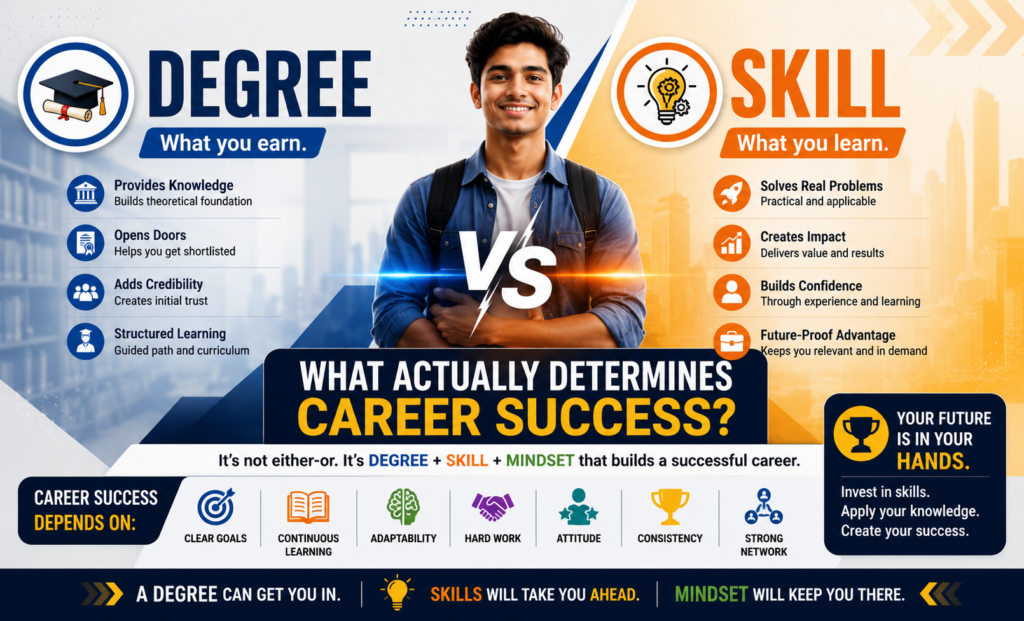
This article will not tell you to drop out, and it will not tell you a degree guarantees anything either. Both positions are oversimplified. The honest answer is that degree and skill do different jobs in a career, and understanding what each one actually does for you is far more useful than picking a side in an online debate.
This matters whether you are currently in a degree program wondering if it is worth finishing, or already employed and wondering whether to invest your limited time in further credentials or in hands-on skill-building.
The Problem: This Debate Is Framed as a Contest It Was Never Meant to Be
Search this topic and you will find two camps shouting past each other. One side points to unemployed graduates as proof that degrees no longer matter. The other points to successful self-taught professionals as proof that degrees never mattered in the first place. Both sides are working from a small, cherry-picked set of examples rather than a structural understanding of what each path actually provides.
The more useful question is not “which one wins” but “what specific function does each one serve, and which functions does my particular goal actually require?”
Why Getting This Wrong Is Expensive
Choosing badly here carries a real cost in both directions. A student who completes a degree with no practical skill-building graduates credentialed but unable to perform the work employers actually need, and discovers this gap only during interviews or, worse, in the first months of a job they struggle to keep.
A student who skips formal education entirely to chase skills alone can build genuine capability, but may find themselves structurally locked out of paths that require a specific degree by law or strict policy — medicine, law, chartered accountancy, most government recruitment, and large-company hiring filters that screen by qualification before they ever see a portfolio.
The Three S’s of Career Success
Career success is better understood through three separate functions, not one binary choice. Each one matters, and each one is served differently by degrees and by skills.
- Signal — what gets you noticed and considered in the first place.
- Substance — your actual capability to do the work well once you have the opportunity.
- Sustain — your ability to keep learning and adapting across a multi-decade career.
Signal: What Gets You Noticed
A degree functions, in large part, as a credibility shortcut. Recruiters screening hundreds of applications, government bodies setting eligibility criteria, and families evaluating a prospective decision all use a degree as a fast, if imperfect, signal of baseline competence and seriousness.
This signal value is not evenly distributed. It is strongest — often legally required — in regulated professions like medicine, law, and chartered accountancy, and in most government recruitment, where a specific degree is a hard eligibility gate, not a preference. It is weaker, though still present, in large-company corporate hiring, where a degree often clears an initial filter even for roles it does not directly prepare you for. It is weakest in small companies, startups, freelance work, and an increasing number of skill-driven roles where a strong portfolio can substitute for credential entirely.
Substance: Your Actual Capability
Once a degree or any other signal gets you into the room, substance is what keeps you there. This is the actual skill — technical, communicative, or problem-solving — that determines whether you perform the job well, get trusted with more responsibility, and eventually get promoted.
A degree alone does not guarantee substance. Many degree programs, particularly when pursued without deliberate effort beyond passing exams, produce credentialed graduates with limited practical capability. Skill-building — through projects, internships, self-directed learning, or hands-on practice — is what actually builds substance, regardless of whether it happens inside or alongside a formal degree program.
Sustain: Your Ability to Keep Growing
The factor most overlooked in this entire debate is the one that matters most over a full career: the ability to keep learning and adapting as roles, technologies, and industries change. A strong start, whether built on a degree or on skill, eventually plateaus without this third factor.
Neither a degree nor an early skill advantage guarantees Sustain. It is built through deliberate habits — staying curious, seeking feedback, taking on stretch assignments, and treating learning as continuous rather than something that ended at graduation or at your first job offer. This is, not coincidentally, the same territory covered by our Consistency and Habit Formation content — Sustain is a habit, not a credential.
Where a Degree Remains Genuinely Non-Negotiable
- Regulated professions requiring a specific degree by law: medicine, law, chartered accountancy, and several engineering-licensure contexts.
- Most government recruitment, where a specific educational qualification is a strict eligibility criterion, not a preference.
- Large-company corporate hiring at scale, where a degree often clears an automated or HR-level initial filter before a portfolio is even reviewed.
- Family and social trust factors that, in many Indian contexts, genuinely affect support, financing, and confidence during the early career years — a real factor even though it is not a technical requirement.
Where Skill Can Carry More Weight Than Credential
- Software development, design, and other portfolio-driven creative and technical fields, where demonstrated work often outweighs formal qualification.
- Sales, entrepreneurship, and client-facing roles where track record and relationship-building matter more than credential.
- Freelance and gig-based work, where a client cares primarily about delivered results.
- Small companies and startups, which frequently lack the scale-driven need for credential-based filtering that large companies use.
A Worked Example
Consider two composite cases, drawn from recurring patterns across mentoring conversations rather than identifiable individuals.
The first is a B.Tech graduate with a strong academic record but almost no independent project work, internship experience, or self-directed skill-building beyond the syllabus. The Signal from the degree is intact — it clears initial resume filters reliably. But Substance is thin, and this becomes visible quickly in technical interviews that probe beyond textbook knowledge, leading to repeated rejections despite a credential that, on paper, looked strong.
The second is a self-taught web developer without a completed degree, who spent two years building a genuine portfolio of real projects through consistent, structured practice. Substance here is strong, and it shows in technical assessments and client work alike. But Signal is weaker outside small companies and freelance platforms — several large-company applications are filtered out automatically before a human ever reviews the portfolio, and government technical posts requiring a specific degree remain structurally closed regardless of demonstrated skill. The lesson from both cases is the same: Signal without Substance fails at the interview stage, and Substance without Signal fails at the application stage, often before either capability is ever actually tested.
Side-by-Side Summary
Mapping the three factors against three common paths makes the trade-offs concrete rather than abstract.
| Factor | Degree-Only Path | Skill-Only Path |
| Signal | Strong, especially for regulated and government roles | Weak outside small companies, freelance, and portfolio-driven fields |
| Substance | Often weak unless deliberately built alongside coursework | Often strong, built directly through practice and projects |
| Sustain | Depends entirely on habits formed after graduation | Depends entirely on habits formed after initial skill plateau |
Notice that the strongest real-world path is rarely either extreme — it is a degree pursued with deliberate Substance-building alongside it, or a skill-only path chosen with full awareness of exactly which doors it leaves closed.
Common Myths Worth Retiring
- “A degree guarantees a good job.” It improves your odds of being considered; it does not guarantee performance or progression once you are in the role.
- “Skills alone can get you anywhere, degree or not.” True in some fields, structurally false in regulated professions and most government recruitment.
- “Successful dropouts prove degrees don’t matter.” This is survivorship bias — the visible successes are a small, well-publicized fraction of everyone who tried the same path; the far larger, quieter group who struggled without either Signal or Substance rarely makes the headlines.
- “Online certificates are equivalent to a full degree.” Some carry real Signal value in specific tech and digital fields; very few carry the same Signal value as a recognized degree in regulated professions or government eligibility criteria.
Common Mistakes Students Make in This Decision
- Pursuing a degree purely for the credential, with no deliberate effort to build Substance alongside it.
- Abandoning formal education entirely for a skill-only path without first checking whether the target field structurally requires a degree.
- Mistaking a handful of visible success stories for a representative outcome, rather than recognizing survivorship bias at work.
- Investing in credentials or skills without a clear sense of which specific field’s Signal-Substance balance they are aiming for.
- Neglecting Sustain entirely — coasting on an initial degree or skill advantage without building the habit of continuous learning.
Action Steps: How to Apply This Framework
- Identify your target field and check honestly whether it has a hard, structural Signal requirement — a specific degree, license, or eligibility criterion.
- If you are currently in a degree program, list one concrete Substance-building activity to pursue alongside it this semester — a project, internship, or self-directed skill.
- If you are considering a skill-only path, confirm specifically which doors that path keeps open and which it structurally closes for your target field.
- Audit your current habits for Sustain: are you still learning deliberately, or coasting on an existing degree or skill advantage?
- Revisit this Signal-Substance-Sustain framework whenever you are deciding where to invest limited time — a further credential, a skill-building project, or simply more practice.
Reflection Questions
- Does my target field have a hard Signal requirement I have not honestly checked yet?
- If I am credentialed, do I actually have the Substance to back it up — or only the credential?
- What have I done in the last three months that genuinely builds my Sustain, beyond what my degree or current skill set already provides?
Key Takeaways
- Degree and skill serve different functions — Signal and Substance — rather than competing for the same job.
- Some fields have a hard, structural Signal requirement (regulated professions, most government recruitment) that skill alone cannot substitute for.
- Other fields weight Substance far more heavily, particularly portfolio-driven creative, technical, and entrepreneurial work.
- Sustain — the ability to keep learning and adapting — matters most over a full career, and neither a degree nor early skill guarantees it.
- Visible dropout-to-success stories are subject to survivorship bias; they are not a representative guide for your own decision.
Frequently Asked Questions
Should I drop out of my degree to focus entirely on building skills?
Generally, no — unless you have specifically confirmed your target field does not have a structural Signal requirement, and you have a concrete, disciplined plan for building Substance on your own. For most students, finishing the degree while deliberately building Substance alongside it captures both functions without closing any doors.
Does a degree matter for private-sector technology jobs specifically?
It varies by company size and role. Many startups and smaller technology companies weight Substance — demonstrated skill and project work — very heavily, sometimes more than the specific degree. Larger technology companies often still use a degree as an initial Signal filter, even when the actual work afterward depends primarily on skill.
Is an online certificate equivalent to a full degree?
Rarely in Signal value, especially for regulated professions or government eligibility. Online certificates can carry meaningful Signal in specific tech and digital skill areas where employers have learned to trust them, and they can be genuinely valuable for building Substance regardless of their Signal value.
Does this framework apply to government job aspirants as well?
Yes, directly. Government recruitment usually has a hard, non-negotiable Signal requirement — a specific degree as an eligibility criterion — but Substance still determines performance once selected, and Sustain still determines long-term career growth within government service. The framework does not disappear once a degree clears the eligibility bar; it simply shifts which factor matters at which stage.
What if my degree is in a field unrelated to the career I now want to pursue?
This is common and rarely fatal. Check first whether your target field has a hard Signal requirement tied to a specific degree — if not, deliberate Substance-building in your actual target field can meaningfully offset an unrelated degree over time, particularly in skill-driven fields that weight portfolio and demonstrated capability heavily.
How do I build Substance without slowing down my degree or current job?
Substance-building does not require a separate, large time block — small, consistent practice compounds faster than most students expect. A few focused hours a week on a real project, applied directly to your target field, usually builds more genuine Substance over a year than an occasional intensive weekend that is hard to sustain.
Conclusion
Degree versus skill is not a contest with a single winner — it is two different functions, Signal and Substance, that matter in different proportions depending on the specific field you are aiming for, plus a third factor, Sustain, that determines how far either one actually takes you over a full career.
The useful question was never “which one matters more” in the abstract. It is: what does my specific target field actually require, and have I honestly built both the Signal and the Substance it asks for — with a real plan for Sustain once I get there?
What to Do Next
If you are weighing this decision for your own situation, the Career Decision Handbook and the Graduate Career Accelerator course at Odia IITian Mentor are built to help you map your specific field’s Signal-Substance balance. For a deeper look at the survivorship bias underlying many dropout-to-success stories, see our companion piece on the Survivorship Bias mental model.
About the Author
Prakash Chandra Mallick, Sr. Development Professional, Sr. Educator and PhD Scholar at IIT Patna, with prior academic training at TISS Mumbai and the University of Hyderabad. He founded Odia IITian Mentor to bring structured, evidence-based career guidance and civil services preparation to students across Odisha, with particular attention to first-generation learners and rural and Odia-medium students who are too often left out of mainstream career advice.