
Introduction
Engineering is, by a wide margin, the most chosen career direction among Indian Science-stream students — and possibly the least understood as a category, precisely because it is chosen so often by default. “Engineer” gets treated as a single destination, when it actually describes dozens of genuinely different working lives sharing little beyond a shared entrance exam and an early curriculum.
This article opens a new section of this series: field-specific deep dives that look honestly at what a career actually involves, beyond the label. Engineering is the right place to start, given how many decisions in this series eventually run through it.
The Problem: “Engineer” Is Treated as One Job, Not Dozens
A Mechanical Engineer designing factory machinery, a Computer Science Engineer building software products, and a Civil Engineer supervising a construction site have substantially different daily realities, skill demands, and career trajectories — yet family conversations frequently treat “becoming an engineer” as a single, settled outcome rather than a starting branch point with major consequences.
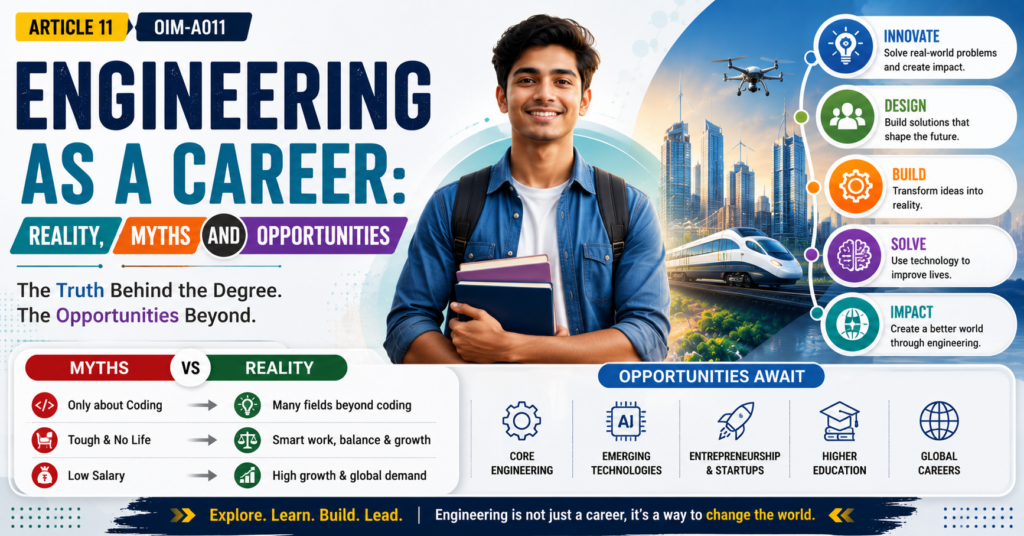
At the same time, a newer narrative has emerged in the opposite direction — that engineering as a whole is now oversaturated or low-value. This is just as oversimplified as the earlier blanket endorsement; it collapses a genuinely wide field into a single verdict in the other direction.
Why Getting the Nuance Right Matters Here Specifically
Engineering decisions touch an unusually large number of students, which means getting this nuance wrong has an unusually large collective cost — either students entering a branch poorly matched to their actual strengths because “engineering” sounded uniformly good, or capable students avoiding the field entirely because of an oversimplified negative narrative that does not apply to their specific branch or goals.
The R.E.A.L Framework
This four-part framework is built specifically for evaluating a field honestly, and will be reused across the field-specific articles that follow this one in the series.
- R — Range: how wide and varied the field actually is beneath its single label.
- E — Entry Path: how people genuinely get into the field, including less obvious routes.
- A — A Day in the Life: what the daily work actually looks like, myths included.
- L — Long-Term Trajectory: where the field genuinely leads over a full career.
R: The Range Inside Engineering
Engineering branches differ from each other more than most outside the field realize. Computer Science and Information Technology branches center on software, systems, and increasingly data and AI work. Mechanical, Civil, Electrical, and Chemical branches — often called “core” branches — center on physical systems, infrastructure, machinery, and industrial processes, with meaningfully different day-to-day work from each other as well, not just from CS.
Newer and hybrid branches — biotechnology, environmental engineering, robotics, and various computer-science-adjacent specializations — sit across this range in different ways, often blending core engineering principles with newer technical domains.
Within a single branch label, the range widens further once you look at sector. A Mechanical Engineer in automotive manufacturing, one in a power plant, and one in a design consultancy share a foundational curriculum but otherwise work in genuinely different environments, with different tools, different team structures, and different career ladders. Treating “Mechanical Engineering” as one job is almost as inaccurate as treating “engineering” as one job in the first place.
E: How People Actually Enter Engineering
The dominant entry route remains a Science-stream Class 12 background followed by a national or state engineering entrance examination, but it is not the only route. Diploma programs followed by lateral entry into the second year of a degree exist specifically for students who did not take the standard entrance-exam path, and several private institutions offer direct admission routes with different eligibility profiles than the most competitive government institutions.
Branch choice at entry is rarely fully fixed either — many institutions allow a branch change after the first year based on performance, which means an initial branch placement, while important, is not always the permanent final word some students treat it as.
A: A Day in the Life, Myths Included
The most persistent myth here is that a Computer Science Engineer spends the entire day writing code alone, when in practice the role frequently involves substantial collaboration, design discussion, debugging as a team activity, and — particularly as seniority increases — considerably more communication and planning work than the stereotype suggests.
The mirror-image myth applies to core branches: that Mechanical or Civil Engineering is purely physical, on-site labor with no design or desk-based work. In reality, many roles in these branches involve substantial computer-aided design, planning, project management, and client-facing work alongside any on-site component, and the balance between desk work and field work varies enormously by specific role and employer, not by branch label alone.
L: Where Engineering Genuinely Leads
Long-term trajectories inside engineering split broadly into a technical specialist track, deepening expertise in a specific technical domain, and a management track, moving toward leading teams and projects rather than performing technical work directly — often supported by further study such as an M.Tech or an MBA, though neither is mandatory for every path.
Engineering backgrounds also serve as a genuine launching point well beyond traditional engineering roles — into data science and analytics, product management, entrepreneurship, and, notably for readers of this series, civil services and public administration, where a technical background is a real and valued asset in many roles rather than an unrelated detour.
Branch Snapshot: A Starting Comparison
| Branch | Typical Daily Mix | Common Further Paths |
| Computer Science / IT | Coding, design discussion, testing, increasing communication with seniority | Specialist tracks, product management, data science, entrepreneurship |
| Mechanical | Design software, manufacturing planning, some on-site or factory-floor time | Design specialization, project management, M.Tech, MBA |
| Civil | Site supervision, planning and design work, client and contractor coordination | Project management, structural specialization, public infrastructure roles |
| Electrical / Electronics | Circuit and systems design, testing, increasingly software-adjacent work | Specialist tracks, embedded systems, power-sector roles |
Common Myths Worth Retiring
- “Engineering guarantees a good job.” It improves access to certain roles, but Substance — actual demonstrated capability, as described in our Degree vs Skill article — still determines outcomes once the credential clears an initial filter.
- “Computer Science is the only branch with a future.” Core branches remain essential to infrastructure, manufacturing, and energy sectors that are not disappearing, even as their specific tools and methods continue to evolve.
- “Core branches have no growth or creativity.” Design, planning, and process-improvement work in core branches involves real creative and analytical demands, not repetitive manual labor alone.
- “You must complete an M.Tech to grow in engineering.” Many strong technical and management trajectories do not require it; further study is one route among several, not a universal requirement.
A Worked Example
Consider two composite cases, drawn from recurring patterns across mentoring conversations rather than identifiable individuals.
The first is a Computer Science graduate who chose the branch primarily because of its strong general reputation, without checking genuine fit. Running the S.T.R.O.N.G strengths framework after two unsatisfying years reveals stronger Natural Energy and Genuine Flow in client-facing and planning work than in solo coding — a mismatch the popular reputation of the branch had quietly obscured. A deliberate pivot toward technical product management, building on the existing technical credential while shifting daily work toward better-fitting tasks, resolves a frustration that had been mistakenly attributed to the branch itself rather than to the specific role within it.
The second is a Mechanical Engineering graduate who very nearly avoided the branch entirely, discouraged by family members repeating the “core branches have no future” narrative. Pursuing it anyway, after independently researching the Range and Long-Term Trajectory lenses in this framework, leads to a design-focused role at a manufacturing company, followed by a deliberate further step into project management — a genuinely strong, growing trajectory that the oversimplified family narrative had nearly talked the student out of pursuing at all.
Common Mistakes Students Make About Engineering as a Career
- Choosing a specific branch based on general reputation rather than genuine fit with personal strengths and working style.
- Assuming all roles within a branch involve the same daily mix of work, when this varies considerably by specific employer and role.
- Treating a negative narrative about one part of the field as a verdict on the entire field.
- Believing branch choice at entry is permanently fixed, when many institutions allow a branch change after strong first-year performance.
- Assuming further study is mandatory for growth, rather than one route among several genuinely strong trajectories.
Action Steps: Apply the R.E.A.L Framework to Engineering
- If you are choosing a branch, run the S.T.R.O.N.G strengths framework against the actual daily-work profile of your top two branch options, not just their reputations.
- Talk to one person currently working in each branch you are considering, asking specifically about their daily mix of tasks.
- Research your specific institution’s branch-change policy before assuming your entry branch is permanently fixed.
- If you are already in a branch and dissatisfied, check whether the dissatisfaction is with the branch itself or with the specific role or employer.
- List two long-term trajectories — one specialist, one management or pivot-oriented — for your specific branch, rather than assuming only one path exists.
Reflection Questions
- Have I chosen, or am I considering, an engineering branch based on its general reputation or on genuine fit with my own strengths?
- What is the actual daily mix of work in my target branch, based on real conversations rather than assumption?
- Am I avoiding or pursuing a specific branch based on a narrative I have not personally verified?
Key Takeaways
- “Engineer” describes dozens of genuinely different working lives, not one single outcome.
- Entry routes into engineering are more varied than the standard entrance-exam path alone, and branch placement is often not permanently fixed.
- Daily work in both software and core branches frequently differs from the common stereotype in both directions.
- Long-term trajectories include specialist, management, and pivot-oriented paths, often without requiring further study.
- Sweeping positive or negative narratives about the field as a whole rarely hold up against the genuine range inside it.
Frequently Asked Questions
Is Computer Science still the best engineering branch to choose?
It is a strong, in-demand branch, but “best” depends entirely on genuine fit. A student with strong Natural Energy and Flow around physical systems, design, or on-site problem-solving may find a core branch a genuinely better fit, regardless of which branch carries the stronger general reputation.
Is engineering as a whole oversaturated now?
Certain roles and certain branches face more competition than others at different times, but treating the entire field as uniformly oversaturated overstates a real but uneven pattern. Researching the specific branch and role you are targeting gives a far more accurate picture than a general claim about engineering as a whole.
Does the specific engineering college matter as much as the branch?
Both matter, though their relative weight varies by branch and goal. For roles where large-company hiring filters heavily on institution reputation, the college can carry significant Signal value, as described in our Degree vs Skill article; for portfolio-driven or skill-heavy specializations, demonstrated Substance often closes much of that gap over time.
Should I do an M.Tech after my B.Tech?
This depends on your chosen Long-Term Trajectory. A specialist track in research, academia, or certain technical specializations often benefits significantly from an M.Tech; a management-oriented or generalist trajectory may benefit more from an MBA, relevant work experience, or neither, depending on the specific roles you are targeting.
Can an engineering background help with a civil services career?
Yes, genuinely. A technical background is a real asset in many public-sector and administrative roles, and is not treated as an unrelated detour — our companion article on Public Service Careers, later in this series, looks at this connection in more depth.
Is it worth choosing a less competitive engineering branch just to get into a better-ranked institution?
This trade-off, sometimes called a branch-versus-institution decision, depends on your specific goals. If your target career genuinely depends on the specific branch’s skill set, prioritizing branch fit usually serves you better long-term; if your target career depends more on the institution’s general reputation and network, particularly for management-track or non-technical pivots, the institution may reasonably carry more weight. Treat this as its own decision worth running through the Career Decision Handbook rather than assuming one answer fits everyone.
Conclusion
Engineering deserves neither the uniform endorsement nor the uniform skepticism it often receives in casual conversation. It is a genuinely wide field, with branches, roles, and trajectories different enough from each other that the only honest answer to “is engineering a good career” is: it depends entirely on which specific version of it you are asking about, and whether it fits you specifically.
Apply the R.E.A.L framework to your own specific branch and goals, rather than to the label “engineer” as a whole, and the right answer for your situation becomes considerably clearer.
The same applies in reverse: if a negative narrative has been quietly steering you away from a branch you have never actually researched in this much depth, this framework is worth running before letting that narrative make the decision for you.
What to Do Next
The Career Exploration Handbook and Future Careers Handbook at Odia IITian Mentor go further into mapping specific branches against your own strengths profile. This series continues with field-specific deep dives into Medical Careers, Law, Management, and Data Science and AI, each using this same R.E.A.L framework.
About the Author
Prakash Chandra Mallick is a Senior Educator, Senior Development Professional, and PhD Scholar at IIT Patna, with prior academic training at TISS Mumbai and the University of Hyderabad. He founded Odia IITian Mentor to bring structured, evidence-based career guidance and civil services preparation to students across Odisha, with particular attention to first-generation learners and rural and Odia-medium students who are too often left out of mainstream career advice.