Introduction
Most careers are not planned. They are assembled, one reactive decision at a time, from whichever opportunity happened to show up next — a college admission, a job offer, a relative’s suggestion, a posting. Looking back a decade later, many people struggle to explain how they ended up exactly where they are, because no one ever actually designed it.
This is not necessarily a disaster. Plenty of good careers happen this way. But it is also not a strategy, and it leaves far more to chance than most people realize while they are living through it. This article offers a different approach: a flexible framework for designing your career deliberately, without pretending you can predict the next twenty years in detail.
If “career planning” already sounds to you like a rigid five-year plan that falls apart the moment something unexpected happens, this framework is built specifically to avoid that trap.
The Problem: Most Career Planning Advice Is Either Too Rigid or Too Vague
Career planning advice tends to fail in one of two directions. One kind insists on a detailed, fixed long-term plan — exactly which role, by exactly which year — which inevitably breaks the first time the world changes in a way the plan did not anticipate, leaving the planner feeling like a failure for something that was never realistic in the first place.
The other kind offers vague encouragement to “follow your passion” or “stay open to opportunities,” with no actual structure underneath it. This produces the same drifting outcome as having no plan at all, just with better vocabulary attached to it.
Why Designing Beats Drifting
The case for deliberate design is not about predicting the future perfectly — no framework can do that. It is about compounding. A career built from a sequence of decisions that each build on the last, even loosely, tends to compound into genuine depth and capability over time. A career built from disconnected reactive decisions tends to stay scattered, no matter how many individual decisions turned out fine on their own.
This is the same compounding logic that applies to skill-building or saving money — small, consistent, connected steps outperform a series of unconnected good moves, even when each unconnected move looked reasonable at the time it was made.
There is also a quieter cost to drifting that rarely gets named directly: decision fatigue. Without any design to lean on, every new opportunity becomes a fresh, isolated decision, evaluated from scratch with no accumulated context. A designed career, by contrast, lets most opportunities be evaluated quickly against an existing destination and milestone sequence — keeping the bigger decisions for genuine forks in the road, rather than treating every offer as an equally open question.
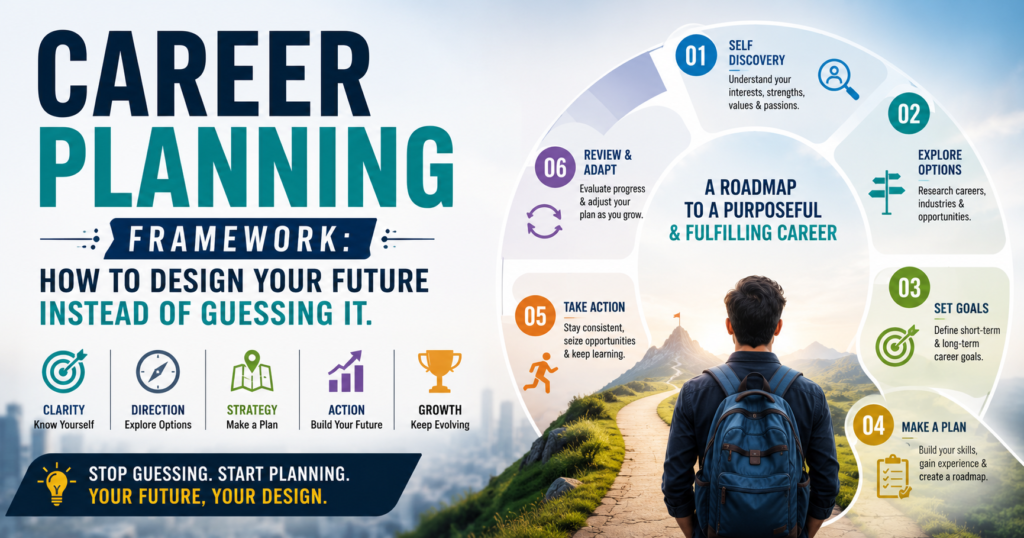
The D.E.S.I.G.N Framework
This six-step framework is built to be revisited, not completed once and filed away. Most people will move through a full cycle of it every one to two years.
- D — Define Your Destination
- E — Evaluate Your Current Position
- S — Sequence Milestones
- I — Identify Skill Gaps
- G — Gather Support Systems
- N — Navigate and Adjust
Step 1: Define Your Destination
Start with a directional destination, not a job title carved in stone. “I want to work in public policy with real impact on rural Odisha” is a usable destination. “I will be a Joint Secretary by age 35” is a specific prediction that may or may not survive contact with reality, and treating it as the plan itself sets up an unnecessary sense of failure if circumstances shift.
A good destination describes the kind of work, impact, and life you are aiming for clearly enough to guide decisions, while staying loose enough to survive being revised as you learn more about yourself and the field.
Step 2: Evaluate Your Current Position
Before planning a route, know your actual starting point — honestly, not aspirationally. List your current skills, network, financial runway, and time availability without softening the gaps. This step fails most often when people skip it because it feels discouraging; skipping it simply means the plan that follows is built on an inaccurate map.
This evaluation is not a one-time event either. Revisit it at the start of every D.E.S.I.G.N cycle, since your current position changes every time you complete one of these cycles.
Step 3: Sequence Milestones
Break the distance between your current position and your destination into milestones at roughly one-year, three-year, and five-year intervals. Each milestone should be specific enough to know whether you have hit it, while still serving the broader destination rather than becoming a rigid target in its own right.
Sequencing matters as much as the milestones themselves. A milestone that depends on a skill or credential you have not yet built should come after the milestone that builds it, not before — an obvious point that is nonetheless one of the most common planning errors, where people set an ambitious end-stage milestone with no realistic sequence of steps actually leading to it.
Step 4: Identify Skill Gaps
For each milestone, name the specific skill or credential gap between where you are now and what that milestone requires. This step turns vague ambition into a concrete, addressable to-do list, rather than a destination you hope to simply arrive at through general effort.
Be as specific as your Evaluate step allows. “Get better at communication” is too vague to act on. “Practice structured answer-writing for 30 minutes daily and get feedback from a mentor monthly” is a gap you can actually close.
Step 5: Gather Support Systems
No career design survives purely on individual willpower. Identify the mentors, peer communities, family support, and resources that will help you close each skill gap and stay accountable to each milestone — and be honest about which of these you do not yet have and need to actively build.
This is also where many ambitious plans quietly fail. A plan with clear milestones but no support structure around it tends to rely entirely on motivation, which is the least reliable resource available for anything spanning multiple years.
Step 6: Navigate and Adjust
Set a fixed review point — every six to twelve months works well for most people — to revisit the entire framework from Step 1. Check whether your destination has shifted as you have learned more, whether milestones need resequencing, and whether new skill gaps or support needs have emerged.
This is the step that makes the framework genuinely different from a rigid five-year plan. The destination, milestones, and gaps are all expected to evolve. What stays constant is the discipline of returning to design the next stage deliberately, rather than drifting until the next unplanned opportunity arrives.
A Sample Milestone Sequence
A simple way to hold Steps 3 and 4 together is a basic table, filled in with your own specifics.
| Timeframe | Milestone | Key Skill Gap | Support Needed |
| Year 1 | (fill in) | (fill in) | (fill in) |
| Year 3 | (fill in) | (fill in) | (fill in) |
| Year 5 | (fill in) | (fill in) | (fill in) |
A Worked Example
Consider a composite case drawn from recurring patterns across mentoring conversations, not one identifiable individual.
A college graduate defines a destination of working in public-sector administration with a focus on rural development — directional, not a specific post or year. Evaluating the current position honestly reveals a relevant degree but no civil-services-specific preparation, limited writing practice, and a supportive but financially cautious family. Sequencing milestones produces a Year 1 goal of completing foundational OAS preparation and a diagnostic mock test, a Year 3 goal of clearing Prelims, and a Year 5 goal of either securing a post or having a clearly evaluated alternative path if the exam route has not yet succeeded.
Identifying skill gaps surfaces structured answer-writing and consistent current-affairs reading as the two biggest gaps relative to the Year 1 milestone. Gathering support means joining a study group and scheduling monthly check-ins with a mentor, rather than assuming solo motivation will carry the full multi-year effort. At the first Navigate and Adjust review, twelve months in, the destination remains the same, but the Year 3 milestone gets resequenced slightly after a first mock-test result reveals current affairs is a deeper gap than originally estimated — exactly the kind of course correction the framework is built to absorb, rather than treat as a failure of the original plan.
Common Mistakes People Make When Planning a Career
- Treating a directional destination as a fixed, specific prediction, then feeling like a failure when circumstances change.
- Setting ambitious milestones with no realistic sequence of smaller steps actually leading to them.
- Listing skill gaps in vague terms that cannot actually be acted on or measured.
- Relying entirely on individual motivation, with no support system built around the plan.
- Creating a plan once and never returning to it, even as the destination and circumstances evolve.
Action Steps: Run Your First D.E.S.I.G.N Cycle
- Write your current directional destination in one or two sentences — specific enough to guide decisions, loose enough to survive revision.
- Honestly evaluate your current skills, network, financial runway, and time availability.
- Sequence three milestones at the one-year, three-year, and five-year marks.
- For your one-year milestone specifically, name one concrete, measurable skill gap to close.
- Identify one mentor, community, or support resource you will actively engage this month.
- Set a calendar reminder six to twelve months from now to run this entire cycle again.
Reflection Questions
- Has my career, so far, been mostly designed or mostly drifted into?
- Is my current destination specific enough to guide a decision, or so rigid that any change would feel like failure?
- What is the one skill gap, named specifically, that would most accelerate my next milestone?
Key Takeaways
- A good career destination is directional and specific enough to guide decisions, not a rigid prediction.
- Honest evaluation of your current position is the foundation the rest of the plan depends on.
- Milestones need a realistic sequence, not just an ambitious end point.
- Skill gaps must be specific enough to act on, not vague aspirations.
- No multi-year plan survives on individual motivation alone — build the support system deliberately.
- Revisit the full framework every six to twelve months; adjustment is part of the design, not evidence it failed.
Frequently Asked Questions on Career Planning Framework
How specific should my destination actually be?
Specific enough that it would change at least one decision you might otherwise make differently, but not so specific that it names an exact job title and year. “Public-sector work focused on rural development” passes this test; “Joint Secretary by 35” usually does not.
What if my destination changes completely during a Navigate and Adjust review?
That is the framework working as intended, not failing. A destination that evolves as you learn more about yourself and the field is healthier than one stubbornly maintained despite new information. Revise it, then re-run Steps 2 through 6 against the updated destination.
How is this different from just setting goals?
Standard goal-setting often stops at Step 3, milestones, without the honest evaluation underneath it or the support system around it. This framework treats goals as one component inside a larger, recurring design process, rather than the entire process by itself.
Can this framework work if I am still unsure about my destination?
Yes — Step 1 only requires a directional sense, not certainty. If you are genuinely unsure even of a direction, our companion Career Clarity content is a useful starting point before running a full D.E.S.I.G.N cycle.
How do I stay motivated to keep returning to this every six to twelve months?
Treat the review itself as a milestone, not an optional extra — schedule it the same way you would schedule any other commitment, and pair it with the Support Systems from Step 5 so the review is not something you are relying on solo motivation to remember.
Does this career planning framework still apply once I already have a stable, established career?
Yes, arguably more so. Established professionals often stop revisiting their own design once early-career momentum settles into routine, which is exactly when drifting quietly resumes — a comfortable role can mask years of unaddressed skill gaps or a destination that has stopped reflecting what the person actually wants. A periodic D.E.S.I.G.N review remains useful well past the early career stage.
Concluding Remarks on Career Planning Framework
Most careers happen by accumulation, not by design — and accumulation can still produce a fine outcome. But a career that is deliberately designed, revisited, and adjusted tends to compound in a way accidental accumulation rarely does, because each step is chosen to build on the last rather than to simply respond to whatever showed up next.
The D.E.S.I.G.N framework will not predict your future. It will give you a disciplined way to keep choosing it, on purpose, every time the world changes around you.
That discipline, repeated over a decade, is usually the real difference between a career someone can describe with a clear sense of how each stage led to the next, and one they can only describe as a series of things that happened to them.
What to Do Next for Execution of the Career Planning Framework
For structured, one-on-one support running your first full D.E.S.I.G.N cycle, the Life Design System course and the Life Planning Handbook at Odia IITian Mentor are built directly around this framework. If you are still working out your directional destination, start with the Career Clarity Workshop first.
About the Author
Prakash Chandra Mallick is a Senior Educator, Senior Development Professional, and PhD Scholar at IIT Patna, with prior academic training at TISS Mumbai and the University of Hyderabad. He founded Odia IITian Mentor to bring structured, evidence-based career guidance and civil services preparation to students across Odisha, with particular attention to first-generation learners and rural and Odia-medium students who are too often left out of mainstream career advice.