Introduction
Almost every Class 10 student in India hears the same three words within days of their board exams ending: Science, Commerce, Arts. And almost every adult around them has a confident opinion about which one is “best,” usually based on one relative’s experience, one news story about a topper, or a vague sense of which stream feels most respectable.
This article is a structural comparison, not an opinion. It will not tell you which stream is best in the abstract, because that question does not have a single answer. It will give you a clear, side-by-side look at what each stream actually involves, so you can compare them against your own situation rather than against someone else’s assumptions.
If you have not yet read our companion article on the full Class 10 decision-making process, the C.H.O.I.C.E framework there is the recommended process for making the final call. This article supplies the detailed comparison material that process depends on.
The Problem: Most Stream Comparisons Are Shallow or Biased
Search online for “science vs commerce vs arts” and you will mostly find two kinds of content: thin listicles comparing average starting salaries, and opinion pieces written from one person’s personal experience, presented as universal truth.
Neither approach actually helps a 15-year-old compare these three paths against their own strengths, interests, and constraints. A meaningful comparison needs to look at more than salary projections a decade out — it needs to look at what the next two years of actual study will feel like, and what range of careers each stream genuinely keeps open.
Why a Structural Comparison Matters More Than Anecdotes
Every family has a story: a cousin who regretted choosing Commerce, a neighbor whose son became a successful engineer, a relative who insists Arts has no future. These stories are real, but they are sample sizes of one, shaped heavily by that individual’s specific choices after the stream, not by the stream itself.
A structural comparison — looking at subjects, career range, and workload separately for each stream — gives you something more durable than any single anecdote: a framework you can apply to your own specific subjects, interests, and goals, regardless of what any one relative’s experience happened to be.
The Three-Lens Stream Comparison
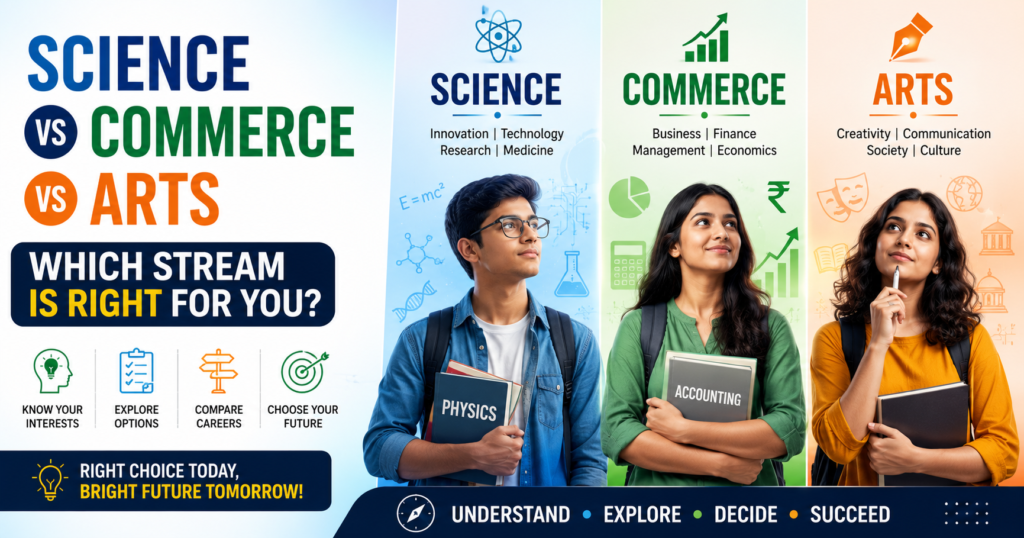
This article compares Science, Commerce, and Arts through three separate lenses. Looking at all three together, rather than picking whichever lens supports a decision you have already made, is what makes the comparison genuinely useful.
- Lens 1 — Subject Fit: what you will actually study, day to day, for the next two years.
- Lens 2 — Career Range: how wide or narrow the realistic career paths are once you finish the stream.
- Lens 3 — Workload, Cost & Demand: how intense the stream is, what it typically costs in further study, and how it is currently perceived.
Lens 1: Subject Fit
Science centers on Physics, Chemistry, and either Mathematics or Biology, depending on the specific combination chosen. These subjects reward precise, step-by-step thinking and a comfort with abstract problem-solving practiced consistently over time, rather than last-minute cramming.
Commerce centers on Accountancy, Business Studies, and Economics, usually alongside Mathematics or an additional subject. These reward structured, rule-based thinking combined with a practical interest in how money, business, and markets actually work — closer to applied logic than to either pure abstraction or open-ended interpretation.
Arts and Humanities cover a wide range — History, Political Science, Psychology, Sociology, Economics, Geography, and languages, in varying combinations depending on the school. These subjects reward strong reading, interpretation, and written expression, along with genuine curiosity about people, society, and how the two interact. They are frequently underestimated as “less rigorous,” which is a myth this article will return to directly.
Lens 2: Career Range
Science keeps Engineering, Medicine, pure research, data and computing, architecture, and design technology open by default, plus most other streams’ careers indirectly through cross-stream entrance routes that increasingly accept Science-stream students.
Commerce keeps Chartered Accountancy, Company Secretary, business management, banking, economics, and entrepreneurship open by default, with a clear and well-trodden path into most corporate and financial careers.
Arts and Humanities keep civil services, law, psychology, journalism, social work, design, education, and an expanding set of policy and social-sector careers open by default — a genuinely wide range that is consistently underestimated in casual conversation, particularly in smaller towns where fewer visible examples exist locally.
Lens 3: Workload, Cost & Demand
Science generally carries the heaviest coaching culture and the longest further-study timelines for its top-end careers — Medicine in particular involves five-plus years of intensive study, and competitive Engineering entrance preparation often dominates Class 11 and 12 almost entirely.
Commerce typically carries a moderate workload through Class 11 and 12, with the heavier lifting arriving later — Chartered Accountancy, for instance, is a demanding multi-year qualification pursued after the undergraduate stage rather than during school.
Arts and Humanities often carry a lighter formal workload during Class 11 and 12 itself, but the careers at the top of its range — civil services and law in particular — demand significant self-driven study afterward that the school syllabus alone does not provide. A light school workload should not be mistaken for a light career path; the effort simply arrives at a different stage.
Side-by-Side Summary
Putting all three lenses together in one table makes the comparison easier to hold in your head at once. Use this as a starting reference, then fill in your own specific subjects and goals using the Action Steps later in this article.
| Lens | Science | Commerce | Arts & Humanities |
| Subject Fit | Precise, step-by-step, abstract problem-solving | Structured, rule-based, applied logic | Reading, interpretation, written expression |
| Career Range | Engineering, Medicine, research, computing, architecture | CA/CS, business, banking, economics, entrepreneurship | Civil services, law, psychology, journalism, design, policy |
| Workload Pattern | Heavy during school; long further study for top careers | Moderate during school; heavy professional study after | Lighter during school; heavy self-driven study after |
Notice that all three streams involve significant effort eventually — the comparison is about when that effort arrives and what shape it takes, not about which stream lets you avoid it altogether.
A Closer Look at Career Range
Because Career Range is the lens most often misjudged, it is worth listing concrete examples rather than category labels alone.
- Science → Engineering (multiple branches), Medicine and allied health, pure sciences and research, data science and computing, architecture, design technology, defense technical services.
- Commerce → Chartered Accountancy, Company Secretary, cost accountancy, banking and finance, business management, economics, entrepreneurship, actuarial science.
- Arts & Humanities → Civil services (UPSC, OPSC, and allied state services), law, clinical and counseling psychology, journalism and mass communication, social work, design, education, public policy and the social sector.
The list under Arts and Humanities is frequently the shortest in a family’s mental model and the longest in actual reality — which is precisely why Lens 2 is the one most worth double-checking before assuming any stream is narrow.
- “Arts is for weak students.” Arts and Humanities lead to some of the most competitive examinations in the country, including civil services and law entrance tests, which demand serious, sustained preparation.
- “Commerce has no creativity or growth.” Modern Commerce paths increasingly include entrepreneurship, financial analytics, and business strategy roles that reward original thinking as much as technical fields do.
- “Science is the only safe choice.” Safety depends on genuine fit and follow-through, not the label of the stream — a poorly fitted Science student who struggles for two years is not safer than a well-fitted Arts or Commerce student who thrives.
- “You can always become an engineer later if Arts doesn’t work out.” Cross-stream switches are possible but costly; this myth often prevents a genuine, well-fitted choice in favor of a default “keep it open” decision that satisfies no one.
- “Commerce students can’t switch into technology or analytics careers.” A growing number of business-analytics, fintech, and data-driven roles specifically value the business and economics grounding Commerce provides, combined with self-taught technical skills.
A Worked Example
Consider a composite case, drawn from recurring patterns across mentoring conversations rather than one identifiable student.
A student with strong, consistent marks across all three potential streams is advised by almost everyone around them to choose Science, on the simple logic that strong marks plus Science equals the best option. Running the Three-Lens Comparison changes the picture. Subject Fit reveals genuine enjoyment of Economics and Political Science discussions, but only lukewarm interest in Physics despite scoring well in it. Career Range reveals that the student’s actual stated interest — eventually working in public policy or administration — sits more naturally in the Arts and Humanities range, with Science offering no particular advantage for that specific goal. Workload and Demand reveals that choosing Science primarily to “keep options open” would mean two years of heavy, less-enjoyed coaching for a career goal that did not require it in the first place.
The student chooses Arts and Humanities, builds a strong portfolio of debate, writing, and current-affairs engagement through Class 11 and 12, and enters a civil-services-oriented undergraduate path with two years of genuine engagement behind them, rather than two years of high-effort, low-enjoyment Science coaching aimed at a career it was never actually needed for.
Common Mistakes Students Make When Comparing Streams
- Comparing streams only by perceived difficulty or prestige, rather than by genuine fit to their own interests and goals.
- Assuming a stream’s career range is smaller than it is, especially with Arts and Humanities, due to limited local examples.
- Choosing Science by default “to keep options open,” without checking whether the actual goal requires it.
- Ignoring the Workload and Demand lens, and discovering only after enrolling how intense — or how self-driven — a stream’s real path turns out to be.
- Letting a single relative’s anecdote outweigh a structured look at all three lenses together.
Action Steps: How to Apply This Comparison
- List your current top one or two career goals, even if they feel uncertain, before comparing streams.
- For each stream, write one honest sentence under each of the three lenses — Subject Fit, Career Range, Workload — specific to your own situation.
- Identify which myths from this article you have been quietly assuming were true, and check each one against your own goals.
- Talk to one person currently in each stream you are seriously considering, asking what their actual daily workload looks like.
- Combine this comparison with the full C.H.O.I.C.E decision framework from our companion Class 10 article before finalizing your choice.
Reflection Questions
- Which stream would I choose if no one’s opinion about prestige or safety were involved?
- Have I been assuming any stream has a narrower career range than it actually does?
- Does my current leaning match my actual stated career goal, or am I choosing a stream “to be safe” for a goal it doesn’t actually serve?
Key Takeaways
- No stream is universally “best” — each has a genuine subject profile, career range, and workload pattern worth comparing on its own terms.
- Arts and Humanities have a wider career range than commonly assumed, including some of India’s most competitive examinations.
- Commerce offers a clear, well-established path into business and finance, with growing room for entrepreneurial and analytical careers.
- Science carries real prestige but also the heaviest coaching culture and longest further-study timelines for its top-end careers.
- A lighter school-stage workload, as in many Arts paths, does not mean a lighter career path overall — the effort simply arrives later.
- Use this comparison alongside a full decision framework, not as a replacement for one.
Frequently Asked Questions
Which stream is best for getting a government job?
All three streams lead to strong government-job pathways, through different routes — Engineering and Science-based services from Science, banking and finance roles from Commerce, and the broad civil services route particularly well-served by Arts and Humanities. The right stream depends on which specific government career path interests you, not on the streams in general.
Is Commerce really easier than Science?
Commerce typically carries a lighter Class 11 and 12 workload than Science, but “easier” is misleading — Commerce’s top-end careers, like Chartered Accountancy, involve a demanding multi-year qualification process after school that is far from easy. Compare full career timelines, not just the school years.
Can I do well in competitive exams like UPSC if I choose Arts?
Yes — Arts and Humanities is one of the most common and successful stream backgrounds for civil services preparation specifically, given its overlap with subjects like History, Political Science, and Sociology that frequently appear in those examinations.
Does choosing Arts close the door to technology careers?
Not entirely. Many technology-adjacent roles — UX design, product management, policy work on technology, and content or research roles within tech companies — are genuinely open to Arts and Humanities graduates, particularly with self-driven skill-building during and after the degree.
How do I know if my interest in a stream is genuine or just family pressure?
Use the Curiosity Audit step from our Class 10 decision-making article: if you removed every external opinion, what would you actually choose based on what holds your attention? If your answer there matches your current leaning, the pressure and the genuine interest are likely aligned. If they don’t match, that gap is worth examining honestly before deciding.
Is it true that switching from Arts to Science later is harder than the other way around?
In most school systems, switching into Science later is harder than switching out of it, because Science builds cumulative subject knowledge — particularly in Mathematics and core sciences — that is difficult to catch up on mid-way. This is a genuine asymmetry worth knowing, though it should inform your decision, not make it for you if Science is not actually your better fit.
Does the stream I choose affect which entrance exams I can sit for later?
Yes, in most cases. Medical and most engineering entrance exams require a Science background with specific subject combinations. Many Commerce-linked professional exams assume Commerce or at least Mathematics. Law and several Humanities-linked exams, including civil services, generally accept candidates from any stream, which is one reason Arts and Humanities students are not at a structural disadvantage for those specific paths.
Conclusion
Science, Commerce, and Arts are not a ranking from best to worst — they are three different shapes of study and career, each genuinely strong for the right student. The mistake is not choosing the “wrong” stream in some absolute sense; it is choosing based on prestige, fear, or a single anecdote instead of an honest look at your own subject fit, your actual career goals, and the real workload each path involves.
Compare structurally, ignore the myths, and the right stream for you becomes considerably easier to see.
What to Do Next
Pair this comparison with the full C.H.O.I.C.E decision-making framework in our companion article, How to Choose a Career After Class 10, to turn this comparison into an actual decision. For structured, one-on-one support exploring all three streams against your specific profile, the Career Exploration Handbook and the Career Clarity Workshop at Odia IITian Mentor are built exactly for this stage.
About the Author
Prakash Chandra Mallick, Sr. Educator, Sr. Development Professional and PhD Scholar at IIT Patna, with prior academic training at TISS Mumbai and the University of Hyderabad. He founded Odia IITian Mentor to bring structured, evidence-based career guidance and civil services preparation to students across Odisha, with particular attention to first-generation learners and rural and Odia-medium students who are too often left out of mainstream career advice.